
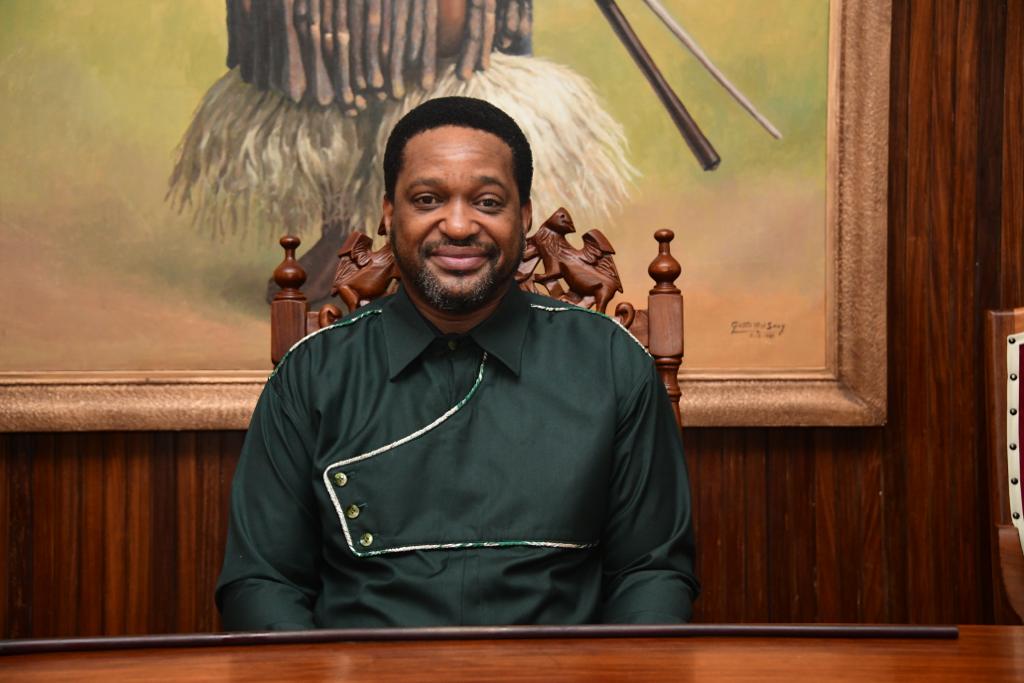
By Lehlohonolo Lehana.
President Cyril Ramaphosa has requested the Supreme Court of Appeal (SCA) to order the Pretoria High Court to reverse a ruling which set aside his recognition of Misuzulu kaZwelithini.
In December 2023, the high court ruled that Ramaphosa was irrational to officially identify Misuzulu as king of the Zulu nation.
This after Zulu princes, Mbonisi and Simakadesamkhosi, approached the courts complaining that the process was conducted unfairly, citing that some members of the royal house were not consulted.
Judge Norman Davies agreed with him and ruled in his favour.
However, Ramaphosa, supported by King Misuzulu, took the matter to the SCA on appeal.
Also in the picture is Prince Mbonisi Zulu, who also claimed the 2021 nomination process was flawed and wants it to be started over.
Prince Mboniso Zulu, the senior Zulu prince, who is a brother of the late King Goodwill Zwelithini, wants the throne to go to Prince Buzabazi Zulu.
Prince Thulani Zulu asserted that the only process under scrutiny is the one of Ramaphosa used to recognise him.
The statement by Prince Thulani Zulu angered the faction of Prince Simakade, with its spokesperson, Prince Thokozani Zulu, saying a proper reading of the statement amounts to a veiled incitement and attack on the rule of law and the supremacy of the constitution.
While the Gauteng High Court in Pretoria did not order the king’s removal, it directed the president to appoint a committee to investigate whether there had been any violations of customary law during King Misuzulu’s identification process.
King Misuzulu ascended to the throne in 2021 following the deaths of King Goodwill Zwelithini kaBhekuzulu and Queen Regent Mantfombi Dlamini.
Ramaphosa then officially presented King Misuzulu with a certificate of recognition at Moses Mabhida Stadium in Durban, KwaZulu-Natal (KZN) on 29 October 2022.
During proceedings before the SCA in Bloemfontein on Wednesday, Advocate Marumo Moerane, representing Ramaphosa and the Department of Cooperative Governance and Traditional Affairs (Cogta), argued that the case was not about the legitimacy of the Zulu royal dynasty or King Misuzulu’s fitness to rule.
Moerane contended that the high court had erred on key issues, including the lawfulness and rationality of the recognition, the interpretation of section 8(4) of the Act, and the application of the legal doctrine of res judicata.
The res judicata principle means that if a court has already made a final judgment on a particular case, the same issue cannot be brought before the court again by the same parties.
“Therefore, the recognition decision should be reinstated,” he told the SCA.
Moerane also emphasised that the president’s role was not to elect a king.
“His function was not elective, but confirmatory. We submit that the legal framework does not permit the president to substitute his own judgment for that of the royal family.
Moerane emphasised that the president should not be forced to reconsider a “factual issue” that has already been resolved by a court.
Advocate Tembeka Ngcukaitobi —representing King Misuzulu—argued that this was done during a lawfully constituted meeting in May 2021.
“The rule of law demands an end to this matter. The identification was done in terms of customary law and the issues had already been resolved during litigation,” Ngcukaitobi said.
It was meanwhile argued on behalf of Prince Mbonisi and his brother, Prince Simakade, that it is their right to identify an heir. The court was told that they did not have a preferred candidate in mind, but all they wanted was the right to identify the next king in terms of customary law.
This prompted the question by Justice Dumisani Zondi on how the royal family could come to court and not say who they want as king. He questioned that if they recognised King Misuzulu, this whole exercise would be futile.
He was told that the royal family did not want this matter to be aired out by the courts. As the ultimate authority, they simply wanted to identify their next king themselves. They maintained that the president did not have the right to identify King Misuzulu without consulting on the matter.
The Zulu kingdom has a proud history. It is world-famous for defeating British troops during the 1879 battle of Isandlwana.
Its succession battles have always been fierce – and at times, bloody. The legendary King Shaka ka Senzangakhona killed his brother in 1816 in order to take the throne, then was himself assassinated in a plot masterminded by his nephew years later.
But this latest saga, following the death of King Goodwill Zwelithini ka Bhekuzulu more than a year ago, has been an embarrassing public spectacle.
Various royal family factions continued to champion their preferred candidates through several legal challenges.
By the time he died last year, King Zwelithini had six wives and had ruled for more than half a century.
In his disputed will, he named his third wife Queen Mantfombi Dlamini Zulu as regent – a sort of caretaker role pending the appointment of a successor.
Queen Mantfombi held the highest status among the king’s wives, because she came from royalty – her father was the late King Sobhuza II and her brother was King Mswati III of Eswatini.
Her marriage to the Zulus came with the condition that her first-born son would be first in line for the throne on her husband’s death.
So when she died a month after becoming regent, their son Misuzulu ka Zwelithini was seen as the obvious choice to take power. He had also been named as successor in his mother’s will.
What’s more, the fact that Prince Misuzulu was the only person to inherit the traditional weapons of his grandfather King Cyprian Bhekuzulu ka Solomon was seen as an endorsement that he would eventually take over from his father.