
By Lehlohonolo Lehana.
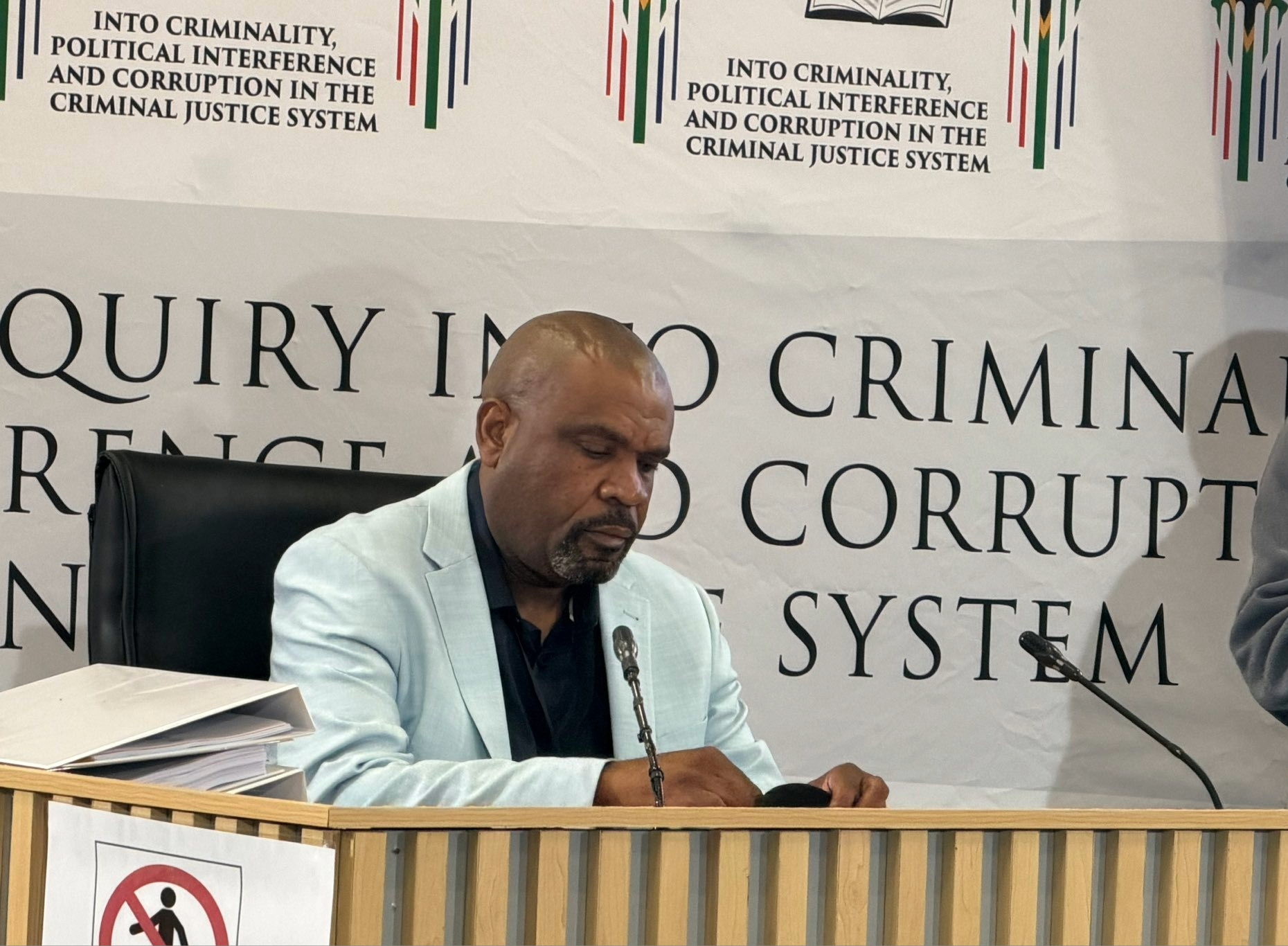
The suspended Tshwane Metro Police Department (TMPD) inspector, Lebogang Phiri, linked to a web of financial transactions tied to companies doing business with the City of Tshwane
Phiri, who works in the municipality’s roads policing division, is primarily responsible for the deployment of private security guards to municipal sites.
Phiri’s bank statements show several transactions between him and security companies currently contracted to the City of Tshwane.
He has denied that his financial transactions with the municipality’s service providers constitute a conflict of interest.
Phiri was implicated in the recent testimony of TMPD Deputy Commissioner for Training and Innovation Sean Bolhuis, who testified that Phiri independently assigned contract work to private companies, sidestepping internal controls and procurement procedures.
Bolhuis, caretaker of the Asset Protection and Security Services (APSS) at TMPD from July 2024 to March 2025, distanced himself from controversial decisions made while he served as caretaker head of that unit, which is charged with safeguarding critical municipal infrastructure.
The unit often employed the services of private security firms. Bolhuis testified that the APSS handover was mismanaged, revealing that emergency ad hoc security services were abused to the point that Tshwane, at one stage, had 43 ad hoc security services, costing the city millions of rands.
Gubis 85 Solutions a security company implicated in the testimony of suspended Gauteng Organised Crime Unit officer Sergeant Fannie Nkosi, was favoured over 21 other service providers in the TMPD tender.
The Commission has heard that the “friend” referred to in bank statements by Phiri, is an employee of Gubis 85 Solutions.
This follows evidence showing that Phiri’s bank records reflect payments from Willy Mosupye and two other individuals, collectively amounting to at least R150 000. Phiri maintains that the money was borrowed and later repaid.
The commission further heard Gubis 85 owner, Calvin Pontsho Mahlangu, made several payments amounting to at least R194 000 to Kgabotjie Logistics Pty Ltd, owned by Mosupye, between February and October 2025.
Bank statements also show that Papador Pty Ltd, another company directed by Mosupye, paid Phiri R35 000 to Phiri on 20 May last year. On the same day, Katlego Moagi, paid him another R35 000, while Hope Monakwe, made an additional payment of R35 000.
The commission further discovered that Papador, Moagi, and Monakwe all received large payments from Gubis 85 Security Solutions, including at least R10.8 million to Moagi, R3.9 million to Monakwe, and R5.9 million to Papador.
The commission also questioned Phiri about funds recieved after records showed he settled his Standard Bank home loan of more than R1.4 million in December last year.
Phiri told the commission he received a lump sum from the Road Accident Fund (RAF) in 2024, which he used to settle his bond and assist friends and family financially, describing it as part of his investment strategy.
His ABSA account also reflects a cash injection of more than R150 000 in May last year, which he said was a loan from a friend with multiple business interests. He further told the commission he repaid the loan in cash, though he did not elaborate in detail.
Records also show he received a further R45 000 in October 2024, which he said was another loan from a friend, identified as Jabu, which he claims to have repaid in cash.
Phiri has also rejected testimony by TMPD Asset Protection and Security Services (APSS) director, Tsukudu Malatji, who claimed he never authorised the deployment of Gubis 85 Security Solutions.
He accused Malatji of being “inaccurate and malicious”, insisting email exchanges show he acted on Malatji’s instructions regarding site allocations and urgent deployments.
Phiri accused Malatji of lying under oath, claiming that proof he acted on Malatji’s instructions is contained in email exchanges between them dating back to December 2024.
Despite the mounting scrutiny, Phiri has rejected the allegations that his conduct was improper.
He insists the payments were legitimate personal loans and disputes the suggestion that they influenced his decisions.
Phiri’s testimony reflects a familiar pattern in South African governance, where blurred lines between personal finances and public duty often lead to serious questions about integrity.