
By Lehlohonolo Lehana.
Kwazulu/Natal (KZN) Commissioner Lt-Gen Nhlanhla Mkhwanazi, in his first few days in the stand, has already mentioned the names of ‘businessmen’ who had influence over senior cops.
He described how Vusimuzi ‘Cat’ Matlala enjoyed unlawful privileges from law enforcement, such as using vehicles fitted with blue lights.
“He facilitated the registration of these vehicles as if they were municipal assets, funded by the Ekurhuleni municipality,” said Mkhwanazi.
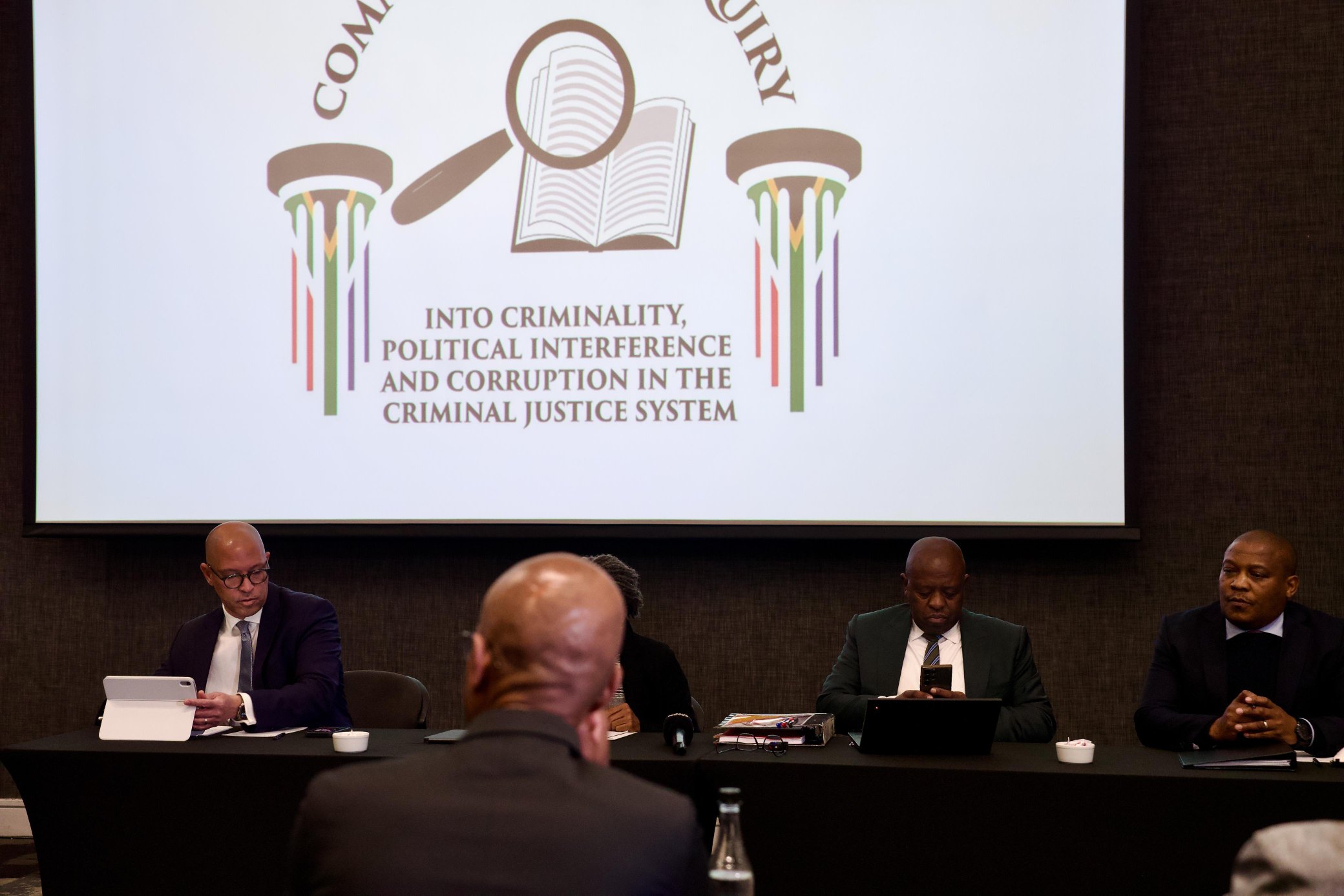
Off the back of his press conference in July, an entire Commission has been set up to investigate his allegations.
The commission will run in three phases.
In Phase One, it’s up to Mkhwanazi to provide the evidence to back up his claims. Phase Two will feature rebuttals from those implicated, and Phase Three will be an opportunity for Mkhwanazi to respond.
On Friday he said he would not allow the kind of crime intelligence corruption that occurred in 2011 under then president Jacob Zuma to take root again.
“What I see happening right now takes me back to 2011 and that makes me realise that I cannot just sit back and allow the irregularities when I was acting police commissioner; it is going to be a culture, it is going to be embed itself in the criminal justice system and therefore the citizens are not going to be safe,” Mkhwanazi said.
He was referring to his appointment by Zuma in late 2011 after the suspension of Bheki Cele.
Mkhwanazi recalled joining police top management in 2011, when the South African Police Service was mired in scandal over the Richard Mdluli murder case and an intelligence slush fund. He said that was “the worst case of political interference” he had seen.
“Crime intelligence, modus operandi back then and players that were still involved back then with the looting of the money and irregularities are still involved in crime intelligence today, and some of them are occupying high positions. So there are no reforms implemented in crime intelligence,” he said.
Mkhwanazi has laid bare details of political interference by Police Minister Senzo Mchunu and at least two of his predecessors, Nathi Mthethwa and Cele.
He said Mthethwa wanted to stop the prosecution of Mdluli and stop the disciplinary case against the former top cop.
He said he demanded that Mthethwa, now the country’s ambassador to France, that if he wanted him to stop charging Mdluli, then he should put it in black and white.
Mkhwanazi said a recent case involving Brian Mogotsi, an associate of Mchunu, raised red flags for him, alleging that a media attack was orchestrated against him while presiding over the disciplinary hearing of deputy head of crime intelligence Feroz Khan, who was accused of covering up a drug bust.
He said Mogotsi pushed a narrative that crime intelligence head Dumisani Khumalo had criticised him about cash-in-transit crimes in KwaZulu-Natal. Mkhwanazi also received a leaked photograph of a crime intelligence presentation, which he said showed how sensitive material was being shared.
He said he later discovered Mogotsi’s underworld links. In September 2024, Mogotsi sent him a WhatsApp message alleging he was under investigation for “defeating the ends of justice “in relation to a drug possessing case.
Attached were internal police documents — a letter and an occurrence book — which Mkhwanazi said were used to discredit him. Although Mokgotsi is from the North West province, the documents originated from KwaZulu-Natal structures.
He told the commission that Mchunu’s chief of staff confirmed the minister’s association with Mogotsi. But Mchunu denied any connection, saying Mogotsi was “a comrade”.
Mogotsi allegedly told him that national police commissioner Fanie Masemola agreed with Khumalo’s view. “This is a person who knows everything about the police, even knowledge of crime intelligence,” Mkhwanazi said.
Mkhwanazi said he was falsely accused of interfering in a case in favour of Nelly Ndlovu, the former head of a prison facility who was accused of possessing drugs and ammunition. He said after arguing that contraband discovered in a dustbin accessible to many people could not reliably implicate her, his remarks were seen as interference.
In March, the Independent Police Investigative Directorate (Ipid) received a complaint from Mchunu accusing Mkhwanazi of meddling in the case. According to Mkhwanazi, Mokgotsi told him that Feroz Khan would brief him about developments.
“I’m not saying that Khan is involved in these leakages of information to members of parliament and these other people, but almost everything we see in the media comes from that component of crime intelligence, and that’s where the real fight comes from,” Mkhwanazi said.
He added that the media played a role in shaping narratives about police corruption: “Part of the system of protecting the drug squad, the media plays a part. Let me rephrase: journalists within media houses play a part in pushing certain narratives.”
Mkhwanazi also alleged that Cele, phoned him to reassign a district commissioner to halt an investigation into Khan. He described being upset by Cele’s interference. Negative articles portraying him as obstructing investigations spread online, which he interpreted as pressure to drop the case.
“I took it as pressure for me to back off on the case I was presiding over about General Khan,” he said, adding that despite his suspicions, Khan was treated fairly in disciplinary hearings.
Mkhwanazi concluded giving evidence on Friday afternoon, but Justice Mbuyiseli Madlanga has indicated that he may be asked to return.