
By Lehlohonolo Lehana.
Deputy President David Mabuza says without urgently resolving inequalities in society, South Africa cannot successfully build and grow as a nation.
Mabuza was addressing the 4th Human Resource Development Council (HRDC) Summit underway at Gallagher Convention Centre in Midrand.
The Deputy President addressed the summit in his capacity as Chairperson of the HRDC, a national multi-stakeholder advisory body established with the objective of improving the foundation of human resources in South Africa.
Mabuza pointed out that the HRDC summit took place against the backdrop of Women’s Month and as such, stressed the need for the inclusion of women in economy reconstruction and recovery efforts.
“This summit takes place two days after we commemorated Women’s Day, which is a reminder of what still needs to be done towards the full emancipation of women and fulfilment of the aspirations of those who marched to the Union Buildings in 1956.
“In pursuance of their aspirations, we should consider how this summit advances the struggle against poverty, inequality, patriarchy, prejudice and exclusion of women, people with disabilities and key populations from accessing skills and broader development opportunities across all facets of life,” he added.
Held under the theme ‘Skills required for the 21st century’, the three-day summit aims to facilitate building the foundational knowledge to respond to the dictates of the changing world of work shaped by the realities of technological advancements.
Mabuza said the theme of the summit is relevant in the South African context to ensure that no one is left behind, as “we implement measures to rebuild and grow the economy”.
The Economic Reconstruction and Recovery Plan, Mabuza said, is premised on reviving the economy devastated by the COVID-19 pandemic, through investment in employment creation initiatives, building the relevant skills and training for the economy, industries and jobs for the future.
“It is encouraging that the objectives of this 4th HRDC Summit focus mainly on building the foundation and skills for a transformed economy and society, and building a capable and ethical developmental state.
“These objectives are significant since the HRDC, as a multi-stakeholder advisory body, is uniquely positioned to ensure that we capacitate the unemployed, those in workplaces and those still in our schooling system, with requisite skills that can respond to new world realities and to make South Africa globally competitive,” Mabuza said.
The Deputy President said the HRDC should use the Revised HRD Strategy to address the four broad challenges of poverty and inequality, quality of education, absorptive capacity of the economy, and social cohesion that will cumulatively contribute towards the attainment of the National Development Plan’s outcomes.
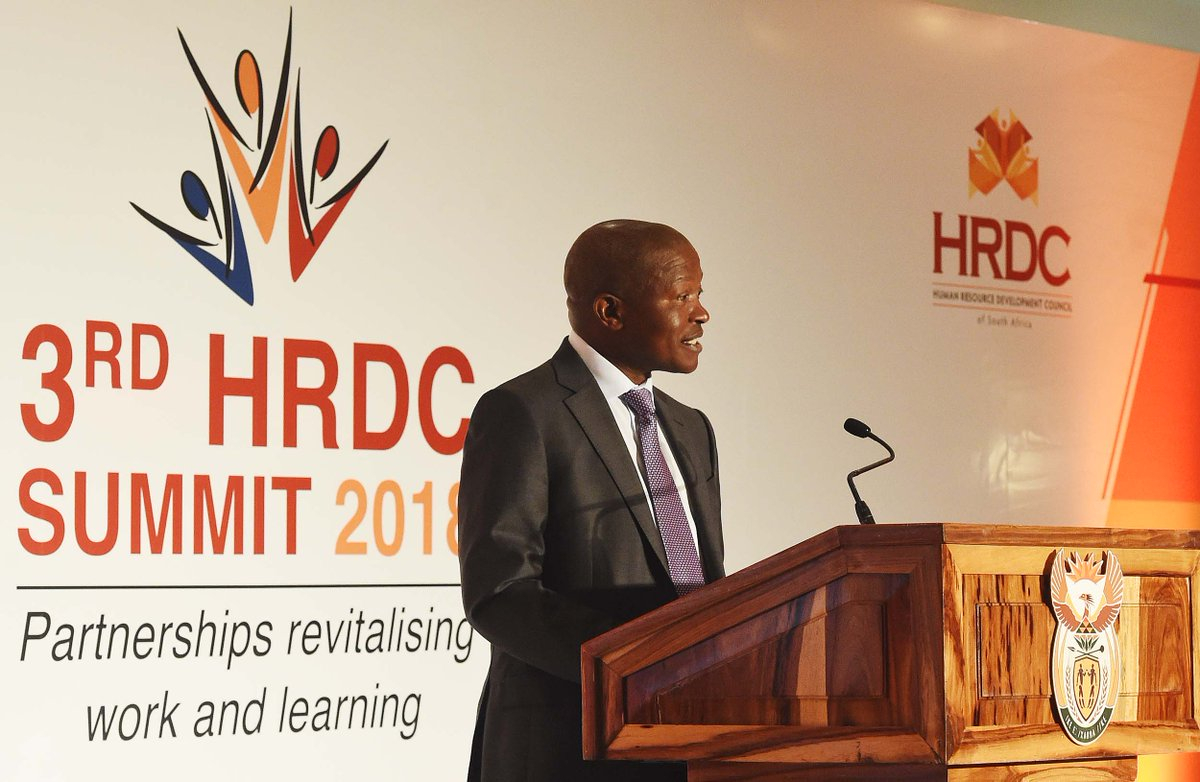
“Before deliberating further on this 4th summit, let us reflect briefly on what was agreed to in 2018 at the 3rd HRDC Summit, to ensure that we underline policy and programmatic continuity, and avoid reinventing the wheel. As social partners, we have to ask ourselves the question whether between the period of the last summit and this one, have we sizeably delivered on equipping and capacitating our young people with practical solutions.
“If we are to recalibrate our human resources development efforts to be skills-based, innovation-led and entrepreneurial-focused, we must be deliberate in implementing resolutions that we take at each summit. That is why at the end of this summit, we need to emerge with a concrete plan of action that will demonstrate measurable progress by the time we meet for the next summit,” he said.
Mabuza welcomed the summit’s focus on building the foundation for a transformed economy.
“We presume there will also be strategic and thematic continuity between this 4th summit and previous summits in areas of implementing pathways and partnerships between training institutions, labour and industry.”