
By Lehlohonolo Lehana.
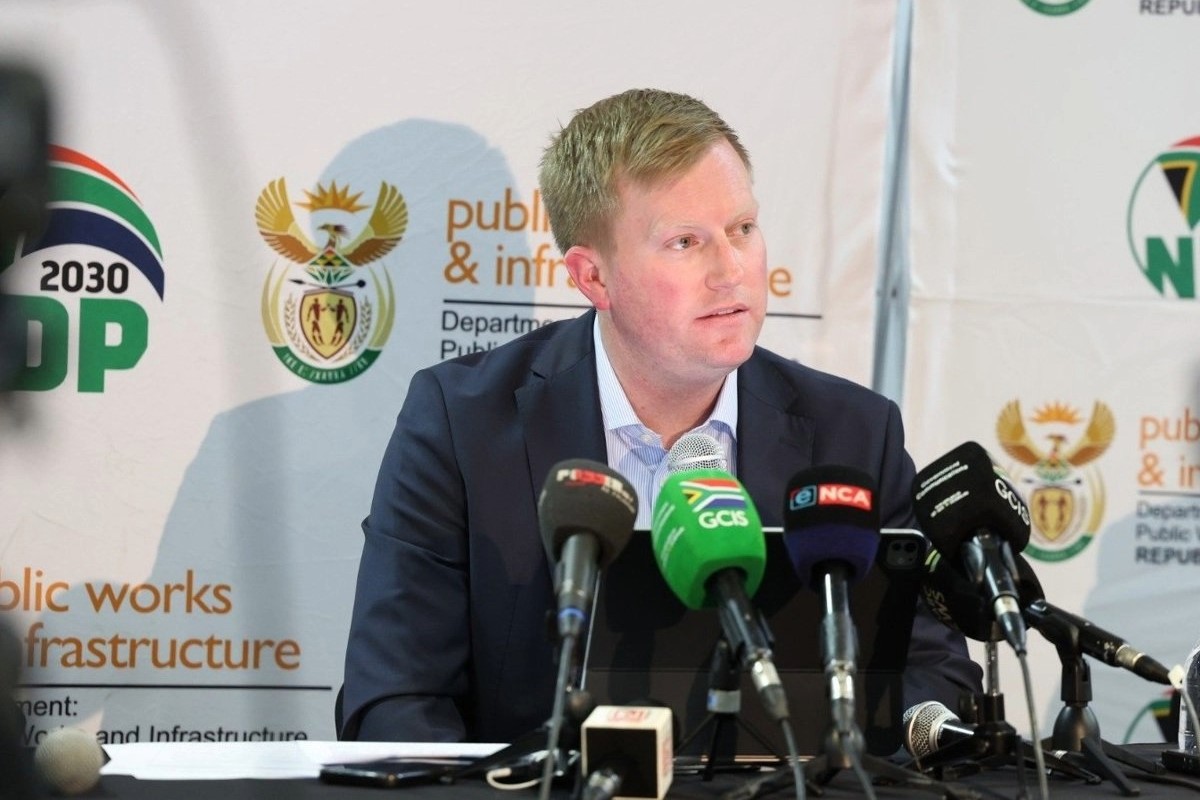
Public Works and Infrastructure Minister Dean Macpherson outlined his department’s achievements and ongoing reforms, including updates on key investigations, property asset utilisation, and anti-corruption efforts.
Macpherson has used his Budget Vote speech to unpack a vision for migrating government departments that collectively spend R6-billion yearly on private leases back to State properties.
The plan involves restructuring the underperforming Property Management Trading Entity (PMTE) into a revenue-generating and investable entity, and to “ensure the asset base of the State is managed with professionalism, discipline and a return-on-investment mindset”.
Through the PMTE, the department manages over 88 000 buildings and five-million hectares of land, making it the country’s largest property portfolio.
“For decades, this portfolio has underperformed and been under-utilised, and we are going to change that,” the Minister said.
Amendments would be made to the Immovable Asset Management Act to facilitate what he described as modern and flexible asset use, as well as to pilot innovation.
“This will mean, the State will finally start to generate revenue from its assets, either through co-development models or through investment into a property fund of A-grade property assets.
“There is strong demand and interest both domestically and internationally in this plan,” the Minister averred.
The department had started identifying government leases that could be migrated back to government buildings from private properties.
While acknowledging that it would be a difficult process, he argued that departments should not be paying R6-billion a year on leases when there were empty government buildings.
“For too long, the State has sat on thousands of unused buildings and parcels of land that are not put to either economic or social use.
“This, while government departments are in some cases paying R120/m in private leases, while our own buildings cost just R26/m.”
In parallel, investigations into failed property projects would continue, including the R600-million purchase of Telkom Towers between 2015 and 2016 to house the South African Police Service’s national head office.
“The draft investigation reveals a significant loss in terms of the value of the property owing to a series of damages to its infrastructure,” Macpherson said, adding that the reports will be finalised soon. “Where individuals have been implicated, we will not hesitate to act.”
Director-General Sifiso Mdakane provided insight into reforms under way within the department’s internal systems, including digitisation and professionalisation.
“We have created a new branch that will be reporting directly to myself that will be leading ICT, which is the level at which we want to take ICT very seriously,” said Mdakane.
“Part of the other issues that we are going to be focusing on is the issue of e-procurement… because you realise the interaction of procurement with human beings directly, it causes a lot of problems.”
Mdakane said the department had audited the skills of all senior managers and was restructuring to ensure it reflected its technical mandate.
“We should have strong skill sets that have technical people… economists, property specialists, developers, engineers, technologists, technicians… architects, quality surveyors. We’re seeking to professionalise the department.”
Macpherson also reported on lifestyle audits and ghost employee detection, saying audits had been launched for 400 high-risk officials. The first batch of 69 audits began in March and will be completed by September.
“Our Anti-Corruption Unit is currently auditing the PERSAL system across the department and EPWP to detect any fictitious employees drawing salaries without working, “he said.
Macpherson confirmed he will meet with the families of the 34 workers who died in the George building collapse on 19 July, following the postponement due to former deputy president David Mabuza’s funeral.
“The collapse was entirely preventable. Accountability cannot be optional when lives are lost due to human error,” he said.
The Engineering Council of South Africa has finalised a report detailing regulatory and professional failings, which will be handed to law enforcement.