
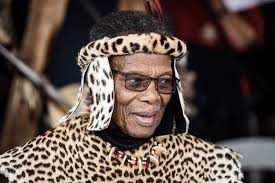
By Lehlohonolo Lehana.
Inkatha Freedom Party founder and president emeritus Mangosuthu Gatsha Buthelezi, who served as traditional prime minister to a succession of Zulu kings, has died at the age of 95.
Buthelezi’s death was announced in a statement by President Cyril Ramaphosa.
“Prince Mangosuthu Buthelezi has been an outstanding leader in the political and cultural life of our nation, including the ebbs and flows of our liberation struggle, the transition which secured our freedom in 1994 and our democratic dispensation, “Ramaphosa said.
Buthelezi was one of South Africa’s longest serving — and controversial — politicians, whose remarkable career spanned five decades and traversed both the apartheid regime and the post-1994 democratic dispensation.
An accomplished orator, historian and custodian of Zulu tradition and culture, Buthelezi was perhaps one of the most contradictory figures in South African politics, claiming to be part of the national liberation movement, while also participating in the apartheid system.
It was this policy of “loyal resistance” to the apartheid regime which placed him on a collision course with the liberation movement he claimed to be part of — and at the centre of the bloody conflict of the 1980s and 1990s.
Buthelezi was born at Mahlabathini in Zululand in 1928 to Princess Magogo kaDinuzulu, sister of the then king, Solomon kaDinuzulu, and Matohole Buthelezi, the chief of the Buthelezi clan.
His parents were Zulu royalty, descended on his mother’s side from King Cetshwayo, who inflicted a historic defeat on British forces at Isandlwana in 1879
After completing his school education, Buthelezi attended the University of Fort Hare, where he joined the ANC Youth League and was expelled for participating in protests in 1950.
Shenge, the honorific clan name by which he was known, completed his bachelor of arts degree at the University of Natal, working briefly as an administration clerk for the department of native affairs.
Buthelezi, who was elected as the territorial authority’s chief executive, became the chief executive councillor of KwaZulu, a title that was changed to chief minister in 1977.
He was also the prime minister of KwaZulu, the homeland of six million Zulus, and the founder of the Inkatha Freedom Party, a Zulu political and cultural movement with 1.9 million members.
Beyond claiming to speak for nearly a quarter of the nation’s 28 million Black inhabitants in 1990, Buthelezi appealed to many white South Africans by advocating a peaceful transition to democracy and free enterprise, and by fiercely opposing Nelson Mandela’s African National Congress and its demands for international sanctions, armed struggle and a socialist revolution to crush Pretoria’s segregationist regime.
But Buthelezi was an enigma.
To his many admirers, he was a statesman, posing in the Oval Office with Presidents Ronald Reagan and George H.W. Bush; having tea with Prime Minister Margaret Thatcher of Britain; visiting Pope Paul VI at the Vatican; and cultivating a persona as the man who might lead South Africa when white rule eventually gave way.
In the first democratic elections in 1994, Buthelezi, after first balking, campaigned with gusto. But Inkatha won only 10 percent of the votes, and his hope for the presidency evaporated. Mandela became South Africa’s first Black president. He appointed FW de Klerk as deputy president and Buthelezi as minister of home affairs. (De Klerk resigned as deputy president in 1996.)
When Mandela left office in 1999, Buthelezi retained the home affairs portfolio under President Thabo Mbeki until 2004. He also held a seat in Parliament for two decades. In 2019, he stepped down as party leader to be replaced by Velenkosini Hlabisa, the party’s provincial party leader in the KwaZulu-Natal assembly. Buthelezi continued to head the party’s caucus in the national Parliament.
In the aftermath of apartheid, a Truth and Reconciliation Commission, which was set up to document abuses of the era, concluded in 1998 that Buthelezi had collaborated with the white regime, and that Inkatha had massacred thousands of opponents. Buthelezi challenged the findings in court, and, as part of a 2003 settlement, the authors dropped his name from the final report.