
By Lehlohonolo Lehana.
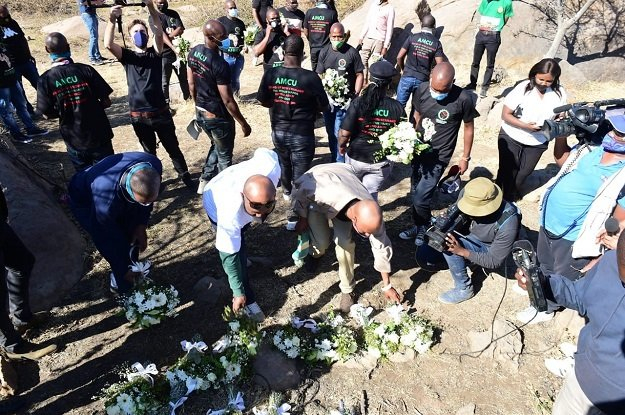
Today marks the 10th anniversary of the Marikana massacre, Sibanye-Stillwater in partnership with government, continues to honour the lives that were lost.
The Marikana strike was organised by worker committees demanding a living wage of R12,500 from Lonmin, now owned by Sibanye. The company refused to negotiate and six mine workers, two SAPS members and two security guards were killed before 16 August 2012.
The company continues to contribute to reparations for those who were and continue to be affected by the tragic events of 2012.
Since acquiring Lonmin’s operations in 2019, Sibanye has been actively engaging with various stakeholders in Marikana and has set up the Marikana Renewal Programme which was launched in 2020 by Archbishop Thabo Makgoba.
The Marikana Renewal Programme seeks to promote healing and provide socio-economic redress that will facilitate the sustainability of the local communities.
Sibanye-Stillwater benefits communities through mandated Social and Labour Plans (SLPs) and various corporate social responsibility projects.
As part of the SLPs, Sibanye has delivered 22 projects in the areas of education, 13 projects in health, 6 projects in welfare, 10 projects in economic development, four projects in social infrastructure and four projects in road infrastructure.
As part of the Letsema Process, which lies at the heart of the Marikana Renewal Programme, the patron has visited families in the Eastern Cape and Lesotho and key stakeholders in Marikana.
Some of the projects is the first phase of the Leokeng Secondary School, which was completed in late 2021, the newly extended Majakaneng Clinic and the Majakaneng Agricultural Project.
Malebo Mototoba, a Professional Nurse at Majakaneng clinic, said the facility is now bigger than it used to be and has made a difference in the community.
“Sibanye has helped us by extending the clinic. It was too small and that resulted in congestion. We now have more consulting rooms and the wellness clinic is big. This makes me happy because we now work in a conducive environment and are able to treat about 400 patients a day, “she said.
Memorial Park
Given the COVID-19 lockdown regulations in the country, implemented on 27 March 2020, delays were experienced in completing some projects in accordance with the 2020 implementation plan.
Some of the projects currently in the pipeline include the upgrading of roads in Wonderkop and Nkaneng and a Memorial Site at the koppie where the 34 miners lost their lives.
The Marikana Renewal Programme held its first pitso – a traditional Sotho gathering – in May, which brought forward the importance of honouring the lives of the fallen.
Tshepo Kgasago – Head of Community Engagement and Development for PMG Region South Africa said the Pitso was attended by 94 family members of the deceased.
He said the families were engaged in a bid to help co-create a path towards constructing a memorial park.
Kgasago said the memorial park that is still in the conceptual stages will be situated in between the two koppies where the majority of the deaths took place on 16 August 2012.
“We have been engaging with the widows on the memorial site. It will not be a project that we are going to develop by ourselves without the inputs of everybody else. We are busy with the concept for the memorial site,” he said.
The families have requested that a task team be put together so they can contribute to the planning in as far as the memorial park is concerned.
Sibanye also continues to support the 1608 Memorial Trust, which was originally founded in September 2012 by Lonmin and its partner Phembani Group (formerly Shanduka Resources) to fund the educational needs of the dependent children of the employees who died in the tragedy.
The Trust currently supports 139 beneficiaries, ranging in age from nine to 41 years old, coming from all over South Africa as well as Lesotho and Swaziland.
The fund has provided for the education of three postgraduate students, one of whom recently acquired a PhD – as well as 14 tertiary graduates.
“Through the 1608 Memorial Trust, we continue to support the dependents by providing educational assistance in the form of schooling and registration fees; stationery, textbooks and uniforms; tertiary tuition fees; transportation and meal allowances; as well as extramural activities such as sports and school excursions for educational purposes,” Kgasago said.
Sibanye has previously committed to building houses for the 16 widows that were not supplied with homes by the AMCU Trust.
Programme Manager for Housing at Sibanye, Riaan Barnard, said that eight houses have been finalised and another eight is being built in locations that were selected by widow.
The locations include the Eastern Cape, Mpumalanga, North West Province (Mahikeng), Northern Cape (Kimberley) and Lesotho.
Living conditions in Marikana
Speaking about housing in the Marikana area, Barnard said the partnership with government in providing further housing has started and is well underway.
Barnard said Lonmin initially donated 50 hectares of serviced land to the Rustenburg Local Municipality, valued at the time at R80 million, proclaimed as Marikana Extension 2.
“This enabled the construction of 2 658 accommodation units by government for employees and local community members. Phase 1 of the project has been completed, with 544 houses having been finalised – 292 for employees and 252 community residential units,” he said.
In 2019, Lonmin formed a partnership with the Housing Development Agency (HDA) to jointly implement defined housing initiatives in the Marikana and surrounding areas in full alignment with the local municipalities and the province.
Contributing to Economic Development
Sibanye-Stillwater employs 84 981 people (including contractors) at its South African and United States operations. Of these, 24 444 employees and contractors are employed at the Marikana operation.
Kgasago said that a R3.9 billion capital investment in the Marikana K4 project will sustain jobs for the next 50 years.
The Marikana K4 project and other operational requirements has directly/indirectly contributed to about 1 563 job opportunities for locals since July 2021.
Claims by injured miners
Last week, department of justice and constitutional development solicitor-general Fhedzisani Pandelani told a media briefing that outstanding matters will be finalised before the end of August.
The lawyer, Andries Nkome, said he could not quantify how much each mineworker will receive from the cases that were settled on Friday.
“It is not possible to mention how much each mineworker will receive because compensation is directly linked to the extent of the injury suffered. The ones who are the most injured will receive a bigger payout, “said Nkome.
He said the victims in the outstanding cases were seeking damages for severe injuries, medical expenses, loss of past and future earnings, and the extent of general damages which includes pain and suffering.
On general damages alone, each victim is demanding that the state pay an amount between R8m and R12m.
Nkome was still adamant that the outstanding matters will not be concluded before the end of August.
Nkome’s firm represents 53 injured and 279 arrested mineworkers.
He said the claims of 23 injured workers were settled on August 2 and last week but payments are yet to be made.
He also said the claims of 223 arrested workers were settled in 2018. Nkome did not want to disclose how much they were paid.
In August last year, the state paid R3.5m to one survivor in the ongoing lawsuit.
Pandelani said he would not comment on matters before court.
“I still remain hopeful that save for some supervening impossibilities beyond the control of the parties, that the majority of the matters from the 48 currently in court.
Justice Delayed
Ten years after Marikana, President Cyril Ramaphosa remains the ultimate symbol of the state’s disdain towards the victims and their families.
No one has been criminally charged for the massacre and the socioeconomic conditions that led to the violence have been perpetuated, sparking further protests and bloody crackdowns across the country.
Marikana might have changed little, but everything changed after Marikana.
Ramaphosa was a non-executive director at the platinum producer after his company Shanduka Resources took a $304-million loan from Lonmin to buy into the mining company’s empowerment vehicle. In the days leading up to the massacre, he put pressure on then police minister Nathi Mthethwa and mineral resources minister Susan Shabangu to treat the strike as a criminal issue rather than a labour dispute.
The Farlam Commission exonerated Ramaphosa and proving criminal charges against him might stretch the limits of both the law and the National Prosecuting Authority’s (NPA’s) capabilities.
The NPA has charged a handful of SAPS members, including former North West deputy commissioner William Mpembe, for causing five deaths on 13 August 2012, but no one has been charged for the 34 deaths on 16 August.
In his report from the Marikana Commission, Judge Ian Farlam said the NPA and the Independent Police Investigative Directorate (Ipid) should investigate the shooters for attempted murder.
In March 2017, Ipid handed 72 dockets over to the NPA for prosecution. Five years later, only the cases from 13 August have been prosecuted. Neither Ipid nor the NPA responded to requests for comment. The NPA has previously said it lacked the resources to complete its investigations.