
By Lehlohonolo Lehana.
Deputy President Paul Mashatile has acknowledged that confidence in South Africa’s criminal justice system was declining, as evidenced by recent surveys.
Mashatile said the system and democracy had been put to the test owing to corruption, criminality and gender-based violence and femicide (GBVF).
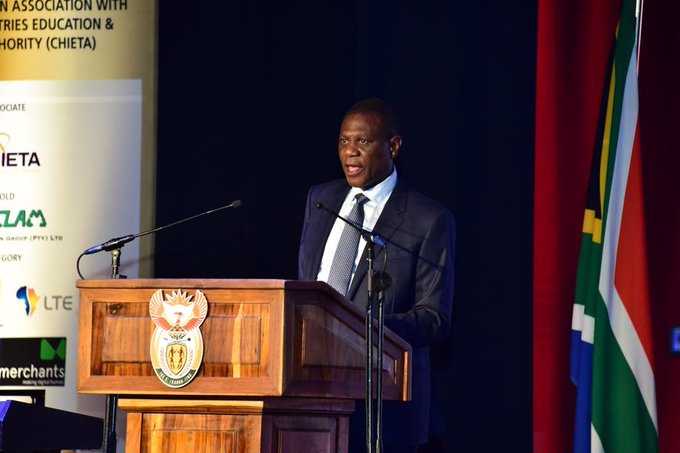
He was providing an update in his keynote address at the National Conference on the Integrated Criminal Justice System and Review of Criminal Procedure Act, in Johannesburg, on Tuesday.
The conference took place under the theme ‘Strengthening the criminal justice system to keep our people safe and secure’ and aimed to take stock of, and critically reflect on, the progress in the implementation of the Justice Crime Prevention and security (JCPS) 7-Point Plan, targeted at promoting an integrated and modernised criminal justice system.
He noted that despite government’s strategies to combat crime, the scourge remained persistent. He also pointed to overburdened prosecution and judicial systems, overcrowded prisons and a beleaguered police system.
“Looking at these challenges, it is easy to grow despondent, but we must never be discouraged. Instead, we must double our efforts to reach our desired goal. The legal system in South Afirca has undergone significant changes since the apartheid era, aiming to ensure fairness and equal opportunities for all citizens. Post-1994, changes include a National Crime Prevention Strategy, victim empowerment programmes, and a diversion programme for low-impact offenses under Pillar 1, to ensure a human rights culture. Recently, we replaced the 1996 National Crime Prevention Strategy with the Integrated Crime and Violence Prevention Strategy, approved in March 2022 by the Cabinet. This strategy focuses on preventing crime and violence through a ‘whole of government’ and ‘whole of society’ approach,” Mashatile said.
Over the next few months, the JCPS will focus efforts on GBVF, corruption, creating an independent unit called the ‘Investigating Directorate against Corruption’ within the NPA, strengthening the Whistleblowers Act and revising the Criminal Procedure Act.
Mashatile also stressed the need to deal with crime in the construction sector, as it directly impacted the country’s economy.
He said the Economic Infrastructure Task Teams were dealing with non-ferrous metal theft, infrastrutucre crimes, and illegal mining activities.
He stressed the need to strengthen existing interventions to protect infrstructure relating to State-owned companies Eskom, Transnet, and the Passenger Rail Agency of South Africa.
“A concerted effort from all is necessary to unravel the complex web of construction site disruptions, which endangers lives and impedes the government’s objective of transforming the nation into a massive construction site that generates employment and expands the economy,” he said.