
By Lehlohonolo Lehana.
Thabo Mbeki says the current method of electing the President fails to adequately assess a candidate’s capability and suitability for the highest office.
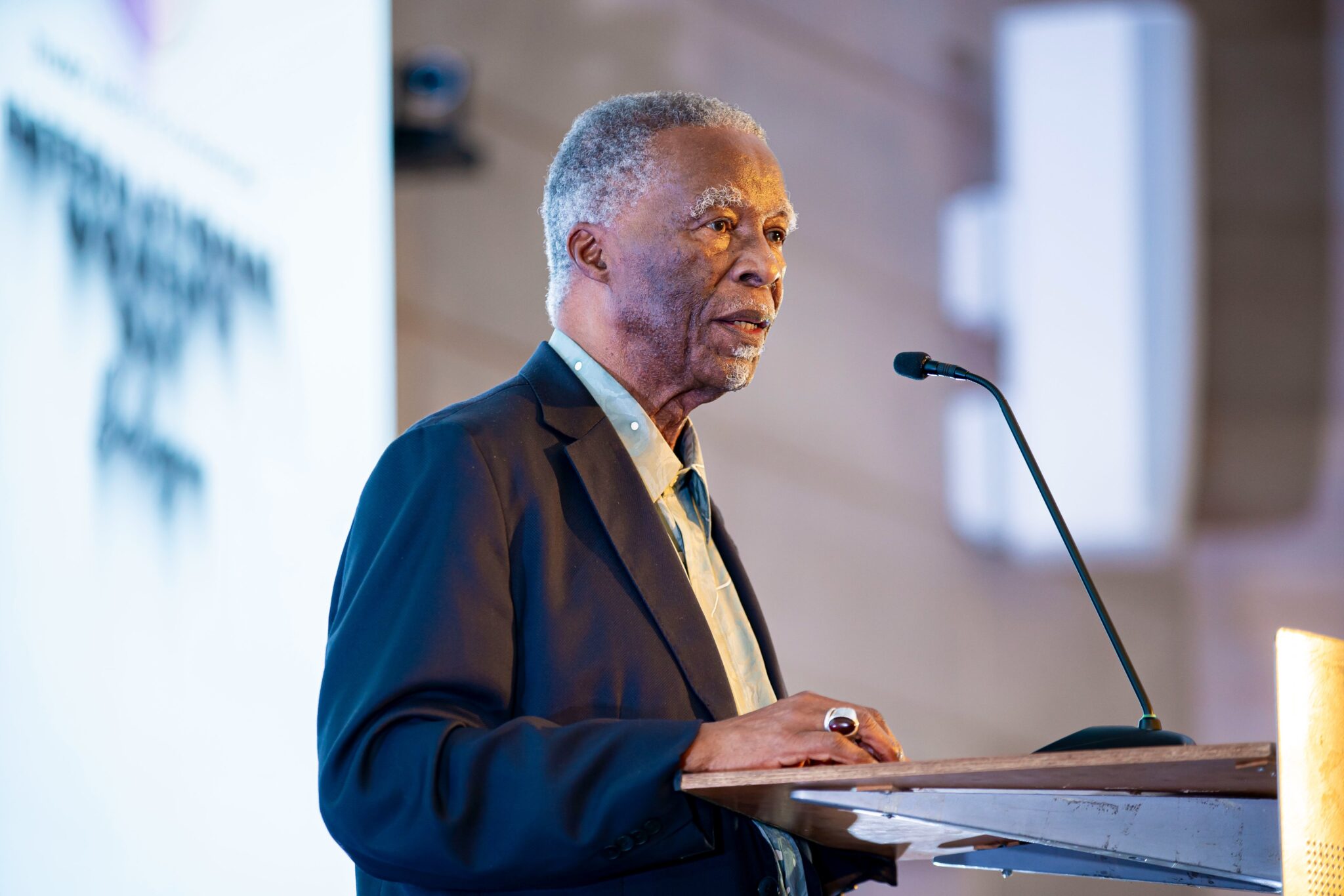
Mbeki was speaking at the launch of the National Dialogue for the Eastern Cape higher education sector at Nelson Mandela University in Gqeberha.
The event forms part of the broader National Dialogue initiative, pursued locally as a sectoral initiative and supported by the Strategic Dialogue Group (SDG) and the Thabo Mbeki Foundation.
Alongside Mbeki, Vice-Chancellor Professor Sibongile Muthwa and other influential thought leaders from across the higher education and development sectors also shared their reflections.
He directly challenged the existing system where South African voters elect political parties to fill 400 seats in the National Assembly, with the President then chosen by a majority of Members of Parliament (MPs).
Mbeki said, “The manner in which we elect the President is wrong. The question is never asked if a President is capable and a fit and proper person.
“When Parliament said I must become president, they did not have a clue what I was capable of doing, and they never asked.”
He said this was one of the issues the National Dialogue had to address. He added that the country now needs “action, not wish lists” to address the crises.
Mbeki also lamented the National Development Plan (NDP), saying it was a brilliant vision for the country, but it was not a plan. “And that is the intelligentsia’s fault, “he said.
“They should have intervened and said, ‘This is what must become of the National Development Plan.’ They should have said: “We have a very good vision, but what is the plan?”
The National Development Plan was adopted by the Cabinet in 2012 and provided a roadmap of how South Africa would develop by 2030.
“The vision was never translated into practical steps,” said Mbeki.
In the health sector, he said South Africa needs to bring together the health profession’s intelligentsia to discuss the National Health Insurance (NHI), put all the problems on the table and the actions that have to be taken for it to be possible.
He emphasised that in all sectors of society this is the moment for people-led change, for action for a new future. It is a moment in history that all the people of South Africa have to make count. A moment that we can look back on and say it feels good to be South African.
There are currently 17 different legal challenges against the NHI, including nine in the high courts and eight in the Constitutional Court (ConCourt). The state is attempting to consolidate all the high court cases into one and put them on hold until the ConCourt has ruled on the cases before it – mostly around the question of whether the president acted rationality in signing the NHI Bill into law, particularly when the country can ill-afford it and public participation was largely ignored.
Economic research commissioned by PriceMetrics shows private healthcare spending currently accounts for about 8% of GDP, with 9.1 million people served by private healthcare and 53.2 million relying on public healthcare.
State healthcare is provided on a universal basis through a network of hospitals, clinics, and community health services. District health services, largely covering primary healthcare, accounted for 44.7% of the R267 billion state spending on the sector in 2024.