
By Lehlohonolo Lehana.
Water and Sanitation Minister, minister Senzo Mchunu, says his department is hard at work to ensure that the challenges facing his department are resolved.
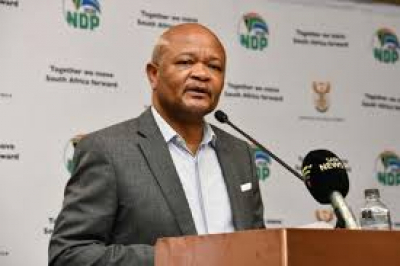
Mchunu made the commitment during a media briefing in Pretoria on Friday to mark one year since he took over the water and sanitation portfolio.
He said while the department strives each day to ensure that South Africans are provided with access to water and basic sanitation services, it is not an easy undertaking.
“There have been many hurdles we’ve had to jump over, many bottlenecks we’ve had to undo in order to realise most of the gains we have made to date.
“We do, however, want to state that notwithstanding the progress, we still have a long way to go but understand us to be ready for the task and dedicated to serving the citizens of South Africa,” Mchunu said.
Mchunu said one of the first priorities was stabilising the department, which resulted in the appointment of Director-General, Dr Sean Phillips, who started his duty on 03 January 2022.
The department set about ensuring that all senior posts are filled, and including the Chief Financial Officer, Deputy Director-Generals for Corporate Services, Water Services Management and Regulation, Compliance and Enforcement.
“When doing so, we took a stern decision that we would employ people who are fit for purpose – with the necessary qualifications, skills and capabilities. I am happy to report that with all of these senior posts filled, the department is fully functional,” Mchunu said.
He outlined progress in Water Resource Management and Water Services Management, the two main streams the department comprises of.
“On Water Services Management, we have several projects throughout the country and others in conjunction with neighbouring countries at various stages, aimed at ensuring water provision and water security. We have said on a number of occasions that we have prioritised Water Services Management while continuing to keep focus on Water Resource Management” the Minister said.
The context in which prioritisation has taken place included incomplete projects that must be completed as soon as possible; addressing the problem of incapacity in municipalities to deliver on water and sanitation services; desperation of communities for water; storms in KwaZulu-Natal and the drought in Gqeberha; lack of resources; and old and dysfunctional infrastructure.
A process to reconfigure water boards is underway and substantial progress is expected to be made by the end of the year.
The Minister explained that the aim is to use water boards, via directives, as one of the delivery mechanisms for water and sanitation to communities, with limited differentiation between bulk and reticulation.
Upscaling partnerships with private sector
The department is also working with the private sector, where traditionally it has been via tenders. However, he said, they are currently working on upscaling partnerships with the private sector.
In achieving this, the department has established a National Water Partnerships Programme and Water Partnerships Office in the Development Bank of Southern Africa.
The Water Partnerships Programme will run five programmes, including non-revenue water, management contract, wastewater treatment, water re-use, and seawater (desalination).
“We have partnerships with the private sector that have already worked out, with Lebalelo Water User Association, Ivanplats Mine and with regards to the Vaal Gamagara project.”
Progress made in Giyani Water Project
Mchunu, says substantial progress has been made in respect of the water pipeline from Nandoni to Nsami, where 4km is left for connection.
Briefing media on the state of water and sanitation a year since he took over the portfolio, Mchunu said work will get underway at the beginning of September to refurbish the existing water works.
In Malamulele, he said they expect the reservoir to be completed and operational by February 2023.
“There is another project that relates to drawing water via the De Hoop Dam pipeline and Flag Boshielo to the Mokopane pipeline. This is a joint venture with mines and the Lebalelo Water User Association. We are monitoring progress in respect of this partnership and the project,” Mchunu said.
Intervention in Nelson Mandela Bay yields positive results
Mchunu said the department’s intervention in Nelson Mandela Bay Metropolitan Municipality has yielded positive results.
As the department continues to work together with the municipality, they are exploring other ways to stretch out the use of the available water.
“One way in which we have assisted the metro was through the Nooitgedacht Water Scheme, which released its first drops at the end of March this year. This has largely assisted in increasing water supply to the Nelson Mandela Bay Metropolitan Municipality.
“We successfully convened a workshop this past Tuesday, focusing on creating a water resilient Nelson Mandela Bay Metropolitan Municipality. The participation and inputs received from all attendees, which comprised members of academia and business, amongst others, were overwhelming,” Mchunu said.
Water challenges in Hammanskraal
In Gauteng, Mchunu said the department continues to engage with the City of Tshwane in respect of the water challenges in Hammanskraal.
The Minister, however, noted that the City of Tshwane has enough money to rehabilitate and fix their system, but “they are dragging their feet in terms of performing their responsibility”.
He noted good progress around four areas of work in Emfuleni, which include refurbishment of treatment plants and pump stations, unblocking, replacing and refurbishment of pipes.
“We’ve engaged with Emfuleni Local Municipality for them to ensure full responsibility for their water and sanitation systems.”
In the Free State, Mchunu said the department is intervening via Bloem Water regarding water and sanitation challenges that continue to plague Matjhabeng, Mangaung, Kopanong and Maluti-A-Phofung.
Addressing challenges in KZN
In KwaZulu-Natal, Mchunu said the water and sanitation situation was exacerbated by flooding which hit the province in April, as most infrastructure critical for the provision of water and sanitation services was left damaged.
He said the department has intervened in the uMkhanyakude District Municipality, issuing a Directive for Mhlathuze Water, as an Implementing Agent, to intervene.
“We have uMkhomazi Water Project, which is set to benefit eThekwini, Msunduzi, uMgungundlovu, Ugu, Ilembe and Harry Gwala. The project will transfer water from the uMkhomazi River to augment the uMngeni Water Supply System, which supplies domestic water to more than five million people and industries in South Africa’s third largest regional economy — the Durban and Pietermaritzburg regions.
“We recently held a meeting with the all the affected Water Services Authorities, the Water Boards in KZN and the Trans Caledon Tunnel Authority, and reached consensus on the offtake agreements that will have to be entered into. I am happy with the current trajectory and the willingness of all parties to work together,” Mchunu reported.