
By Lehlohonolo Lehana.
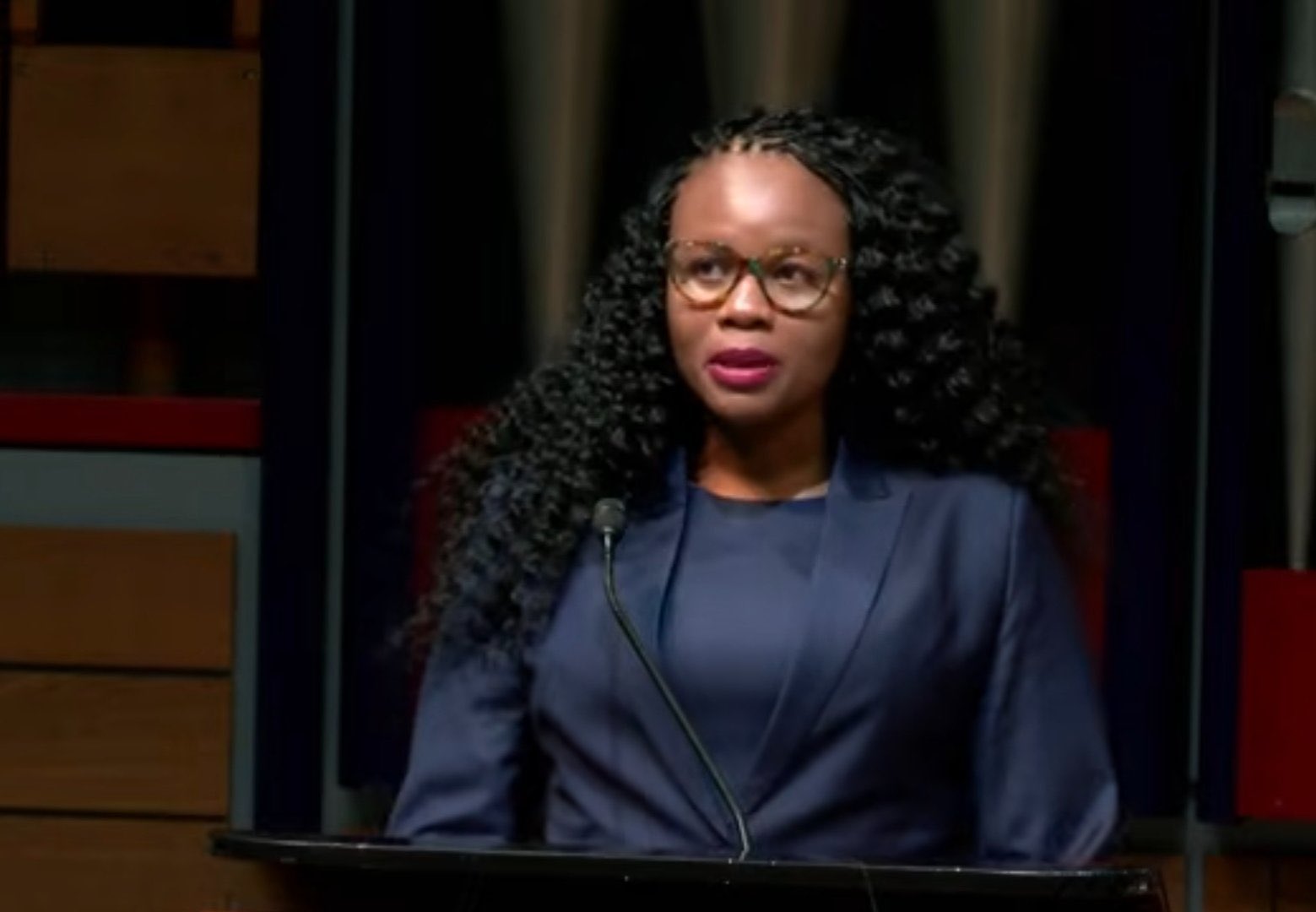
Photo Credit: Nasiphi Moya X.
The executive Mayor of Tshwane, Nasiphi Moya delivered the 2026 State of the Capital Address (SOCA) at the Winnie Madikizela-Mandela Building at the University of South Africa (UNISA) on 16 April 2026.
Moya outlined service delivery progress, infrastructure renewal, financial stability plans, and a commitment to rebuilding Tshwane.
In recent weeks, the city has made headlines following corruption allegations at the Madlanga Commission of Inquiry.
This resulted in the suspension of the city’s Chief Financial Officer, Gareth Mnisi, following allegations of tender irregularities. The MMC for Corporate and Shared Services Kholofelo Morodi was also fired following corruption allegations.
Moya revealed that in the current financial year to date, 684 incidents have been reported through formal channels including the fraud hotline and internal reporting systems.
“This reflects a system that is becoming more accessible and responsive, with employees and residents increasingly making use of formal reporting mechanisms. These reports are translating into action,” Moya said.
Moya said reforms were already under way to strengthen oversight, controls, and consequence management, and to address the same issues now being examined by the commission.
She clarified that the city’s challenge is not a shortage of water supply, but significant water losses caused by ageing infrastructure, leaks and system inefficiencies.
“The city meets a demand of 800 to 900 million litres per day through a mix of procurement and internal production,” she said.
According to Moya, about 72% of Tshwane’s water is sourced from Rand Water, which supplies over 600 million litres daily, while additional supply comes from Magalies Water. The remaining 28% is produced internally.
The has been an ongoing, concerns about water and sanitation in the metro, including a directive giving the city 60 days to fix failing sewage treatment plants.
The 2025 Green Drop Report shows Tshwane’s performance has dropped sharply from 82% in 2013 to below 34%, highlighting serious operational and governance challenges.
Moya acknowledged long-standing issues in areas such as Hammanskraal and Bronkhorstspruit, which have faced water challenges for years, including a deadly cholera outbreak in Hammanskraal.
She said the city has introduced a Water Stabilisation Plan aimed at improving infrastructure, fixing leaks, reducing illegal connections and strengthening monitoring systems.
Turning to the city’s finances, Moya said the administration inherited an institution under severe strain, with debt exceeding R13 billion, unfunded budgets and weak financial controls.
“This was not a city on stable ground. It was an institution under pressure, constrained in its ability to meet service delivery demands and exposed to growing risks that threatened its sustainability,” she said.
Moya said the city has since focused on restoring financial discipline, rebuilding credible budgets and strengthening internal controls. Tshwane has now delivered a fully funded budget for the 2025/26 financial year—the first since 2021/22—validated by National Treasury of South Africa.
She added that the draft 2026/27 budget and Integrated Development Plan aim to maintain a fully funded, cash-backed position while increasing capital investment from R2.8 billion to R3.5 billion.
The Global Credit Ratings revised Tshwane’s outlook from negative to positive. Their assessment highlighted better fiscal control, easing liquidity risks, and an operating surplus for the second consecutive year.
The collection rate has stabilised at around 82%, and billing accuracy exceeds 99%, with 90% of bills based on actual meter readings – without stating what the collection rate was a year ago or whether the issue with the cleaning levy was accounted for in the claim of 99% billing accuracy.