
By Lehlohonolo Lehana.
Picture: Neil McCartney.
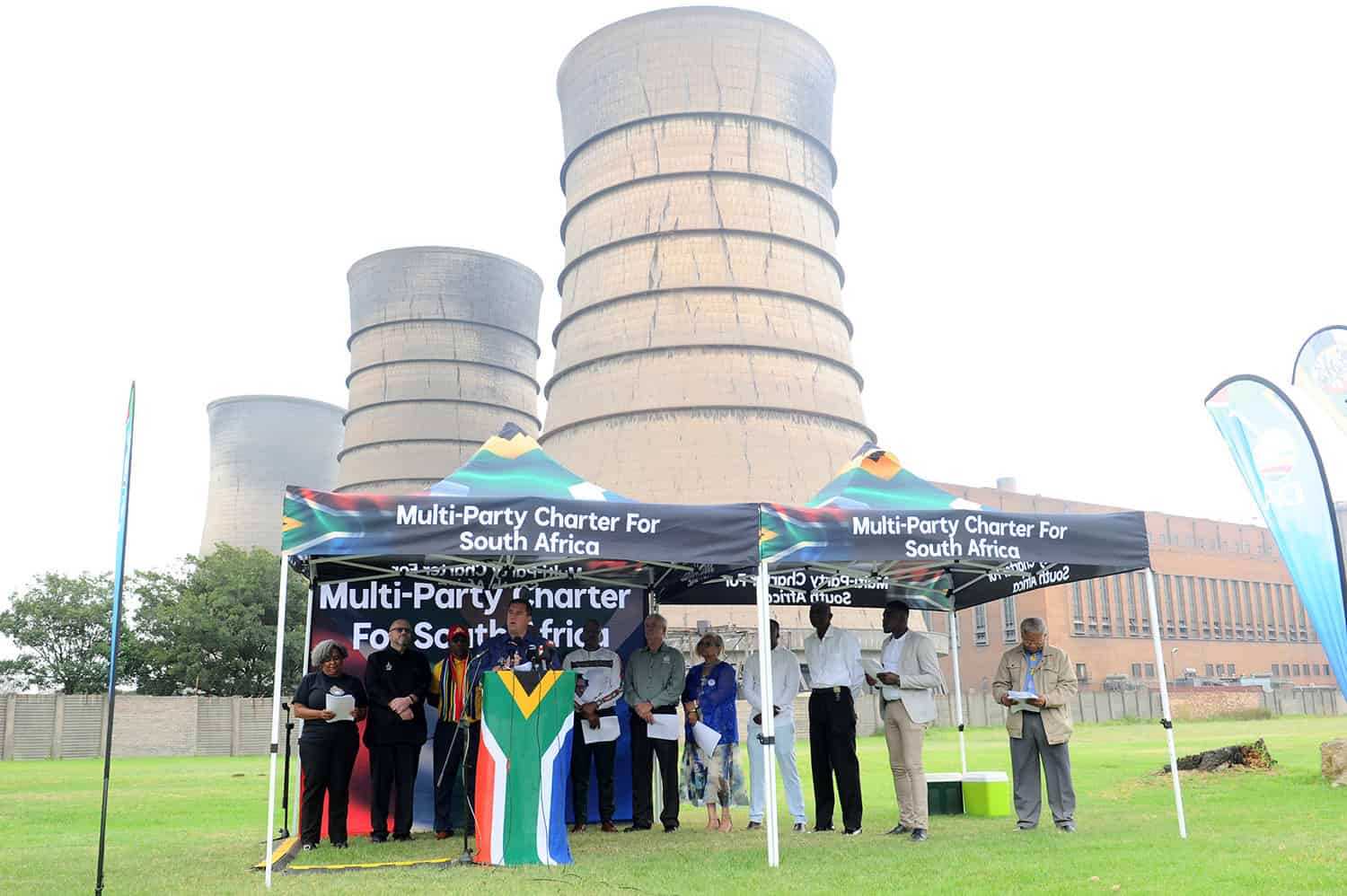
The Multi-Party Charter (MPC) has unveiled their plans to keep South Africa out of darkness after this year’s general elections … and getting rid of the Electricity Ministry.
The MPC is comprised of the Democratic Alliance (DA), the Inkatha Freedom Party (IFP), the Freedom Front Plus (FF Plus), ActionSA, the African Christian Democratic Party (ACDP), the Independent South African National Civic Organisation, the United Independent Movement (UIM), the Spectrum National Party, Ekhethu People’s Party, the Unemployed National Party and the United Christian Democratic Party.
Speaking at a media briefing at the Kelvin power station, in Kempton Park, on February 28, the leaders of several of the participating parties set out how an MPC-led government could put a decisive end to South Africa’s electricity crisis and achieve energy security so that the economy could begin to revive.
The MPC’s position is that the energy crisis can only be averted through the election of an alternative government with the skill, political will and integrity to fix the problem.
“We need the MPC parties to get over 51% of the vote. You can’t do any of this from the opposition bench. So we need the people of South Africa to get behind the MPC to bring us over that finish line.”
“That way, we can then start to drive legislative and regulatory changes that will immediately see the opening up of the energy sector to independent power producers, allowing innovators and entrepreneurs to provide feed into the grid,” DA leader John Steenhuisen said.
IFP president Velenkosini Fiki Hlabisa accused the ANC of destroying South Africa’s energy security through three decades of bad policy decisions, lack of planning, State capture, corruption and mismanagement of State-owned utility Eskom.
He said loadshedding had devastated the country’s economy, negatively impacting on economic growth by as much as 3.2 percentage points.
“{The national government’s inability to create a competitive and modern energy market that is capable of meeting South Africa’s energy needs has robbed the South African people years of progress.
The ANC is 100% responsible for loadshedding, but they want people to be grateful when we are on a lower stage of loadshedding. The notion that rolling blackouts have improved in South Africa thanks to the intervention by the government must be rejected with contempt,” he asserted.
Isanco leader Dr Zukile Luyenge added that the MPC was the South African energy sector’s last line of defence – and that of the economy in general.
“Ending loadshedding and ensuring a reliable, affordable power supply for South Africa will be a top priority of an MPC government. We will achieve this by increasing sustainable energy development and creating a competitive energy market that is centred on increased private power generation,” he said.
Luyenge explained that the reversal of South Africa’s energy crisis would be achieved through the MPC’s three-pronged approach.
Steenhuisen explained that MPC’s first step to fixing Eskom would be to expedite the unbundling process to produce a separate transmission company, which will be a standalone grid and market operator.
“This is a fundamentally crucial first step, because a separate, independent transmission company will break Eskom’s monopolistic stranglehold over the grid, enabling an open competitive generation market with a wide and diverse range and variety of energy suppliers, both small and large.”
It is only when the market for energy generation is open and competitive, where we see consumers, households and businesses getting a reliable supply at the most affordable prices,” he noted.
He said this would also open up an entirely new greenfield industry for innovators and entrepreneurs in South Africa to enter the energy space.
“Our second step to fixing Eskom would be to abolish the Ministry of Electricity because its functions can easily be housed within existing Ministries. This Ministry has produced little tangible results towards resolving the electricity crisis. The bulk of the new energy coming into the sector is independent power producers and people going off grid themselves,” Steenhuisen stated.
He said the Ministry had not added any value to date, and that it was simply layering yet another strata of salaries and bureaucracy on top of what already existed, inhibiting the country from being able to get to the real root cause of the problem.