
By Lehlohonolo Lehana.
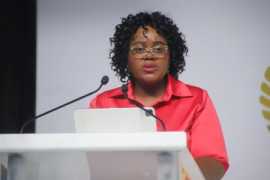
Human Settlements Minister Mamoloko Kubayi says government will be fitting solar panels to all new RDP houses being built to help mitigate the impact of load shedding.
Kubayi addressed the media on Friday on the policy changes to accelerate performance in the sector.
“Our focus this morning will be on the changes we are making to the subsidy quantum, the enhancements we are making on fully subsidised housing (Breaking New Ground, commonly known as RDPs) and our new approach to the Emergency Housing Programme,” said Kubayi.
The minister announced that they will be increasing the subsidy quantum to 29.7% for the 2023/2024 financial year, mainly to address the ever-increasing building costs effective from 1st of April.
“The adjustment will ensure that we speed up the pace of delivery and also deal with the quality of homes we provide to beneficiaries.
“BNG services and top structure will move from R196 887 to R255 364,house for persons with disabilities will move from R209 071 to R271 166, military veterans’ houses will move from R240 607 to R312 069,first home finance will move from R130 505 to R169 265 and social housing will move from R327 667 to R424 984.
The change in the quantum includes solar panels being fitted in every RDP house, burglar bars fitted for persons living with disabilities and rainwater harvesting devices in rural areas.
“Every RDP unit will be fitted with a solar kit so that these households can have access to basic electricity. This change will ensure that households who are far from electricity infrastructure can get access to electricity.
“It has come to our attention that the houses we provide to persons with disabilities are vulnerable to burglaries and other security issues. For this reason, all the units delivered to persons with disabilities will be fitted with burglar bars.
Kubayi says her department will be working closely with law enforcement agencies and community structures to avoid theft of these solar panels.
The minister also said the increase in the frequency of natural disasters and the severity of the devastation requires a Human Settlements disaster response that is swift and appropriate for alleviating the plight of the affected.
She acknowledged that the department’s response has been “underwhelming and slow”, resulting in disaster victims finding themselves without homes two to three years after disaster has struck.
Kubayi attributed the inadequate response to long delays in applications for disaster grant funding from affected municipalities and provinces due to the lack of skills for assessment of disasters at a provincial and municipal level; the dysfunctionality of municipalities due to political instability, and prolonged delays in land acquisition, which frustrates the process of temporarily accommodating people.
However, Kubayi emphasised that provinces and municipalities are expected to ensure that they still attend to all outstanding households, whose properties were destroyed in previous disasters and are yet to receive assistance, despite the municipalities and provinces having received funding for those disasters.