
By Kevin Rademeyer, Sports Journalist.
When Springboks meet All Blacks across four Tests this August and September, the contest will not drift into polite deadlock. It will be forced, by design, into resolution. That administrative detail matters more than it first appears. It sharpens intent, alters risk profiles, and nudges both coaching groups toward decisions that echo beyond eighty minutes.
SA Rugby has confirmed what purists have long argued this rivalry deserves. No shared spoils. If the series sits at two all after Baltimore, some form of tie breaker, whether extra time or sudden death, will crown a champion. In a fixture list already dense with narrative, that stipulation injects a tournament edge into what is nominally a tour.
From a South African vantage point, this will serve to test the system of resilience under Rassie Erasmus. The Springboks, double world champions and top ranked, have built a methodology that leans on territorial pressure, aerial contest, and a defensive lattice that compresses space with ruthless efficiency. Yet knockout logic demands variation. When a series cannot end level, the final Test becomes less about accumulation and more about moment capture.
Expect selection to reflect that tension. A traditional Bomb Squad split might still dominate the bench, but the composition of that seven one or six two balance could tilt toward players capable of sudden scoreboard swings. A long range goal kicker. A scrum half who accelerates tempo rather than manages it. Marginal gains become decisive when there is no tomorrow.
Across the aisle, the All Blacks arrive with a familiar warning label. As Steve Hansen has pointed out, dominance invites complacency. His language is simple but instructive. Get comfortable and you get beaten. It is not nostalgia speaking. It is a reminder that New Zealand sides, even those labelled inconsistent, possess the structural instincts to exploit overconfidence.
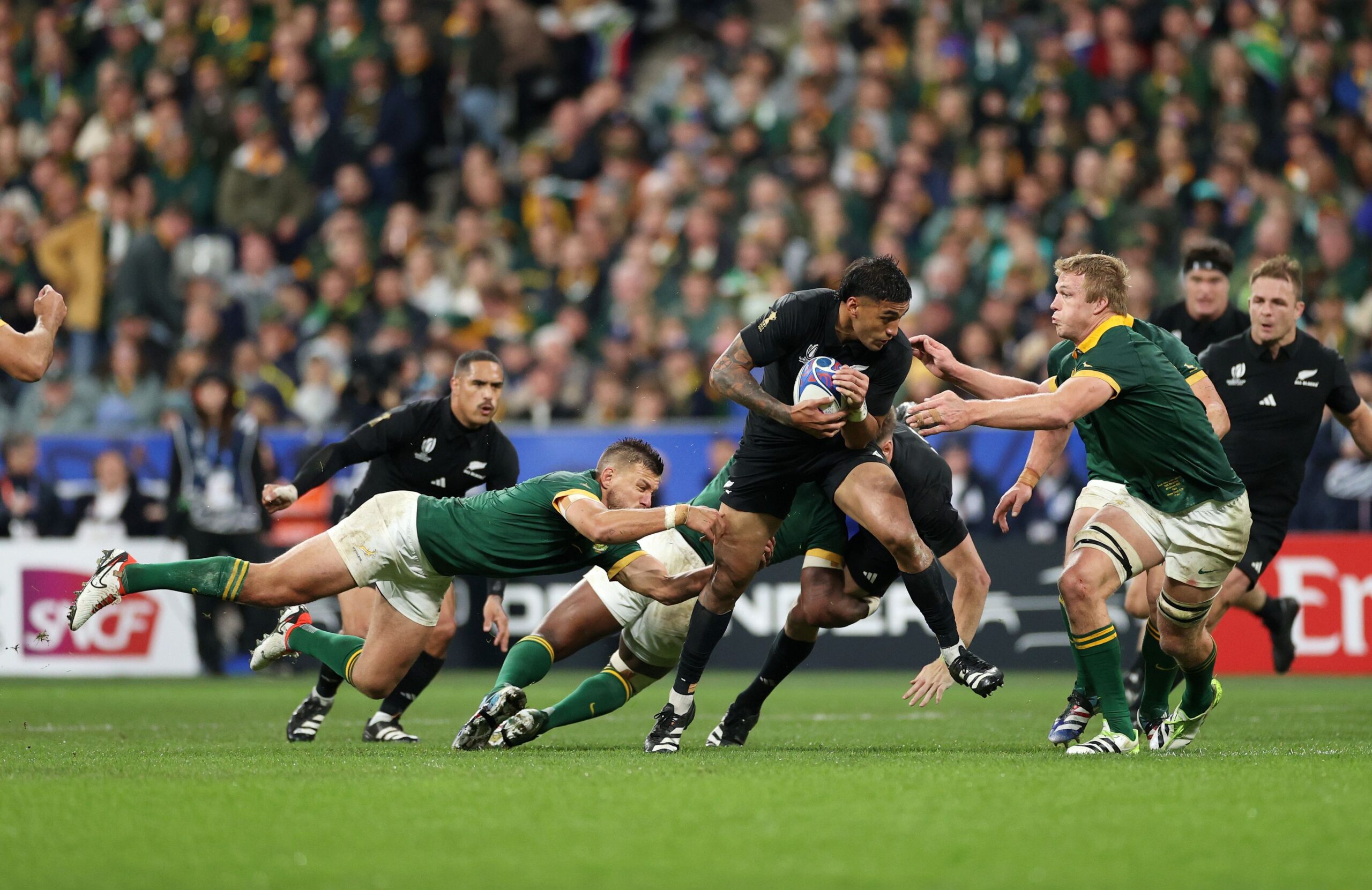
Strip away last year’s scorelines and a clearer tactical picture emerges. The Springboks’ 43 to 10 win in Wellington owed much to late game control and breakdown suffocation. But New Zealand’s attacking framework still generated line breaks when width was accessed early. The real contest, then, sits at the collision between Bok line speed and All Black distribution.
If you were diagramming it, you would isolate the first receiver channel. South Africa’s rush defence thrives on closing that gate before decision making settles. New Zealand will look to shift the point of attack one pass wider, forcing the Bok midfield to hesitate for a fraction. That fraction is everything. It determines whether a carry becomes a gain line win or a dominant tackle.
Equally, the aerial duel will shape territory. The Boks treat the high ball as both weapon and safety net. Contestable kicks are not exits. They are invitations to chaos. New Zealand’s back three must therefore balance ambition with pragmatism. Running from deep against a set chase can ignite momentum, or hand over seven points within two phases.
The series structure adds another layer. Three Tests on South African soil, at Ellis Park, Cape Town Stadium and FNB Stadium, before a transatlantic shift to Baltimore. Altitude, travel fatigue, and surface variation will all influence tactical calls. Johannesburg demands lung capacity and kicking precision. Cape Town often rewards width and tempo. By the time the teams reach the United States, physical attrition may outweigh any grand plan.
History, inevitably, frames the stakes. Since 1921 these sides have contested more than a century of rugby’s purest rivalry. Twelve series. Each nation claiming iconic away triumphs that still echo. South Africa in 1937. New Zealand in 1996. Add World Cup finals and the ledger becomes richer still. This is not just a fixture. It is a running argument about how the game should be played.
There is also a commercial subtext. Taking the decider to the United States is no accident. With the 2031 World Cup on the horizon there, rugby’s power brokers are exporting their most bankable product. And nothing travels quite like this rivalry. Physical, strategic, unpredictable. A spectacle that translates even to audiences unfamiliar with its nuances.
Yet for South African supporters, the appeal is more immediate. This is a chance to measure the current Bok cycle against the one opponent that consistently exposes its edges. Not in isolation, not in a one-off Test, but across a sustained series where adaptation is mandatory.
The absence of a draw forces honesty. Coaches cannot hide behind parity. Players cannot settle for parity. Somewhere, in Johannesburg, Cape Town, Pretoria or Baltimore, a decision will tilt the balance. A kick taken quickly. A scrum called instead of three points. A defensive read made half a second earlier.
And when that moment arrives, the team that has resisted comfort, that has kept its tactical picture clearest under pressure, will not just win a series. It will claim, at least until 2030, the loudest voice in rugby’s oldest conversation.