
Staff Reporter.
Deputy President David Mabuza said while government is not in possession of any empirical evidence linking low voter turnout in the recent local government elections to service delivery, he said leaders must listen and respond to issues raised by the people.
Mabuza said this when he fielded oral questions in the National Council of Provinces on Thursday.
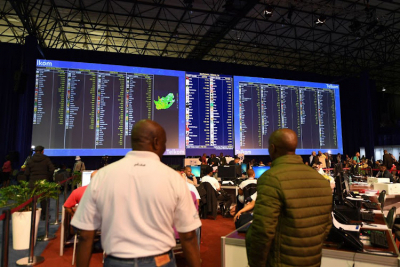
“As for low voter turnout, we are not in possession of any empirical evidence which suggests that poor service delivery especially by outgoing local government administrations, has resulted in low voter turnout during these elections.
“In fact, there are many variables including the ongoing COVID-19 pandemic and related risk-adjustment restrictions. This is a trend elsewhere in the world where elections were conducted under similar conditions.”
The Deputy President said, however, that the fact that people did participate, is an illustration of their commitment to democracy, and added that this is what government must build on.
“Having said that, it is important to point that as we were campaigning for our parties, some of the criticism levelled at us as leaders, is of our own making.
“We get preoccupied by our own responsibilities of office as members of parliament, members of the executive or as mayors and councillors, thus spending less time talking to the people and responding to their needs.”
The Deputy President said leaders must listen to the people and respond to the issues they raise that affect them at community level.
“In our view, all leaders must make themselves available to be at the service of the people and work to unite our communities.
“People are looking for collaborative approach by parties that places their needs at the centre as opposed to party agendas.
“To improve the situation, the arrogance of leadership must give way to humility.
“We continue to work hard to restore the confidence of the people by implementing municipal interventions that government has put into place.”
Mabuza also said the July civil unrests, which saw violence and looting break out in parts of Gauteng and KwaZulu-Natal, are an indication that leaders across the political divide should work together to roll-out anti-poverty programmes and promote social cohesion.
“The extent of poverty and inequality in our country especially in the affected communities of Gauteng and KwaZulu-Natal, suggests that we must work together and harder across the political divide to deepen anti-poverty programmes in order to ensure that we achieve inclusive growth and we enhance social cohesion.
“Public sentiment to the possibility of a better South Africa, should be constantly kept alive through concrete improvement to their socio-economic condition. Doing so is in our collective interest,” he said.
Mabuza said following the July unrests and violence – that led to more than 359 deaths – law enforcement agencies are still busy with investigations into all criminal acts of violence and looting that took place.
He said government was pleased that the affected provinces of KwaZulu-Natal and Gauteng are starting to normalise and businesses and logistics networks are back to full operation.
Meanwhile government’s localisation strategy is bearing fruit, and by the end of October, the Rural and Township Entrepreneurship Programme that was approved by Cabinet eight months ago had resulted in 289 products – manufactured by 45 small business – being placed on the shelves of major retailers and wholesalers.
In February 2020, Cabinet approved the Township and Rural Entrepreneurship Programme as championed by the Department of Small Business Development.
This Fund was developed as a response to the urgency of the need to roll out appropriate support to small businesses in townships and rural areas.
“Through the programme, qualifying small enterprises are provided with financial and non-financial support to empower them to run their businesses in a profitable manner and also help them to acquire business equipment, tools and machinery with a view to increase their capacity to access economic opportunities and enhance their competitiveness.
“As of 31 October 2021, 289 products manufactured by Small Medium and Micro Enterprises have been placed on the shelves of major retailers and wholesalers in the country as part of the localisation programme.
“These products were manufactured by a total of 45 small businesses, creating over 700 jobs,” he said.
The Deputy President said it is government’s vision that through the programme, more products will be locally produced by small businesses for supply to local and global markets and create more job opportunities.