
By Kevin Rademeyer, Sports Journalist.
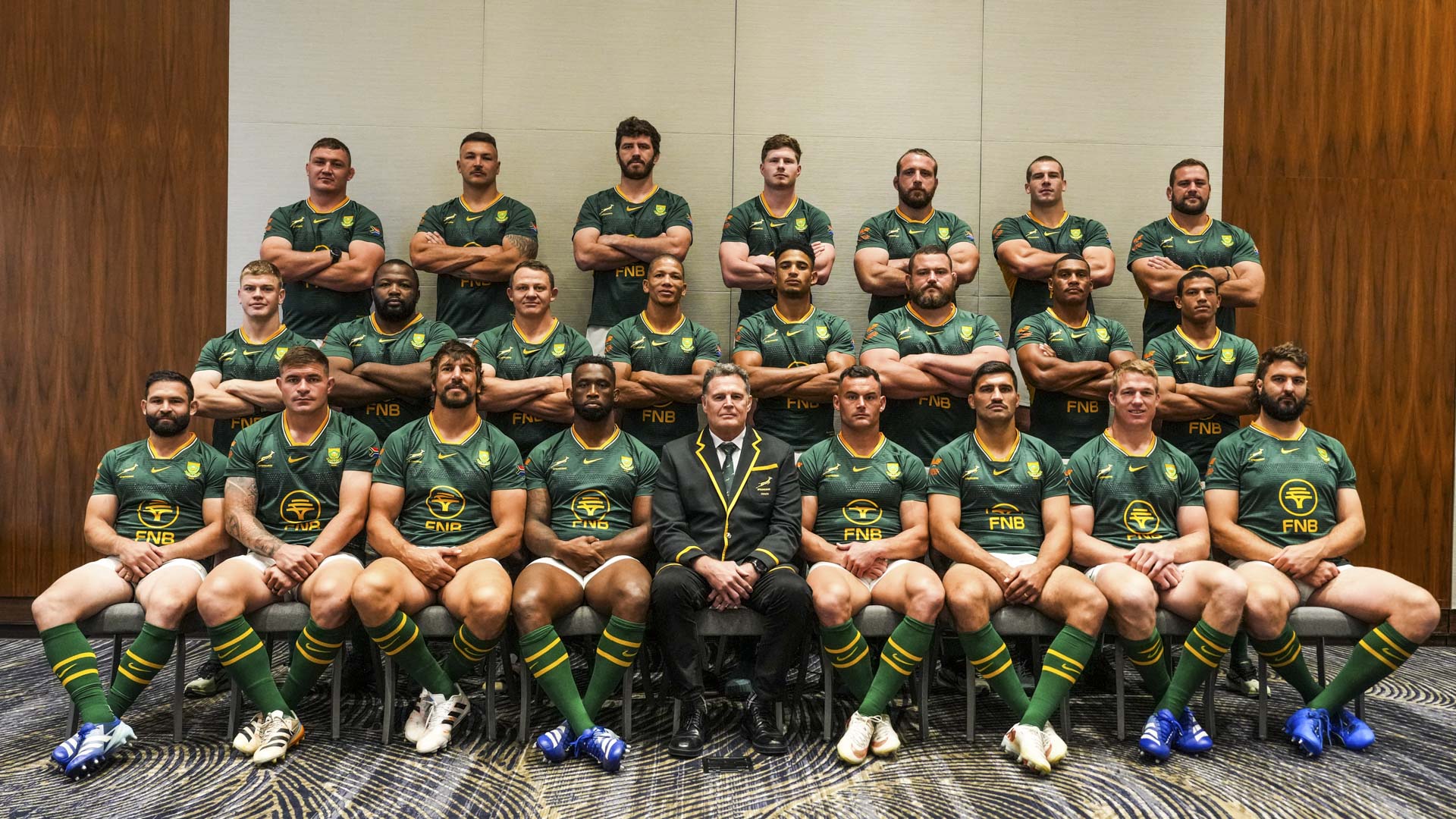
Photo Credit: SA Rugby.
The noise around the Springboks and All Blacks has followed them across the Atlantic, but by Saturday afternoon in Baltimore there will be nowhere left for either side to hide.
South Africa arrive at M&T Bank Stadium with a 2 -1 lead in the four Test Rugby’s Greatest Rivalry series. New Zealand need a victory to force a share of the spoils. The Springboks need one more win to claim the inaugural series outright.
It is a remarkably high- stakes finale for a fixture being played on neutral ground, and the 71,000-capacity crowd is expected to make it the biggest rugby attendance in American history.
For Rassie Erasmus, there is another marker. Saturday will be his 100th Test match in his two roles with South Africa, first as head coach and now as Director of Rugby.
The occasion, however, will mean little if the All Blacks have their way.
New Zealand have already shown in this series how quickly a Test can turn. Their 33- 16 victory at Ellis Park in the opening match exposed South Africa’s initial attempt to control the game through power and territory, with the All Blacks scoring five tries.
The Springboks responded with a 33- 26 victory in Cape Town before surviving another frantic contest in Soweto last weekend, winning 29- 24.
Those three matches have produced the sort of rugby that makes this rivalry different. There has been brutality, but also invention. Momentum has shifted repeatedly and neither side has been able to impose itself for 80 minutes.
Erasmus believes that may be the lesson South Africa have learned most clearly. “I think one of the biggest mistakes you can make against the All Blacks is just to try and defend,” he said. “At the end of the day you just need to outscore your opposition.”
That is more than a throwaway line. South Africa’s attacking game has developed as the series has progressed, with assistant coach Tony Brown working to give the Boks more options beyond the familiar scrum and maul.
The improvement was visible in Soweto, where South Africa were prepared to move the ball into wider channels and allow their backs to attack space rather than simply squeeze New Zealand out of the game.
“We obviously don’t just want to score maul tries or scrum tries,” Erasmus said. “We also want to use other opportunities, so we’ve been working hard at that.”
Damian de Allende, Jesse Kriel and Ethan Hooker were among the backs he singled out for praise. The intention is clear. South Africa don’t want to spend the final Test merely trying to survive the All Blacks’ attack.
They want to make New Zealand defend.
There is continuity in the Springbok selection. Erasmus has made only two changes to the side that started in Soweto. Damian Willemse returns at fullback for the injured Cheslin Kolbe, while Morne van den Berg starts at scrumhalf, with Cobus Reinach moving to the bench.
Willemse had been expected to start the previous Test before a niggle ruled him out. “He is a quality player, and he knows the guys around him very well,” Erasmus said. “It will simply be a matter of him picking up where he left off.”
Van den Berg’s promotion is reward for the impact he made from the bench in Johannesburg. It also gives South Africa another scrumhalf capable of injecting pace into what promises to be a demanding final quarter.
New Zealand have responded by bringing Richie Mo’unga into the starting side at flyhalf, a selection the Springboks expected and one which changes the shape of the challenge facing them.
Mzwandile Stick believes the All Blacks will be even more adventurous with the ball. “Richie is world class and we know him well,” he said. “I think the All Blacks are going to be even more bold tomorrow when it comes to keeping the ball alive and using the wide channels.”
That threat is precisely why the Springboks have spent the week insisting on physicality first. Siya Kolisi, who will win his 107th Test cap, knows that New Zealand will arrive desperate and that desperation can make an already dangerous opponent even more difficult to contain.
“We definitely want to win the series,” Kolisi said. “We don’t want to draw it.”
“For the captain, the four Test series has become something approaching a sequence of World Cup finals. “In my experience, it doesn’t get tougher than this,” he said. “It’s like playing four Rugby World Cup finals in as many weeks given the quality of both teams.”
There is another layer to the occasion. The Springboks have been struck by the number of South Africans who have travelled to Baltimore from across the United States.
Stick described the sight of green and gold around the team hotel as a reminder that this is not simply an exhibition match in a foreign market.
“There are a lot of South Africans here and the vibe is great,” he said. “Everywhere you go around the hotel you see green and gold and people are proud to see us, so we want to make sure we represent them and put up a good show.”
The commercial dimension is impossible to ignore.
Taking the series decider to the United States is expected to generate about $8 million more for the two unions than staging the match in South Africa. Around 70,000 spectators are expected at the home of the Baltimore Ravens, with average ticket prices reported at about $200.
South African Rugby chief executive Rian Oberholzer has been blunt about the reason for making the move. “This game was always about finding an option where we could make as much financial gain as we could,” he said. “At SA Rugby, it is essential that we keep working on our financial stability. To do that, we have to take our brand wider than South Africa.”
For World Rugby, Baltimore is about more than one lucrative afternoon.
The United States will host the 2031 men’s Rugby World Cup and the 2033 women’s tournament. Alan Gilpin, World Rugby’s chief executive, sees Saturday’s fixture as a valuable test of whether elite rugby can work commercially in the American sports market.
A sellout would provide a useful answer.
Gilpin has also floated the possibility of taking major Six Nations matches to the United States, pointing to cities such as Boston and New York where large Irish and Italian communities could create an immediate audience.
That makes Saturday’s match an experiment as well as a decider. The rugby has to be compelling. The occasion has to work. The business case has to survive contact with reality.
Yet none of that will matter to Kolisi once the whistle goes.
The Springboks have heard the talk around the series, the money and the American expansion. Their captain insists their attention remains narrower.
“What matters within our circle is what we want of each other, “he said. “What is said outside doesn’t really matter because we do what works for us, and we know who we are.”
That certainty will be tested by an All Blacks side that has already proved it can punish the slightest lapse.
South Africa lead 2 -1. New Zealand have nothing to lose and everything to gain. They have the chance to split the trophy and claim the world number one title. The world champions surrendered top spot after losing the series opener at Ellis Park, before regaining and then retaining it with wins in Cape Town and Soweto.
The Boks currently hold a 2.43-point lead over the All Blacks and will extend it to 3.94 with a win by between one and 15 points at M&T Bank Stadium in Baltimore on Saturday, or to 4.70 with a victory by 16 points or more.
An All Blacks win by any margin would see them return to No 1. A victory by between one and 15 points would give them a 0.06-point lead over the Boks, while a win by 16 points or more would extend that advantage to 1.30.
After three Tests in which the margin between triumph and collapse has been so thin, Baltimore has the feel of a final that needs no embellishment.
Veteran centre Anton Lienert-Brown knows the key to victory for the All Blacks in Saturday’s Rugby’s Greatest Rivalry finale will come down to the “small margins”.
“We can all see it comes down to small margins. In the last two Tests they’ve had the rub of the green at that; they’ll probably say the same thing about Ellis Park,” he told reporters. “Even though we ended up winning by a big margin, it really was small margins, so we expect nothing less this weekend.”
All Blacks lock Patrick Tuipulotu reiterated how important this match is to both teams. “This isn’t a dead-rubber game. I think for us, it’s still … we don’t want them to win the whole series, you know,” Tuipulotu said on levelling matters and sharing the spoils.
“We’re obviously aiming for a draw, and they’re aiming for a series win. So we’ve got to win this. This is a must-win for us.”
The test is huge and the defining test for the year. It is the All Blacks’ chance to level the series. It is the Springboks’ chance to finish it.
Kick- off : 23h00 in South Africa.
Fullview prediction: Springboks by 12
SPRINGBOKS – 15 Damian Willemse, 14 Kurt-Lee Arendse, 13 Jesse Kriel, 12 Damian de Allende, 11 Ethan Hooker, 10 Sacha Feinberg-Mngomezulu, 9 Morné van den Berg, 8 Jasper Wiese, 7 Pieter-Steph du Toit, 6 Siya Kolisi (c), 5 Ruan Nortjé, 4 Eben Etzebeth, 3 Wilco Louw, 2 Malcolm Marx, 1 Ox Nché.
Bench: 16 Deon Fourie, 17 Gerhard Steenekamp, 18 Thomas du Toit, 19 Lood de Jager, 20 André Esterhuizen, 21 Cameron Hanekom, 22 Cobus Reinach, 23 Manie Libbok.
All Blacks – 15 Damian McKenzie, 14 Will Jordan, 13 Anton Lienert-Brown, 12 Jordie Barrett, 11 Josh Moorby, 10 Richie Mo’unga, 9 Cam Roigard, 8 Peter Lakai, 7 Ethan Blackadder, 6 Tupou Vaa’i, 5 Sam Darry, 4 Patrick Tuipulotu, 3 Fletcher Newell, 2 Codie Taylor (c), 1 Ethan de Groot.
Bench: 16 Asafo Aumua, 17 Xavier Numia, 18 Tyrel Lomax, 19 Josh Lord, 20 Wallace Sititi, 21 Kyle Preston, 22 Rieko Ioane, 23 Beauden Barrett.