
By Lehlohonolo Lehana.
Political Parties are under pressure to conclude negotiations and reach an agreement to consider the offer to become part of a government of national unity.
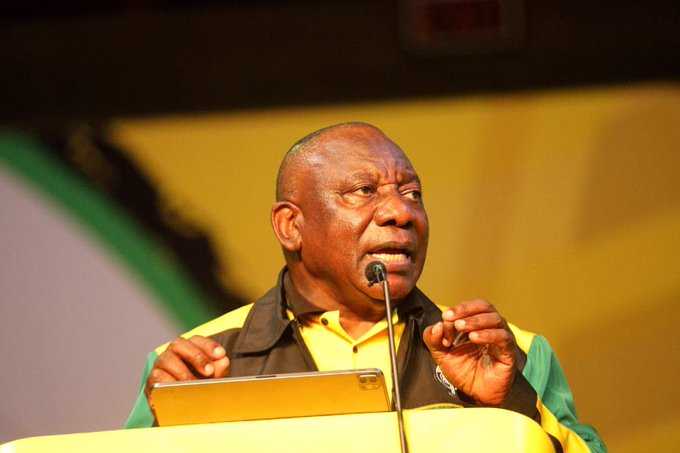
On Thursday night, President Cyril Ramaphosa has announced that his African National Congress (ANC) party will seek a national unity government, which he said would reflect the will of voters and help move the country forward.
Ramaphosa made the announcement late on Thursday after an hours-long meeting of the party’s National Executive Committee (NEC) in Johannesburg, where ANC leaders held talks to try to agree on a post-election strategy.
ANC failed to secure a majority in last week’s highly contested election, but some opposition parties are already rejecting the party’s offer because of deep-seated divisions.
The Democratic Alliance (DA) has signalled that it did not want to join a government that will include Umkhonto weSizwe Party (MKP) or the Economic Freedom Fighters (EFF).
DA national spokesperson Werner Horn made it clear that they would not work with MKP and the EFF because of their policies.
Horn said avoiding the two parties is to protect private property.
The DA wanted details on how the government of national unity will operate in its next meeting with the ANC.
The DA’s framework document for negotiations with the ANC sets out that the party will be interested in a governance agreement if it is based on crucial tenets of the Constitution.
According to the document, which will be used as the point of departure in Friday’s first official meeting between the ANC and the DA, the country’s supreme law must guide any governing arrangement.
The DA also proposes an operating model to guide the functioning of a multi-party government, including a dispute resolution mechanism.
Inkatha Freedom Party (IFP) National Spokesperson Mkhuleko Hlengwa says it is abundantly clear that difficult choices and political considerations of material consequences of the country are upon us.
He says in light of Thursday’s announcement by the ANC the IFP Coalitions Task Team resolved to give them more space and time to apply its mind and consult further.
Hlengwa said the IFP will broaden the scope of its engagement with other parties.
He says the IFP is not opposed to a GNU and remains committed to giving this matter of national importance the priority attention it deserves by putting South Africa first.
“The devil is in the details, which will become clearer in the coming days thus enabling the IFP to make a well-considered decision” he said.
ActionSA has already declared it won’t be part of the negotiations, saying that it refuses to work with the ANC.
Other small grouping which include Bosa, UDM, ACDP, PAC and UAT, says that political parties should convene a meeting that will address the challenges of the envisaged government and give fulfilment to the constitutional inheritance as enshrined in the founding pillars of the constitution and by extension, the Constitutional Court.
“Given the new terrain where no one party has an outright mandate to form a government, it is imperative that a critical meeting be convened promptly.”
This meeting must serve as a platform for fostering a transparent collaborative agenda for South Africa.
Meanwhile EFF leader Julius Malema took to “X” on Thursday calling the ANC arrogant as they continue even after the South African voters issued warning signs.
“You can’t dictate the way forward like you have won elections. We are not desperate for anything, ours is a generational mission.
“We can’t share power with the enemy,” he said.’
EFF deputy president Floyd Shivambu said as far as the Red Berets are concerned, the DA and, what he calls white minority parties, represent the apartheid system.
He said they will not endorse a government deal that has the same makeup as in 1994, which handed former apartheid leaders key ministerial positions.
“If you were to check the outcomes of that government of national unity of Nelson Mandela, it had FW de Klerk as an executive deputy president, Pik Botha as the minister of minerals and energy, Andre van Niekerk as the minister of agriculture, and even in social development, it had a minister from the apartheid establishment. We don’t want to form any part of a government with representatives of the white colonial and apartheid system.”
The EFF is adamant it will not form part of a government with the DA and Freedom Front Plus as deliberations on the formation of a GNU are set to begin in earnest.
South Africa has been struggling with sluggish economic growth, high levels of poverty and unemployment, a persistent racial wealth divide, severe power shortages and political corruption.
The election outcome has created a complex situation for the ANC, which will have 159 of the 400 seats in the new National Assembly – down from 230 in 2019.
The ANC’s nearest rivals are the pro-business, white-led Democratic Alliance (DA), with 87 seats, the populist uMkhonto we Sizwe (MK), led by former President Jacob Zuma, with 58, and the hard-left Economic Freedom Fighters (EFF) with 39.
MK Party confirmed in a statement on Thursday that “engagements with the [ANC] have indeed taken place regarding the coalition discussions”.
“A meeting is expected to take place soon, where the MK Party will hear the views presented with an open mind,” it said.
The new parliament has to convene within two weeks of Sunday’s results declaration and one of its first acts must be to elect the president.
The constitutional deadline, which will fall on or near June 16, is putting pressure on the ANC and others to reach an agreement quickly.