
By Lehlohonolo Lehana.
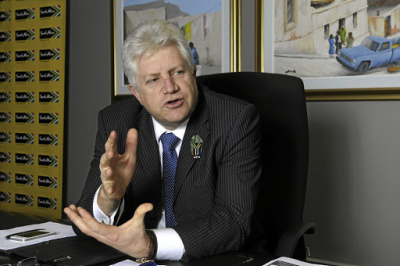
Public Protector Busisiwe Mkhwebane found that both Western Cape Premier Alan Winde and his MEC Anton Bredell were in breach of the executive ethics code over their handling of issues at the Oudtshoorn local municipality.
This centres around allegations that Winde had failed to act on serious claims made against Western Cape local government MEC, Anton Bredell, by the former mayor of the Oudtshoorn Local Municipality, Colan Sylvester.
GOOD member of the provincial legislature (MPL) Brett Herron, lodged the complaint with Mkhwebane’s office in July last year against the premier and the MEC.
He alleged that in March 2019, Sylvester alerted Bredell to several allegations of maladministration, fraud, corruption and financial misconduct at the municipality in a letter. But Bredell only responded to the letter on 22 January 2020 after the mayor had commissioned an independent investigation into the allegations.
Herron also claimed that on 12 December 2019, Bredell addressed the municipality’s DA councillors proposing that they should agree to the Western Cape government placing Oudtshoorn under administration.
Sylvester, the former mayor, on 6 March 2020, allegedly wrote a letter to Winde, in connection with the conduct of Bredell.
According to Herron, Winde was obligated to “conduct an enquiry in terms of section 2.2 [sic] of the Executive Ethics Code, taking into account the promotion of an open, democratic and accountable government”.
In her report, Mkhwebane said some of the allegations against Winde were not substantiated.
“We found the allegation that the premier failed to act on the allegations against the MEC, contained in the letter addressed to him by the former executive mayor of the municipality, was not substantiated.
“The same allegations became the subject of an investigation by the Public Protector, in terms of the Executive Members’ Ethics Act, when a complaint of a breach of the Executive Ethics Code was lodged on 2 July 2020. I will deal with that matter shortly,” she said.
Mkhwebane said they found the statements made by the premier to Parliament’s Portfolio Committee on Cooperative Governance and Traditional Affairs on 23 June 2020, in connection with the proposal made by Bredell to DA councillors of the municipality on 12 December 2019, that they should agree the municipality be placed under administration, were improper.
Winde’s statement to the portfolio committee, supporting the conduct of the MEC, were not in accordance with the Constitution and legislation regulating the intervention by a provincial government in a municipality, as well as the practice of political negotiation and agreement as submitted by him.
Mkhwebane said:His statements were, therefore, not in the best interest of good governance and not consistent with what is expected of a person in the position of a premier. He, therefore, acted in breach of section 136(2) (b) of the Constitution and paragraphs 2.1(c) and (d), and 2.3(c) of the Executive Ethics Code.
To remedy the breach, Mkhwebane said the president must, in terms of section 3(5)(2)(b) of the Executive Members’ Ethics Act, submit a copy of the report and any comments thereon to the National Council of Provinces within a reasonable time, but not later than 14 days after receiving the report.
Winde’s spokesperson, Cayla Murray, said Winde had not seen the Public Protector’s report. He had only learnt of its content via the media.
“Once it has been received by his office, it will be considered, and only then determine a way forward,” she added.
Meanwhile, the Public Protector found that Bredell failed to take timeous, appropriate action in connection with the allegations of improper conduct against officials of the municipality, when he was requested to do so by the former executive mayor on 11 March 2019.
“To remedy this breach of the Executive Code of Ethics, the premier of the Western Cape must, in terms of section 3(6) of the Executive Members’ Ethics Act, within a reasonable time, but no later than 14 days after receiving this report, submit a copy thereof and any comments thereon, together with a report on any action taken or to be taken in regard thereto, to the Western Cape Provincial Legislature,” Mkhwebane said.
Mkhwebane also found that there was an “undue delay” in the investigation conducted by the Independent Regulatory Board for Auditors (IRBA) as part of the “Please call me” against Vodacom.
Read the full report here:An investigation into allegations of breach of the executive Ethics Code.
Nkosana Makate lodged a complaint with the Public Protector against IRBA.
For more than a decade, Makate has been in a fight with Vodacom to get compensation for creating its “Please Call Me” feature.
In 2016, the Constitutional Court ruled that Vodacom had to enter into negotiations with Makate to find fair compensation.
Vodacom offered R47 million, but Makate wants more than R10 billion. The North Gauteng High Court in Pretoria still needs to rule about what the amount should be.
In 2018, Makate requested IRBA to investigate various accounting problems at Vodacom. IRBA is a body that oversees the accountancy profession.
Unhappy with IRBA’s progress, Makate turned to the Public Protector with a complaint about the delays by the IRBA.
“We found that, indeed, there was an undue delay on the part of the IRBA to finalise their investigation into Mr Makate’s complaint,” the Public Protector’s office found.
It found that IRBA failed to allocate the case file to the investigator within a reasonable time – it only happened after more than 22 months.
“That was close to two years after receipt of the complaint. Such a long delay is considered to be unreasonable, and constitutes maladministration. The IRBA lacks adequate internal processes and service standards in which investigation timelines are prescribed and it further failed to implement proper processes to ensure speedy resolution of complaints,” the Public Protector found.
“It is, however, acknowledged that the investigation — from the time the matter was allocated to a Senior Investigator for investigation — was conducted and finalised within a reasonable period.” The investigation was concluded in January 2021.
The Public Protector ruled that IRBA must develop a new procedure manual and service standards to conduct investigations within 90 days.
Read the full report here: Investigation into allegations of undue delay and/or improper conduct by the IRBA.