
By Estea Rademeyer, Sports Journalist.
Photo Credit: CSA.
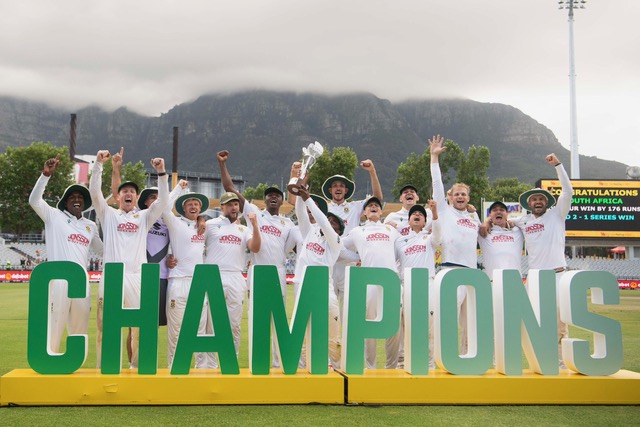
Temba Bavuma could barely contain his satisfaction after South Africa completed a 176 run victory over Australia at Newlands. It was not simply the result that pleased him. It was the manner in which his team had earned it.
“I have not been in a better series than this,” the captain said after the Proteas secured the third Test and a 2-1 series win. “We will celebrate everyone’s performance and the team’s performance.”
There was plenty to celebrate. South Africa had been pushed hard across three Tests, found themselves in difficult positions and repeatedly had to rely on players willing to take responsibility.
By the end of the Newlands decider, they had shown why their status as the world’s top ranked Test side is about more than individual reputations.
The final day belonged to Kagiso Rabada and Simon Harmer. Australia began their chase of 288 with a realistic chance of making South Africa work for the victory. Rabada quickly removed Matt Renshaw, Marnus Labuschagne and Travis Head, leaving the visitors reeling. Harmer then took control, exploiting the turn and bounce to claim six for 16 and complete his first ten wicket match haul in Test cricket.
Harmer had the final say on Day five when asked about his expectation at the start of the day “I think it was just dealing with the expectation, putting that to one side, and understanding what I needed to do, getting the ball in the right areas as often as I could”.
That’s exactly what he did, as Australia were bowled out for 111. The result was emphatic, but the work that made it possible had begun a day earlier, when Ryan Rickelton and Wiaan Mulder refused to let the match drift away from South Africa.
At the close of the third day, the Proteas were effectively 40 for four in their second innings.
Temba Bavuma had been bowled by Nathan Lyon, and Australia appeared to have the match firmly in hand. South Africa needed a partnership that could change the direction of the game. Rickelton and Mulder supplied it.
Rickelton’s 101 from 218 balls was an innings of patience and judgement. He resisted Australia’s short ball tactics, accepted the physical punishment when necessary and kept his focus on the partnership. Mulder made 115 from 221 deliveries, demonstrating a level of concentration that was crucial to South Africa’s recovery.
Their 154 run stand for the sixth wicket transformed the contest. South Africa were eventually dismissed for 387, setting Australia 288 to win. The partnership was not built on spectacular strokeplay.
It was built on an understanding of the situation and a willingness to stay at the crease long enough to make Australia’s bowlers work.
Rickelton spoke afterwards about the importance of keeping Mulder focused as the pressure mounted. “We had to be willing to absorb for a long period of time,” he said. “It can get frustrating sometimes when you’re not scoring. So, it was to emphasise a lot on that with Wiaan and with Matty Breetzke as well: ‘Just hang in there, hang in there. The runs will come.'”
That determination has become a defining feature of this South African side. They are not a team built around a collection of household names, but they have developed a strong sense of collective responsibility. Rickelton and Mulder’s partnership was one example. Rabada and Harmer’s work on the final morning was another.
“We’re not a team packed with massive names or superstars, but we swim hard for each other and we fight hard for each other,” Rickelton said. “We really try to do right by each other as well.”
It is a useful description of a side whose strength has often been found in unexpected places. Bavuma has continued to establish himself among the leading batters in world cricket, while Rabada has added another extraordinary milestone to his career by becoming the quickest bowler to reach 350 Test wickets.
Jansen has developed into one of the world’s most formidable fast bowlers and the premier all rounder.
Harmer, returning to the Test side, delivered the kind of performance that will be remembered long after this series.
The numbers tell part of the story. Mitchell Starc finished as the leading wicket taker in the series with 15, followed by Harmer on 14 and Jansen on 13.
Renshaw topped the run charts with 369, ahead of Bavuma on 218 and Head on 210. But the series was not decided by statistics alone. It was shaped by the ability to respond when momentum shifted.
Jansen described the contest as an exhausting but rewarding experience. “Yeah, very intense, very a lot of pressure, a lot of ebbs and flows, ups and downs,” he said. “Very proud of the boys and how we performed and how we got ourselves into and out of tough situations.”
That was evident in the way South Africa recovered from their first innings position at Newlands. Australia had posted 429, taking a 100 run lead, and South Africa were forced to fight their way back into the match. The centuries from Rickelton and Mulder gave them the opportunity. Rabada and Harmer made sure it counted.
For Australia, the defeat was a bitter end to a series in which they had enjoyed periods of control but failed to sustain them. Cummins acknowledged that South Africa’s fourth innings batting had made the chase difficult, particularly after the partnerships on the fourth day.
South Africa’s victory also completed a successful limited overs campaign against Australia, having won the ODI series 2-1, including the Pink Day match.
The Test triumph gave the Proteas a second series victory over the visitors and reinforced the sense that this group is developing a distinct identity. They have returned to the number one spot in the rankings and second on the ICC World Test Championship log.
The series will be remembered for a long time. The pitches provided a compelling contest between bat and ball, while the players produced performances that shifted the series at crucial moments. There was no shortage of pressure, and neither side was allowed to coast. South Africa simply found more ways to respond.
Bavuma’s pride was understandable. His team had shown grit, determination and a willingness to fight for one another, even when the match appeared to be slipping away.
The Newlands victory was not the product of one star or one session. It was the result of a collective effort, with different players stepping forward at different stages.
The Proteas leave this series with a 2-1 Test victory, a 2-1 ODI victory and a growing belief in what this group can achieve. Their most valuable quality may be the one that is hardest to measure: when the pressure rises, they do not wait for someone else to rescue them. They find a way to fight back.