
By Estea Rademeyer, Sports Journalist.
Photo Credit: CSA.
South Africa had their moments on the second day at Newlands, but they could not turn them into a sustained assault.
By stumps, Australia had moved from a precarious 66 for two to 330 for four, edging one run ahead of the Proteas and placing themselves in control of the deciding Test.
The hosts had entered Wednesday with the advantage of Mitchell Starc’s extraordinary six wicket burst, which had brought South Africa’s first innings to an end at 329.
Yet the Proteas’ attack lacked the fire and consistency required to capitalise on that work, allowing four Australian batters to make half centuries and leaving Josh Inglis and Alex Carey unbeaten at the close.
Inglis was the outstanding figure, reaching 85 not out from 111 deliveries in his return to Test cricket.
He had not played a red ball match since March and missed the opening two Tests with a finger injury. Initially subdued, he gradually found his timing and began to take control, while Carey’s unbeaten 51 provided the stability Australia needed after a pair of wickets had briefly brought South Africa back into the contest.
The innings was a lesson in patience for a Proteas side that had lost its own concentration at a crucial point on the first day. South Africa had reached 158 without loss before collapsing to 329 all out, with Starc taking four wickets in six deliveries late in the innings. Australia were more measured on Wednesday.
They weathered the pressure, rotated the strike and punished loose deliveries rather than allowing the innings to unravel.
Simon Harmer gave South Africa hope in the morning, bowling Travis Head for 41 before removing Marnus Labuschagne for a duck.
Head once again fell chopping the ball onto his stumps, while Labuschagne’s brief stay did little to quiet the questions surrounding his place in the Australian side.
At 66 for two, the Proteas had an opening. But Matt Renshaw and Cameron Green took the game away from them with a 126 run partnership that demonstrated the value of concentration on a surface offering limited assistance to the seamers.
Renshaw made 74 and Green 65. Both had difficult moments, and South Africa believed they had Green caught at second slip on 22, only for replays to show the ball had bounced short. Renshaw survived a review for leg before wicket on 49 when ball tracking showed the delivery clipping the bails, leaving the on field decision in place.
Those reprieves proved expensive. Green countered Kagiso Rabada’s short ball barrage with a series of aggressive strokes, while Renshaw continued to work the ball into the leg side. The pair reached their half centuries in consecutive deliveries and looked set to bat through the afternoon until Marco Jansen intervened.
Jansen removed Renshaw, caught behind attempting to upper cut a short ball, and then found Green’s outside edge four deliveries later. It was a significant double strike, and Jansen’s dismissal of Renshaw also brought up his 100th Test wicket.
But the Proteas could not build on it. Inglis and Carey settled into a partnership that grew in confidence as the final session progressed. Carey was nearly run out after a mix up, but Marques Ackerman’s throw missed the stumps.
Inglis then began to take on Harmer, including a clean strike over deep midwicket for six, and finished the day within reach of a second Test century.
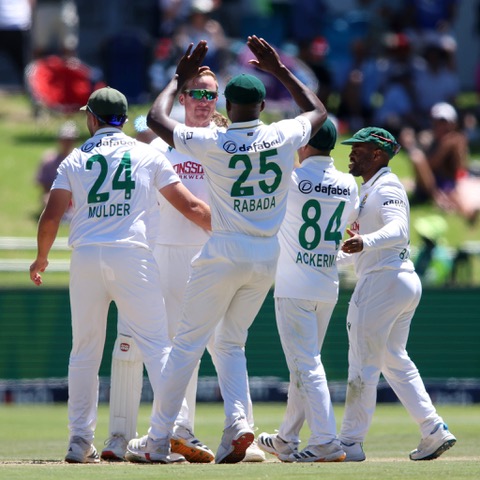
Rabada’s figures of none for 81 from 18 overs reflected South Africa’s broader problem. The pace attack could not find the movement or sustained accuracy that Starc had produced late on Tuesday. Harmer took two wickets for 84, while Jansen also finished with two, but too much of the responsibility fell on the spinner to create chances.
The surface is expected to turn more sharply and become harder to bat on over the fourth and fifth days. South Africa may rue the decision to field only one specialist spinner, particularly if Australia build a substantial lead and force the Proteas to bat under increasing pressure later in the match.
Jansen’s rise to the top of the ICC Test bowling rankings, announced on Wednesday, has been deserved recognition of his impact in the series.
He took five for 33 in the second Test at Gqeberha and contributed 85 runs in South Africa’s victory there. His two wickets on Wednesday again showed how important he is to the attack, but he needs greater support from Rabada and the other seamers.
The Proteas now need early wickets on Thursday. Inglis is well set, Carey has shown he can occupy the crease, and Australia have already erased South Africa’s first innings advantage.
If the hosts allow the partnership to continue, they will be left trying to recover on a pitch expected to offer more assistance to spin as the match wears on.
A lead of over 100 could possibly end all hopes of the Proteas winning the series in South Africa and moving to number one on the World Test Championship Table.
South Africa’s problem is not simply the one run deficit. It is the missed opportunity to take control after dismissing Australia’s top order. On a day when patience was rewarded, the visitors showed more of it. The Proteas will need to respond quickly if they are to prevent that difference in application from deciding the Test.