
By Kevin Rademeyer, Sports Journalist.
Analysis – The unbeaten march of the Proteas has brought them to a familiar yet transformative moment. On Wednesday at the storied Eden Gardens in Kolkata, South Africa confront both New Zealand and a history that has shadowed them for decades.
A place in the T20 World Cup final beckons. So too does a chance to redefine a narrative that has clung stubbornly to South African cricket. For years, the Proteas were cast as serial underachievers on the global stage. Now, under the assured leadership of Aiden Markram and the steely oversight of Shukri Conrad, they arrive at the semi final as the tournament’s only unbeaten side.
This is no accident. It is the product of strategic clarity, ruthless execution and a squad fortified by recent silverware.
Momentum and Maturity
South Africa’s 7 and 0 record is more than a statistic. It is a declaration of intent. No team has completed a T20 World Cup campaign with a flawless win rate. Sustaining that invincible aura under the pressure of a knockout, however, presents a psychological and tactical examination.
The Proteas have been clinical across departments. Their bowling unit has operated with pace and precision. Their middle order has balanced aggression with composure. Their fielding has been sharp, athletic and unrelenting.
Markram himself has been emblematic of this equilibrium. With 268 runs at an average north of 53 including a strike rate of over 175, he has combined complete authority with needed restraint. He requires just 36 runs to break the record for the most runs by a captain in a single T20 World Cup edition.
Records, though, are secondary to legacy. “We want to be favourites,” Conrad said this week. “The quality of our performances warrants it.” It is a marked shift in tone. South Africa are no longer deflecting expectation. They are embracing it.
The Ghosts of Knockouts Past
The Proteas’ relationship with ICC semi finals is complex and, at times, painful. From rain affected heartbreaks to tactical miscalculations, from the infamous Duckworth Lewis confusion to moments of inexplicable collapse, the catalogue is well documented.
The “C word” has followed them. As for the “C word”, there is another one for it: cupcakes,” Conrad remarked, disarming the narrative with wry humour. “We kind of enjoyed that.” His approach is confrontation rather than avoidance.
Conrad was not present during South Africa’s agonising defeat in the 2024 T20 World Cup final, when they fell seven runs short against India despite needing only 26 from the last four overs with six wickets in hand. Yet eight members of that World Test Championship winning side remain in this squad, hardened by that experience.
“Well, I wasn’t there,” Conrad noted when asked what separates this side from its predecessor. “But our experience of the last T20 World Cup will stand us in good stead.” The subtext is clear. This group carries scars, but also resilience.
History and Recent form
South Africa’s authority over New Zealand was underlined earlier in the tournament during their pool stage meeting, when the Proteas delivered one of the most complete performances of the competition.
Chasing 176, Markram’s unbeaten 86 anchored a composed yet assertive pursuit, completed with 17 balls to spare in a seven wicket victory.
Marco Jansen’s incisive 4 for 40 had earlier fractured Black Caps’ middle order, exposing technical frailties against high pace and steep bounce. That result not only extended South Africa’s winning run but planted a psychological marker ahead of the semi final, reinforcing their tactical superiority in both phases of the game.
History in ICC knockout cricket between the two sides, however, tells a more sobering story for the Proteas. New Zealand have prevailed in two of their most painful eliminations, most famously in the 2015 ODI World Cup semi final in Auckland, and again in subsequent global events where the Black Caps’ senior core outmaneuvered South Africa under pressure.
The Proteas are yet to defeat New Zealand in a World Cup knockout fixture across formats, a statistic that adds historical tension to Wednesday’s contest. While this current South African side arrives unbeaten and statistically dominant, the ledger of past ICC knockouts lends the semi final an added layer of narrative gravity.
Tactical Chess on a Turning Track
The toss at Eden Gardens could prove decisive in shaping the semi final’s strategic tempo. With evening dew expected to settle and the outfield renowned for its pace, the captain who calls correctly is almost certain to bowl first.
The moisture makes gripping the ball increasingly problematic for spinners and death bowlers alike, while the slick surface turns well timed strokes into instant boundaries, making run containment a formidable task. Yet the dynamic cuts both ways. In a knockout contest, chasing under lights carries its own psychological tax.
Even with conditions favouring stroke play, the weight of a semi final scoreboard can distort decision making, tighten technique and amplify risk. The side batting second may benefit from the dew, but they will shoulder the full burden of expectation as the target crystallises in front of them.
Conditions at Eden Gardens have favoured spin in recent matches, introducing a compelling subplot. New Zealand’s twin threats in Rachin Ravindra and Mitchell Santner have operated with superior economy rates to South Africa’s frontline spinner Keshav Maharaj. If the surface grips and slows, the Black Caps possess a pathway to parity.
Ravindra represents a dual menace. A leading wicket taker for New Zealand and a composed top order batter, he embodies the modern all round asset. Glenn Phillips offers similar versatility, capable of delivering tight overs of off spin before clearing the ropes from ball one.
Yet South Africa’s seam arsenal has been relentless. Lungi Ngidi, with 12 wickets at an average under 14, has been incisive at the death. Marco Jansen’s 4 for 40 dismantled New Zealand in the group stage. Corbin Bosch has emerged as the tournament’s breakout pace revelation.
He may however lose his place to allow the Proteas to have extra spin option in George Linde. Add the experience of Kagiso Rabada and the Proteas possess a pace cartel equipped for high stakes.
The powerplay battle could prove decisive. South Africa have claimed three or more wickets inside the first six overs in three of their last four matches. Should Jansen and Rabada prise out Finn Allen and Tim Seifert early, New Zealand’s middle order will be exposed to scoreboard pressure.
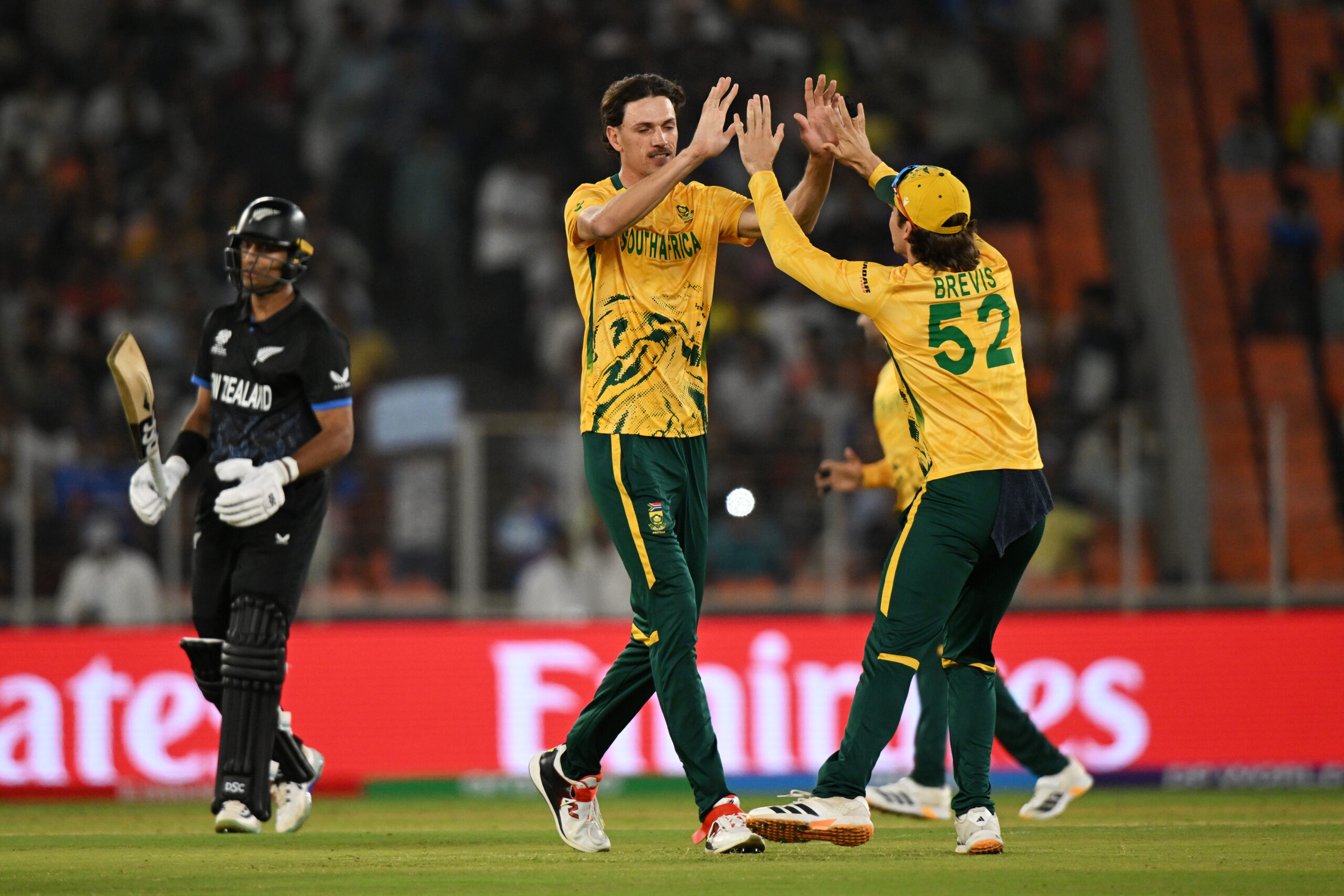
Conversely, Dewald Brevis has injected volatility at the top for South Africa. Nicknamed Baby AB, his fearless striking in the power play has allowed Markram to anchor with calculated assurance.
The Black Caps Conundrum
New Zealand’s route to the semi final has been less emphatic. They required net run rate to edge into the final four after defeats to England and India in the Super Eight stage. Yet their pedigree in knockout cricket commands respect.
They have ended South Africa’s campaigns before, most memorably in the 2015 ODI World Cup semi final. More recently, their senior players outperformed the Proteas in Champions Trophy and World Cup encounters. They are tactically disciplined, emotionally composed and unburdened by external noise.
Mitchell Santner’s side thrives on marginal gains and situational awareness. They are adept at absorbing pressure and exploiting lapses. Against an opponent carrying the weight of expectation, that composure can be weaponised.
A Defining Opportunity
Beyond Kolkata lies the possibility of a final in Ahmedabad. India, the defending champions, await England in a blockbuster second semi final in Mumbai. The prospect of a rematch with India, in front of 1300 000 screaming fans, two years after heartbreak in Barbados, adds narrative symmetry.
This semi final is less about exorcising demons and more about consolidating evolution. The World Test Championship triumph last year provided validation. It proved that South African cricket can close. Yet limited overs global silverware remains elusive.
“Our practices are whatever the individual requires,” Conrad said. “If there is a need to have a conversation around the psychological part of the game, then we will have that. But I don’t think it is necessary. It’s just business as usual.” Business as usual has yielded seven wins. Business as usual must now withstand the most searching examination.
For the Proteas, Wednesday is not merely another fixture. It is a referendum on identity. Invincibility, leadership records, historical baggage and tactical nuance converge under the lights at Eden Gardens.
Win, and they move within touching distance of a maiden T20 World Cup crown. Lose, and the old questions will resurface with renewed volume. In Kolkata, South Africa have the chance to silence them once and for all.