
By Lehlohonolo Lehana.
South Africa’s fifth and final investment conference is currently underway at the Sandton Convention Centre, the target of reaching R1.2 trillion worth of investments has been successfully reached.
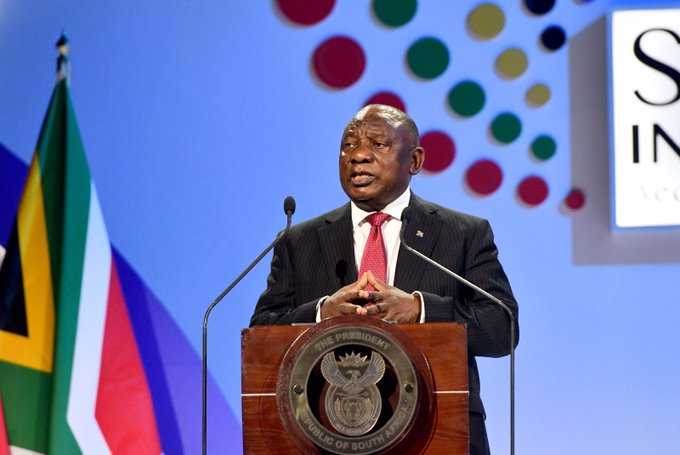
Speaking at the country’s fifth Investment Conference, president Cyril Ramaphosa engaged with domestic and foreign investors seeking to add billions of rands more to his five-year plan investment to the country.
Since 2018, the country has been able to amass R1.14 trillion in investment pledges – and Ramaphosa hopes that the current conference will be able to shoot past that.
“With the achievement of our R1.2 trillion target today, we now cast our collective eyes to the horizon. With your support, with your investment, we can realise more growth, offer more opportunities and create even more jobs. As we work with dedication and focus to overcome our immediate challenges, let us not lose sight of the incredible promise of our country, South Africa,” Ramaphosa said.
“We remain convinced that South Africa is an investment destination with significant untapped potential. We do believe that by leveraging our unique value proposition, we have the ability to attract higher levels of investment. In the midst of all the challenges we face, our ambition has not been misplaced. We do believe that the target we set in 2018 was not misplaced either. The four South African Investment Conferences that have taken place to date have attracted R1.14 trillion in investment pledges.”
And today the 2018 target of R1.2 trillion has been reached.
Looking towards the upcoming five years, Ramaphosa said that the new target is an additional R2 trillion in new investments between now and 2028.
South Africa’s positioning
Ramaphosa acknowledged the own-goals that have been scored by over a decade of mismanagement.
He said the country has had to contend with a global pandemic, damaging social unrest, natural disasters and a cost-of-living crisis.
“In addition, we are now confronted with the consequences of years of under-investment, mismanagement and corruption in our electricity, rail and logistics sectors,” he said.
“We are on a long journey to rebuild our country and recover the ground we have lost. Our recovery is a mission that will take time to accomplish. We are on the recovery path, we refuse to be daunted by the challenges we face, we are confident that we will recover,” he said.
The president said that although investment decisions have taken several years to reach fruition, almost 70% of the total number of projects announced since 2018 have been completed or on their way to completion.
“To date, approximately R460 billion of capital has been invested in building new factories, purchasing equipment, constructing roads, sinking mine shafts and rolling out broadband infrastructure.”
He added that international companies are turning to South Africa for business process outsourcing, tech start-ups, the automotive sector, green ammonia, green hydrogen or in the construction of mega data centres.
Energy sector
Addressing the thorn in South Africa’s side – load shedding – the president said that the energy sector remains the country’s foremost priority.
“The lack of reliability in electricity supply weakens business and consumer confidence, taints international perceptions about our country and affects investment sentiment and decisions.”
He reiterated the fact that the government, last year, implemented the Energy Action Plan to reduce the severity and frequency of load shedding in the short term.
The Minister in the Presidency responsible for Electricity, with the support of the Departments of Mineral Resources and Energy, Public Enterprises and the National Energy Crisis Committee, is overseeing the implementation of this plan.
“Our immediate focus is on improving the performance of our existing coal fired power stations as they continue to provide the baseload of our energy. Demand-side management initiatives will receive elevated attention, including through consumer behaviour, rooftop solar and facilitating embedded generation.
“We have been implementing wide-ranging reforms in the electricity sector to enable private investment in electricity generation and accelerate the procurement of new generation capacity from solar, wind, gas and battery storage, “explained the President.
Despite this initiatives, a little reprieve from rolling blackouts has reached consumers and businesses nationwide.
Analysts and researchers at large are pointing to load shedding worsening in the coming months.
Ramaphosa said that load shedding would remain a challenge in the immediate future. However, its severity will begin to ease.
“Government will implement the Just Energy Transition Investment Plan, which outlines the investment needs to support a just and inclusive transition towards cleaner forms of energy. In addition, the review of the Integrated Resource Plan to lay the foundation for a fundamentally transformed energy landscape that transitions us along a low-carbon, climate resilient developmental path will soon be completed.
Transnet
On top of issues arising from the troubled Eskom, the logistic sector is further driving growth estimates downward. Ramaphosa said that the country is prioritising port and rail efficiencies as part of the structural reform process.
“To facilitate third-party access, Transnet is establishing a separate Infrastructure Manager for the rail network,” said the president.
“In the interim, Transnet is implementing a range of measures to arrest the decline in the performance of the freight rail system, including increasing the availability of locomotives for key corridors.”