
By Lehlohonolo Lehana.
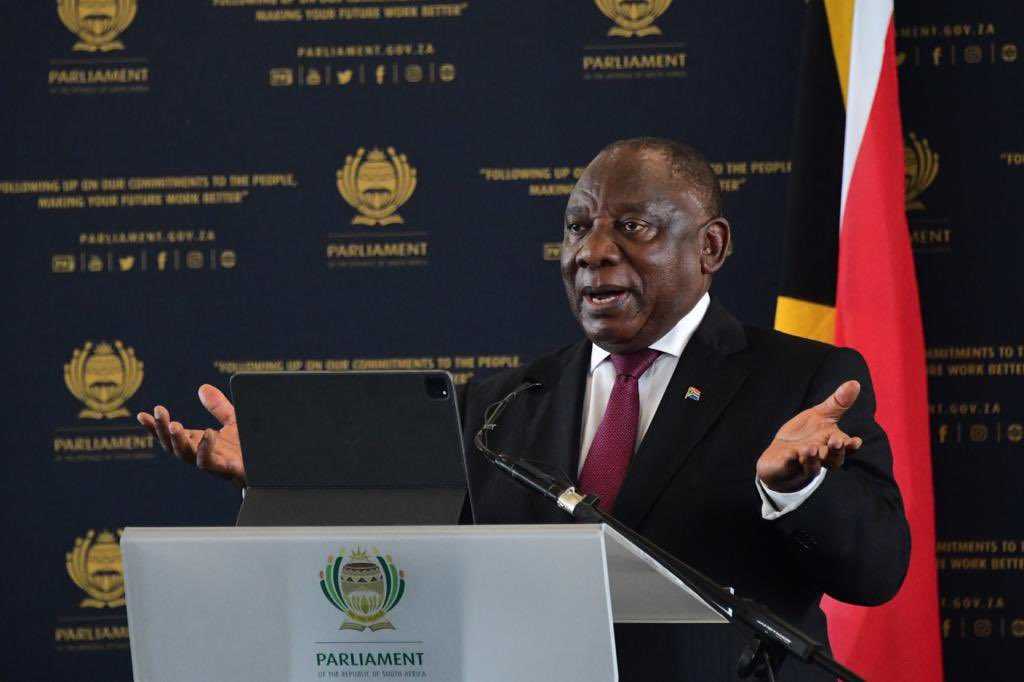
President Cyril Ramaphosa again hinted at introducing a basic income grant, saying there is a “strong case” for it despite the nation’s “fiscal constraints.”
Delivering the 2024 State of the Nation Address, the president said that this will be done by extending and amending the Social Relief of Distress [SRD] Grant.
“We have seen the benefits of this grant and will extend it and improve it as the next step towards income support for the unemployed,” said Ramaphosa.
The R350 SRD grant was introduced during the Covid-19 pandemic and currently supports 9 million unemployed people monthly. The Basic Income Grant is said to increase and expand on this.
The SRD is currently one of the only sources of financial support for millions of South Africans who are unable to find employment. South Africa’s unemployment rate of 31.9% is one of the highest in the world.
Ramaphosa went on to dismiss the critique that the grants have been establishing a “dependent society” – saying that it rather serves to protect the unemployed from the threat of poverty.
However, no concrete plans or details on the grant have been presented yet. Further details are expected to emerge during the 2024 Budget Speech.
Here are the key takeaways from Ramaphosa’s address:
Climate Change Fund
Over the past few years, parts of South Africa have been ravaged by floods – particularly in KwaZulu-Natal – as well as fires in other parts of the country and drought.
“This will bring together all spheres of government and the private sector in a collaborative effort to build our resilience and respond to the impacts of climate change, “Ramaphosa said.
Ramaphosa explained that furthermore, through reforms, government is positioning the economy for “future growth in a world shaped by climate change and a revolution in green technologies”.
“In the last three years, our country has seen an increase in extreme weather events, often with disastrous consequences. This is why we are implementing a just energy transition, not only to reduce carbon emissions and fight climate change, but to create growth and jobs for our own people.
“We will undertake this transition at a pace, scale and cost that our country can afford and in a manner that ensures energy security.
“With our abundance of solar, wind and mineral resources, we are going to create thousands of jobs in renewable energy, green hydrogen, green steel, electric vehicles and other green products.”
High-Speed trains
Ramaphosa says that his promise of high-speed trains for South Africa is still making its way to reality – with the Joburg-Durban being the first point of focus.
The president’s long-held ambitions for a high-speed rail (HSR) network connecting cities got a brief mention in his 2024 State of the Nation Address (SONA) on Thursday evening (8 February), updating the nation on its progress.
“In November last year, Cabinet approved a framework for high-speed rail, focusing initially on the Johannesburg to Durban corridor,” the president said.
Cabinet approved the framework on 1 November 2023, but little detail was given aside from naming the Durban-Joburg corridor as the priority route, which would move on to feasibility studies.
“Cabinet approved the High-Speed Rail Development Framework and the financial implications for implementation will be discussed between the Ministers of Transport and Finance,” government said at the time.
“Cabinet approved the prioritisation of the Johannesburg to Durban corridor for a detailed feasibility study, and the Johannesburg-Polokwane to Musina, and the Johannesburg to Mbombela will be put to the market.”
On the topic of rail, Cabinet also adopted the Freight Logistics Roadmap in December 2023, which includes a broad plan to implement the National Rail Policy.
The National Rail Policy is the whitepaper that contains specific mention of High Speed Rail (HSR), which was adopted by cabinet in March 2022.
The HSR framework within the policy had not received particular mention until a few months ago.
In June 2023, the Department of Transport noted that the framework was still being developed, with various criteria and specific corridors needing to be identified.
Further, the department said that feasibility studies still needed to be conducted on prioritised HSR corridors – contingent on approvals and funding being secured.
Off the rails
Ramaphosa’s fixation on high-speed trains dates back to his 2019 SONA, where he said he dreams of South African cities filled with skyscrapers and connected by bullet trains.
“We should imagine a country where bullet trains pass through Johannesburg as they travel from here to Musina, and they stop in Buffalo City on their way from Ethekwini back here.”
“Has the time not arrived to build a new smart city founded on the technologies of the Fourth Industrial Revolution? I would like to invite South Africans to begin imagining this prospect,” Ramaphosa said at the time.
However, contrary to the president’s lofty ambitions, South Africa’s rail networks have gone in the opposite direction, being virtually unusable for passenger transport and heavily crippled for heavy haul and freight.
The railway lines themselves have been besieged by criminals and stripped bare. The rail logistics crisis has become a disaster almost on par with the Eskom power crisis, leading to billions of rands of lost revenue and investment.
The Freight Logistics Roadmap approved at the end of 2023 aims primarily to stabilise and improve the operational performance of Transnet’s freight rail network – with the NRP and HSR likely falling down the list of priorities.
Investment in infrastructure
Ramaphosa says investment in infrastructure is gaining momentum, and new and innovative funding mechanisms will be used to increase the construction of infrastructure.
He said to deal with severe inefficiencies in the freight logistics system, government is taking action to improve the country’s ports and rail network and restore them to world-class standards.
“We have set out a clear roadmap to stabilise the performance of Transnet and reform our logistics system. Working closely with business and labour, we have established dedicated teams to turn around five strategic corridors that transport goods for export purposes.
“The number of ships waiting to berth at the Port of Durban – which has experienced severe congestion in recent months – has reduced from more than 60 ships in mid-November to just 12 ships at the end of January,” Ramaphosa said.
The President also noted that Transnet has appointed an international terminal operator to help expand and improve its largest terminal at the Port of Durban, and government is overhauling the freight rail system by allowing private rail operators to access the rail network.
“With the current conflict in the Middle East affecting shipping traffic through the Suez Canal, South Africa is well positioned to offer bunkering services for ships that will be rerouted via our shores.
Broadband and investment
“We completed the auction of broadband spectrum after more than a decade of delays, resulting in new investment, lower data costs and improved network reach and quality. These reforms have a profound impact in a society in which access to the internet has risen dramatically over the last decade,” the President told a joint sitting of the National Assembly and National Council of Provinces.
He also noted that less than half of all households had internet access in 2011, compared to 79% of households in 2022.
“Just this week, we published new regulations to reform our visa system, which will make it easier to attract the skills that our economy needs and create a dynamic ecosystem for innovation and entrepreneurship.
“We raised R1.5 trillion in new investment commitments through five South Africa Investment Conferences, of which over R500 billion has already flowed into the economy.”
Bulk water projects
The President further announced that several bulk water projects are under construction across the country to improve water supply to millions of residents in villages, towns, and cities.
“The Department of Water and Sanitation aims to enhance water resource management by initiating infrastructure projects to secure water supply and diversifying water sources to reduce dependence on surface water.”
The President highlighted some of the water infrastructure projects, which are in progress or completed, and these include the Lesotho Highlands Water Project, Umzimvubu, Hazelmere Dam, uMkhomazi Water Project, Clanwilliam Dam, Tzaneen Dam, Loskop, Mandlakazi, pipeline from Jozini Dam, Giyani and the pipeline from Nandoni Dam.
Included among these are also Pilanesberg Water, Vaal Gamagara and the pipeline from the Vaal River to Hothazel.
“In the Eastern Cape, the Msikaba and Mtentu bridges are beginning to rise over the landscape and will be among the highest in Africa once complete.The steel used for part of the project is fabricated in Mpumalanga, and the iron ore comes from the Northern Cape, “he said.
He also noted that in the past five years, the South African National Roads Agency (SANRAL), which manages nearly 25 000 km of roads, has awarded more than 1 200 projects to the value of R120 billion.