
By Lehlohonolo Lehana.
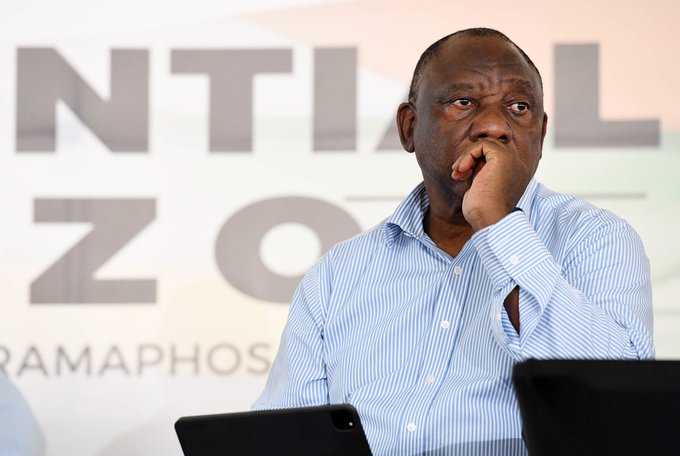
President Cyril Ramaphosa has called on Water and Sanitation Minister Senzo Mchunu to make recommendations to strengthen the governance, management and regulatory framework for municipal water and sanitation services.
This includes ensuring that national minimum norms and standards are comprehensive, monitored and adhered to by all water service providers, he said.
The statement comes as people have died from a cholera outbreak in Hammanskraal, Gauteng, and in the Free State. Over 200 patients had been admitted to the Jubilee District hospital, with 48 confirmed cases and 24 deaths due to cholera.
Writing in his weekly newsletter to the public, Ramaphosa said an investigation is underway into the source of the outbreak; however, to date, the original source of the cholera infection has not been located.
The president said that technical teams from the City of Tshwane, the Department of Water and Sanitation, and the provincial and national departments of Health are carrying out water quality tests at distribution points and at water treatment works in the area.
He also pointed to South Africa not being alone in the outbreak, citing a World Health Organisation (WHO) report that showed that there had been several cases since the beginning of the year in Malawi, Mozambique and Zimbabwe.
Water quality
Regarding water quality, Ramaphosa cited the most recent Green Drop Report to try and put a positive spin on the narrative.
“Generally, water quality in South Africa is of a high standard, which, according to our Water Research Commission, ‘compares well with the best in the world”, he said.
“It is important to note that the dual water systems supplied by Magalies and Rand Water to the Tshwane area meet national standards.”
While the president claims that South Africa has high-quality water – the report he cites shows the exact opposite.
The Green Drop report and Blue Drop report were published by the Department of Water and Sanitation in March 2022, each gauging different aspects of South Africa’s water systems. The Green Drop report focuses on wastewater management, while the Blue Drop report looks at drinking water quality.
The Greed Drop report requires wastewater systems to achieve a 90% score to be issued a Green Drop certificate – indicating a working, efficient and world-quality system.
No certificates were issued in 2022 for any of the country’s systems as no wastewater systems scored a minimum of 90% when measured against the Green Drop standards for the audited period.
On the contrary – there are a significant number of wastewater systems that scored under 31%, and are regarded as being in a critical condition. The provincial Risk Ratio for treatment plants also regressed from 80% in 2013 to 88% in 2021.
The 2022 Blue Drop report, meanwhile, showed that 40% of South Africa’s water supply systems achieved microbiological water quality compliance, and 23% have achieved chemical water quality compliance. When looking at the ‘drinkability’ of the water in these systems, the data shows:
- 48% of water supply systems are in the low-risk category;
- 18% are in the medium-risk category;
- 11% are in the high-risk category;
- 23% are in the critical risk category.
While the country’s major metropoles still have safe drinking water, the report flagged concerns in more rural and isolated municipalities.
Call for action
Ramaphosa explained that it is encouraging that the City of Tshwane and the Department of Water and Sanitation are working together to ensure the various water supply systems meet drinking quality standards.
He said unreliable and poor-quality drinking water had been a problem in Hammanskraal for many years.
“The Rooiwal wastewater treatment works, which is upstream of Hammanskraal, has not been well-maintained and has insufficient capacity to deal with the volume of wastewater entering the works.”
“Over the years, in its role as the regulator of the water sector, the Department of Water and Sanitation has issued many directives to the City of Tshwane to address pollution from the Rooiwal Wastewater Treatment works. Regrettably, these directives were not acted upon.”
He added that many local councils have underspent on critical water infrastructure, and this is unacceptable.
“While there must be full accountability for the failings that have resulted in the outbreak in Hammanskraal, at this time, we must focus on the problem at hand.”