
By Lehlohonolo Lehana.
President Cyril Ramaphosa described the National Health Insurance (NHI) as an opportunity to break with the prevailing inequality in the health system and called on stakeholders to work with government to make it work.
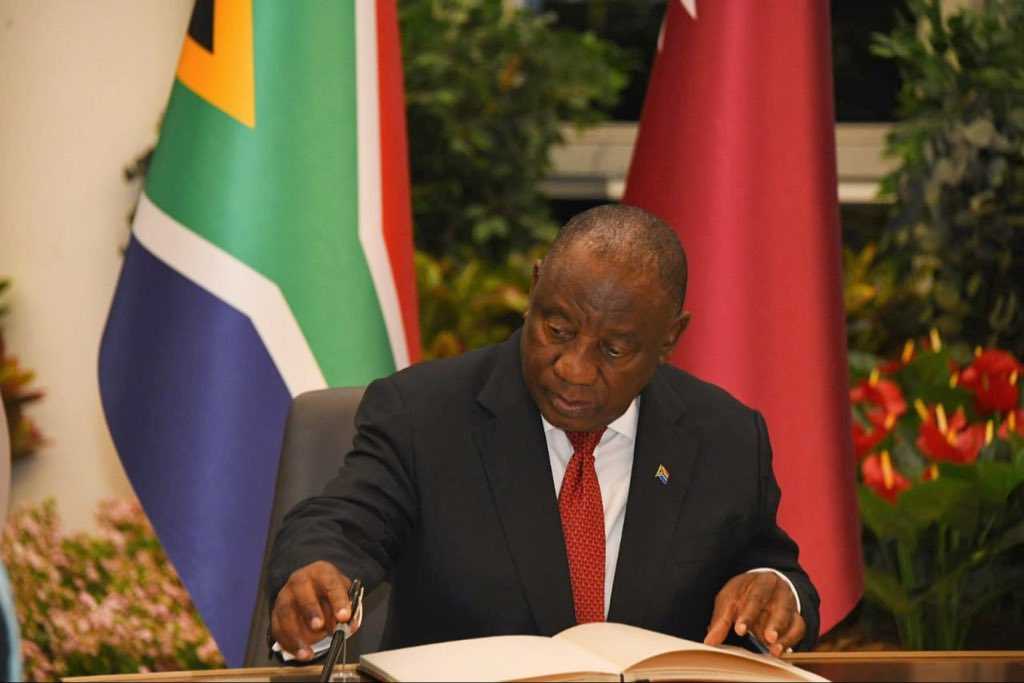
Ramaphosa signed NHI Bill into law during a ceremony held at the Union Buildings on Wednesday.
“We are a country that has been built on dialogue and partnership, on working together to overcome differences in pursuit of a better life for all its people. Let us work together, in a spirit of cooperation and solidarity, to make the NHI work,” Ramaphosa appealed.
He was speaking, however, against the backdrop of strenuous opposition to the legislation by healthcare practitioners, funders, business, civil society groupings, some trade unions, as well as opposition political parties and an expectation that the Act would be challenged legally.
Nevertheless, Ramaphosa described the signing – which he had signalled his intention to carry out on several occasions, including while on the campaign trail ahead of what is set to be a highly competitive election on May 29 – as a “pivotal moment in the transformation of our country”.
He likened the current anxiety to fears expressed ahead of the transition to democracy and the introduction of the right to strike and argued that those fears had proved to be unfounded.
“By putting in place a system that ensures equal access to health care regardless of a person’s social and economic circumstances, the NHI takes a bold stride towards a society where no individual must bear an untenable financial burden while seeking medical attention.”
Despite grave concerns about the implications of the NHI for taxpayers, as well as the potential for corruption, the President did not provide details on how the scheme would be financed.
He said only that the NHI would be funded through a comprehensive strategy that would combine various financial resources, including additional funding and reallocating funds already in the health system.
It has been estimated that the NHI would require yearly funding of at least R400-billion.
“The financial hurdles facing the NHI can be navigated with careful planning, strategic resource allocation and a steadfast commitment to achieving equity,” the President added.
Speaking from the same podium, Health Minister Dr Joe Phaahla emphasised that the yet-to-be-established NHI Fund, which would procure services from public and private service providers, would be governed by a board made up of “people of good standing”.
Both Phaahla and Ramaphosa also underlined that implementation would be pursued on a phased basis and would not be implemented as a single event.
“Following the signing of this Bill, we will be establishing the systems and putting in place the necessary governance structures to implement the NHI based on the primary health care approach,” Ramaphosa said.
They also denied that the legislation has been rushed and that its passage had failed to follow the correct procedure, arguing that it had undergone thorough consultations ahead of the parliamentary process, which had itself endured for five years.
“What we need to remember is that South Africa is a constitutional democracy.
“The Parliament that adopted this legislation was democratically elected and its members carried an electoral mandate to establish a National Health Insurance.
“South Africa is also a country governed by the rule of law in which no person may be unduly deprived of their rights,” the President said.
Several organisations and political parties have vowed to challenge the bill in court, while others have expressed support for it in its current form.
The South African Communist Party (SACP) picketed outside the Union Buildings to support Ramaphosa’s signing of the bill into law.
“In our country, quality health care is an exclusive preserve of a minority who are opposed to the NHI. They want to be the only ones who have access to quality healthcare. The president will bring this to an end,” said the party’s spokesperson Alex Mashilo.
“So we are going to the Union Buildings to express our support for the president and our support for the actions taken by the National Assembly, which allows the bill into law after years of extensive consultation”.
Nursing union Denosa believes the NHI will rid the country of healthcare inequality.
“We have been consistent in our support for the NHI for various reasons. The concept of equal access to universal health coverage will finally be realised in the country, whereby everyone has equal access to healthcare on the basis of their healthcare needs and not on the basis of how deep one’s pocket is,” said Denosa’s spokesperson Sibongiseni Delihlazo.
At the same time, the Democratic Alliance has vowed to challenge the NHI Bill at the Constitutional Court..
“Out of desperation, it (the ANC) cast around for any populist lever it could pull in the hopes of magically boosting its terminal fortunes,” said DA’s leader John Steenhuisen on Tuesday.
“Unfortunately for the people of South Africa, Ramaphosa chose the NHI as the ANC’s last stand before it finally loses power in less than three weeks.”
The Hospital Association of South Africa also expressed disappointment, citing the government’s lack of collaboration and consultation.
“In moving to sign the bill, the president and the cabinet have regrettably disregarded our views and our best advice. We sincerely believe the unfortunate consequence is that this version will hamper, rather than promote, access to quality healthcare for citizens in our country,” said the association’s Mike Peach.
Shares in Discovery, the biggest health insurance provider, and peers, including Momentum Metropolitan Holdings and Sanlam, sank on Tuesday after Ramaphosa announced that he would sign the bill.
Read the full Act Here: No. 20 of 2023: National Health Insurance, Act 2023:National Health Insurance, Act 2023.