
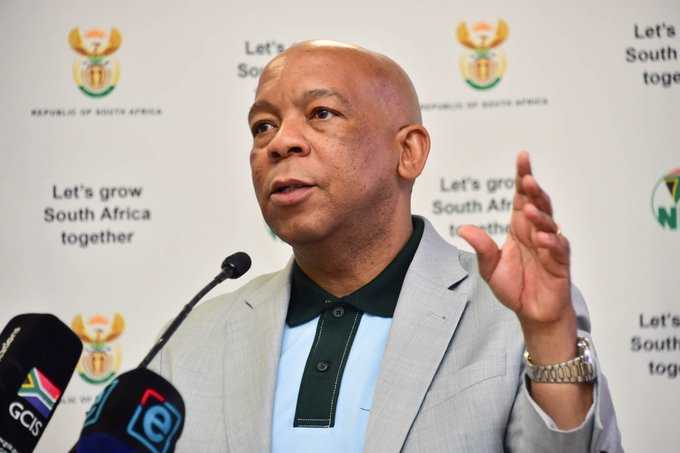
By Lehlohonolo Lehana.
The Minister in the Presidency responsible for Electricity, Dr Kgosientsho Ramokgopa says all the work being done by government on the financial structure to facilitate private investment into the country’s transmission infrastructure is being consolidated under his Ministry, including the work being done on the issue by the National Treasury and the International Finance Corporation (IFC).
This confirmation follows an announcement in the National Treasury’s Budget Review that a request for proposals will be released by the end of July for a pilot project involving “off-balance-sheet financing to accelerate private-sector investment in transmission, without negatively affecting Eskom’s balance sheet and the fiscus”.
He briefed the media on Monday as the country sits on rotational stage 3 and 2 load shedding.
Ramokgopa indicated during a briefing on the implementation of the Energy Action Plan that his Ministry had been working with the National Treasury, the IFC and others on what he termed an “EPC plus F” concept, involving the engineering, procurement, construction plus financing of new transmission infrastructure.
He insisted that the plan was being coordinated under his auspices with the intention of settling on a way to structure such transactions without the need for government guarantees or undermining the National Transmission Company South Africa (NTCSA), the grid and system operator currently being established as an independent entity under Eskom Holdings.
“I’m confident that within the next two weeks I will be coming back to the country to say: ‘This is how we are going to progress’,” Ramokgopa said.
Internal discussions within government, including discussions with the NTCSA, still had to be finalised, however. Once concluded, it was possible that private sector participation could be directed towards supporting three priority corridors, which Ramokgopa indicated could unlock 2 300 MW of new renewables generation capacity.
He also expressed confidence that there was funding available for developing new grid infrastructure based on a build, own, operate and transfer model used internationally, which would be “domesticated” for the South African context, including the policy that the NTCSA remained the sole system operator and the custodian of the grid.
Lessons were being drawn from South Africa’s experiences in procuring generation capacity from private investors, including the value of having procurement located at “arm’s length” from government’s bureaucratic processes, as has been the case with the Independent Power Producer Office.
Prior to the appointment of the NTSCA board earlier in the year, the Minister indicated that the transmission procurement agency might be located within either the Development Bank of Southern Africa or the Industrial Development Corporation.
The NTCSA already had a Transmission Development Plan and any private sector participation would be guided by that plan with the intention of accelerating implementation.
There is also an ambition to channel concessional and grant funding towards transmission projects, especially the nearly $12-billion in funding committed to the Just Energy Transition Partnership Implementation Plan. To date, this funding has not been integrated with physical projects, with most of the concessional loans approved to date having flowed into the general fiscus as ‘policy loans’.
Ramokgopa also said significant progress has been made in reducing the intensity of load shedding since the government implemented its Energy Action Plan.
Ramokgopa said despite the odd setback, the government is making progress.
“The improvement of the EAF (energy availability factor) and unplanned outages are a result of concerted efforts focusing on priority power stations, Kusile, Kendal, Majuba, Matla, Tutuka and Duvha, where each power station has its detailed recovery plan. A total of 3 510MW was recovered by January 2024 through these interventions.
“The highest level of planned maintenance was performed between December 2023 and January 2024, reaching an average of 18% of the generation capacity.
“Although heightened maintenance negated the EAF, the deliberate spike in planned maintenance is aimed at improving the reliability of the generation fleet to deliver long-term benefits and ensure the security of energy supply.”
Ramokgopa said a comparison of load shedding between December 2022 and February 2023 showed a reduction of load shedding by some 600 hours.