
By S’thembile Cele.
South Africa’s new ambassador to the US says persuading US President Donald Trump to revoke an executive order that underpins Washington’s hostile stance toward Pretoria is his top priority, arguing that it remains the biggest obstacle to restoring normal diplomatic and trade relations.
Trump signed the order in February 2025, suspending US assistance to South Africa and offering Afrikaners refugee status after falsely accusing Pretoria of subjecting white farmers to a genocide and seizing their land.
Trump has also criticised the country’s genocide case against Israel at the International Court of Justice and its relations with Iran and allied militant group Hamas.
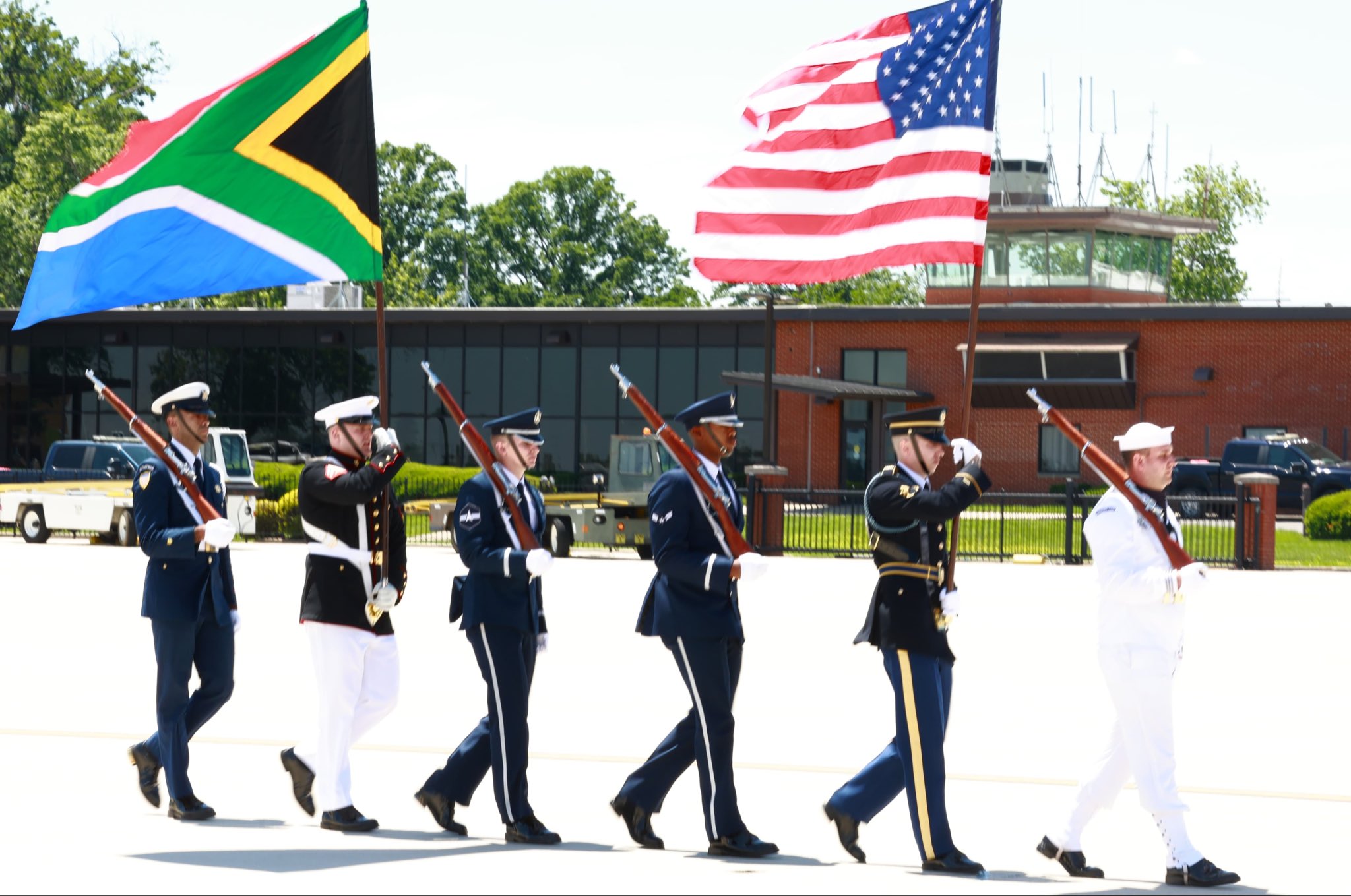
Roelf Meyer, who presented his ambassadorial credentials to Trump earlier this year and left for Washington on Thursday, says he has authority to negotiate with the US administration and seek compromises on some issues.
“The starting point, I think, is for us to get the executive order lifted,” Meyer said in an interview.
As long as the executive order remains “it can be used” against South Africa to justify the imposition of tariffs, trade restrictions or other punitive measures, he said.
Meyer’s comments offer the clearest indication yet of how President Cyril Ramaphosa’s government intends navigating one of the most difficult periods in relations between South Africa and the US since apartheid ended in 1994 – while balancing pressure from its second-biggest trading partner after China against domestic political constraints.
A white Afrikaner and veteran political negotiator, 78-year-old Meyer served as constitutional affairs minister during the apartheid era and is widely regarded as one of the architects of South Africa’s democratic transition alongside Ramaphosa.
He was tapped to replace Ebrahim Rasool, who was expelled from the US last year after he criticised the Trump administration.
Pretoria’s immediate objective is to persuade the administration that the assumptions underpinning the executive order were incorrect.
Meyer plans to engage not only the White House, but also the State Department, Congress and the Office of the US Trade Representative to better understand Washington’s current position.
“We have to go full out and change that” position, he said.
Trade negotiations will be key to the interactions.
Meyer said the latest communication the US Trade Representative conveyed to Minister of Trade, Industry and Competition Parks Tau raised issues ranging from tariffs and longstanding trade disputes to broader political considerations, including black economic empowerment (BEE), South Africa’s land-expropriation laws and foreign policy, along with market access for US pork and poultry.
South Africa is among 60 countries that were hit by new US duties last week.
Its exports will be subjected to 12.5% tariffs, though some goods are exempt, including specified agricultural products and other commodities.
While Meyer declined to detail the concessions he had been authorised to make before formal negotiations begin, he said had broad backing from the government.
“I received a clear picture,” he said of his consultations with Ramaphosa and several cabinet ministers.
“It was a clear mandate to go ahead and do what we can to find solutions.”
Pretoria is however adamant that it won’t abandon its BEE policies, which are aimed at ensuring that racially based wealth disparities stemming from the apartheid era are addressed.
“There’s no way that South Africa can walk away from that,” Meyer said, describing the stance as “a matter of principle”.
He stressed that the focus should instead be on how the policy is implemented, pointing to South Africa’s equity equivalence framework as a mechanism that may allow multinational companies to meet empowerment requirements without having to relinquish partial ownership.
“We can’t make exceptions only for American companies,” he said.
Meyer acknowledged the unpredictability of dealing with Trump, noting that what is said in public could differ sharply from private discussions.
“I don’t think it’s that easy to please President Trump,” he said. “If I was a golfer, maybe it would have been easier.”
Meyer described his own encounter with Trump as “very friendly” but cautioned that personal chemistry alone won’t be enough to shift US policy.
“My impression from the three weeks that I spent in Washington is that there are agencies of government” that want to step up investment in South Africa and expand trade, but their views may differ from Trump’s, Meyer said. I don’t think we can rely only on that. The White House might come back tomorrow and say something different.”