
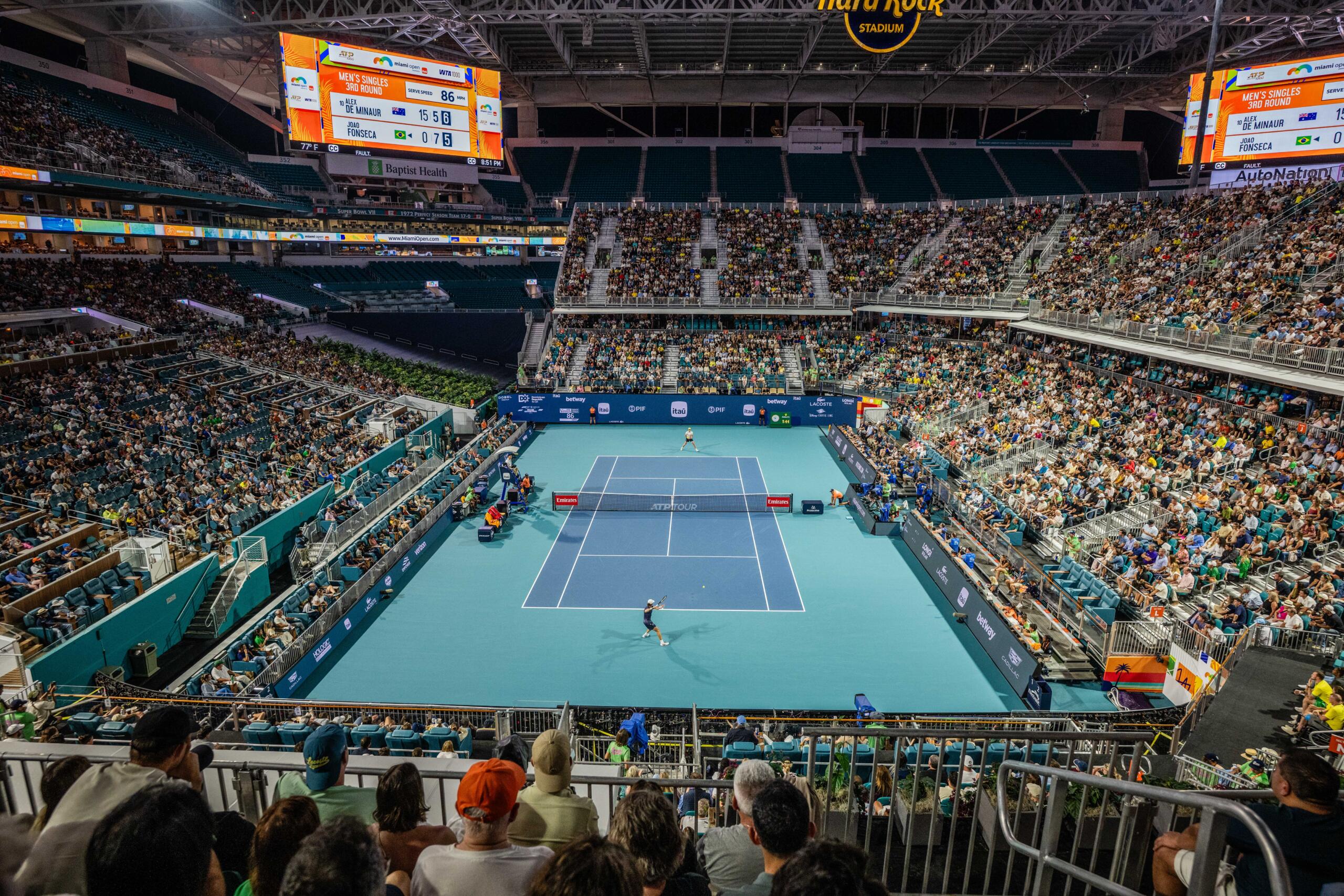
By Kevin Rademeyer, Sports Journalist.
Photo Credit: Peter McMahon// AP.
There are tournaments that simply crown champions, and then there are those that signal something deeper. The 2026 Miami Open may well be remembered as the latter.
Across two weeks in Florida, the sport revealed both its established authority and its shifting future. At the centre stood Aryna Sabalenka, who confirmed her dominance on the women’s tour, while Jannik Sinner moved to the brink of a rare milestone. Around them, a new wave of contenders announced themselves with clarity and intent.
Sabalenka’s authority, forged under pressure
Sabalenka’s 6–2, 4–6, 6–3 victory over Coco Gauff in the final was not just about power, though there was plenty of that. It was about control in moments where, historically, she has faltered.
Having taken the opening set with authority, Sabalenka found herself pulled into a familiar pattern as Gauff responded with resilience and tactical adjustment. The American elevated her level, serving with greater precision and attacking with intent to force a deciding set.
In previous high stakes encounters, including Grand Slam finals, that scenario has unsettled Sabalenka. This time, there was no unraveling. She reset quickly, broke early in the third set and managed the match with a composure that underlined her evolution.
The victory secured back to back Miami titles and completed the so called Sunshine Double, following her triumph at Indian Wells. In doing so, Sabalenka became only the fifth woman to achieve the feat, reinforcing her position as the defining player of this moment in the women’s game.
For Gauff, the defeat will sting. Playing close to home, she carried both expectation and momentum into the final. Yet her run to the title match, particularly given recent struggles with her serve and a lingering arm concern, suggests she remains firmly in contention as the season shifts to clay.
Sinner’s surge and a final with consequence
If the women’s final offered resolution, the men’s draw builds towards possibility.Sinner enters the championship match against Jiri Lehecka in formidable form. The Italian has not dropped a set en route to the final and is riding a remarkable streak at Masters 1000 level, blending consistency with controlled aggression.
Victory would see him complete his own Sunshine Double, a feat not achieved since Roger Federer in 2017. It would also deepen his push towards the top ranking, intensifying a rivalry with Carlos Alcaraz that is beginning to shape the men’s tour.
Yet Lehecka’s presence in the final is no accident. The Czech player has navigated the tournament without dropping a set, striking cleanly and serving with authority. This will be his first Masters 1000 final, but his level suggests a player unburdened by occasion and ready to disrupt expectation.
A breakthrough moment for the next generation
Beyond the headline acts, Miami offered a compelling glimpse of the sport’s next layer. Among the standout stories was Martin Landaluce, whose run to the quarter finals marked a decisive step in his development. Entering the tournament outside the top 150 and without a win this season, the Spaniard pieced together a series of composed victories over established opponents.
His progress did not go unnoticed. Rafael Nadal, whose academy has played a role in Landaluce’s development, acknowledged the performance in measured terms. The message was simple, but its implication clear. This was a player moving from promise to presence.
More broadly, the tournament reflected a shift in competitive balance. Younger players advanced deep into both draws, while several established names exited earlier than expected. The average age of the latter stages dropped, and with it came a different tempo. Matches were faster, more aggressive and often decided by fine margins.
Why Miami matters in 2026
The significance of this Miami Open lies not only in its results, but in its direction. Sabalenka’s continued rise illustrates what sustained development can produce at the highest level. Her journey from raw power to refined control mirrors the kind of progression that federations and players across emerging tennis nations strive to replicate.
On the men’s side, Sinner’s consistency and Lehecka’s emergence highlight the depth now shaping the tour. There is less predictability, more opportunity and an increasing sense that the hierarchy is fluid.
And then there is the broader narrative. The sport is no longer waiting for change. It is happening in real time. As the clay season approaches, with its distinct demands and traditions, the questions raised in Miami will follow.
Can Sabalenka maintain this level across surfaces. Will Sinner convert dominance into silverware. Which of the emerging names can sustain their momentum. For now, Miami leaves behind a clear impression. The present is being defined. The future is already arriving.