
By Lehlohonolo Lehana.
The South African Human Rights Commission (SAHRC) is calling for the water outages currently crippling South Africa to be declared a national disaster.
The SAHRC will be issuing a letter to the head of the National Disaster Management Centre (NDMC) containing the recommendation of a national disaster on the water crisis.
“Water is the lifeblood of human existence and plays a critical role in the realisation of several rights, including healthcare, children’s rights, and education, “the SAHRC said on 12 February.
The Commission has repeatedly highlighted the impact of water shortages on essential services.
“The absence of water at schools negatively impacts educational outcomes as learners are forced to miss school,” while hospitals and clinics also suffer disruptions that infringe on the right to healthcare.
The Commission further emphasised that “the lack of access to water disproportionately affects women and girl-children and compromises the attainment of gender equality.”
According to the SAHRC, multiple systemic and structural factors have contributed to the ongoing crisis.
“Insufficient attention and allocation of budget for the maintenance of water infrastructure, poor planning for population growth, high levels of water losses, lack of skilled personnel… water infrastructure vandalism and the emergence of water mafias” are all key drivers of the current challenges.
The Commission warned that these issues are particularly pronounced at municipal level, where service delivery failures most directly impact households.
While the country has sufficient water in its dams, the system is failing at municipal level due to crumbling infrastructure, financial mismanagement, and extreme heatwaves.
The crisis is acute in Gauteng, where Johannesburg, Tshwane, and Ekurhuleni face a “Day Zero” reality for many residents.
The Department of Water and Sanitation (DWS) Director-General Dr. Shaun Phillips told Parliament in September 2025 that Rand Water provides sufficient water to meet municipal needs in Gauteng.
“If they were to reduce leaks in their distribution systems and invest more in distribution infrastructure, including storage and pumping capacity, this issue would not exist,” he said.
President Cyril Ramaphosa meanwhile ordered minister of water and sanitation Pemmy Majodina and her counterpart in Cooperative Governance, Velenkosini Hlabisa, and their deputies to deal with the ongoing water crisis in Gauteng.
The two ministers were told to sit out of SONA this evening as the ongoing water crisis in some parts of Gauteng and the frustration of many residents has caught the President’s attention.
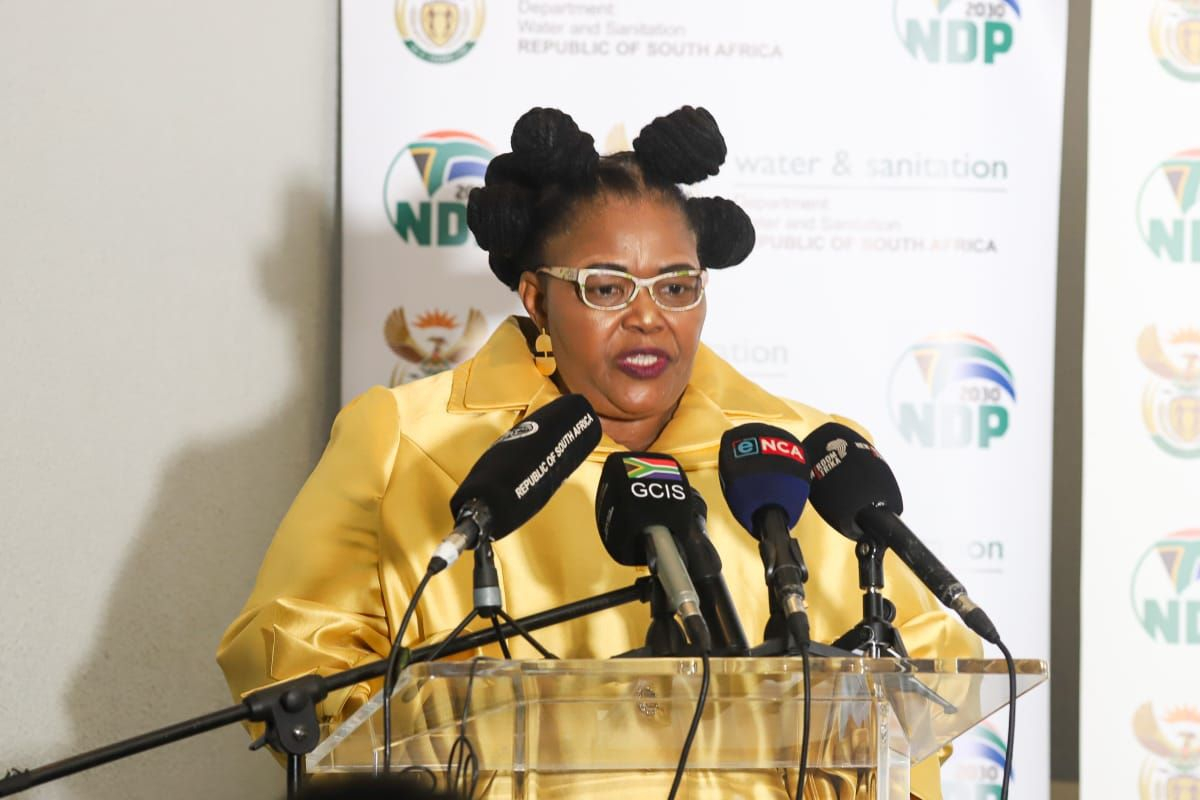
“We must be honest about the scale of the challenges and the funding required. At the local government level, at least R400 billion is needed to repair and upgrade water infrastructure. Clearly, that amount is not currently available in the fiscus,” Majodina told a media briefing.
Majodina said the high water consumption in Gauteng municipalities is caused by rapid population growth.
“There is significant overconsumption of water in Gauteng due to a growing population, both in formal and informal settlements. In this area, many hijacked buildings are occupied and use water services for free.
“The deteriorating water infrastructure is a major concern. At present, the system is severely overburdened, and any system under such strain is at risk of collapse,” she warned.
Majodina urged residents to conserve water while the city replaces ageing pipelines and upgrades reservoirs.
She said support from the national Treasury and private partners is being sought to expedite infrastructure improvements:
“We have put ourselves a timeframe that on Sunday we expect that we’ll be standing at 90% in terms of all the reservoirs. “
“Our technical teams will be going out and checking the reservoirs that are picking up very slowly. When we work together, it’ll take us to a better position.”
Experts warn that nearly around half of treated water in Johannesburg is lost to leaks before reaching taps, while suburbs like Melville, Parktown West, and Briandene have been without water for over 21 consecutive days.