
By Lehlohonolo Lehana.
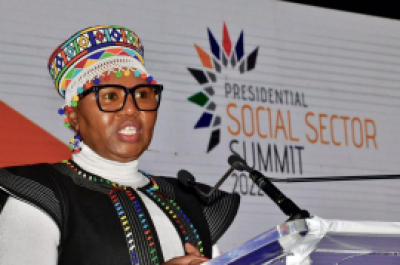
The Department of Social Development minister Lindiwe Zulu says that the critical shortage of social workers in the country has hit crisis levels and can no longer be ignored.
“I need to indicate that the shortage of social workers is now becoming a crisis that cannot be ignored anymore – especially with rising social ills in our country,” Zulu said in a written parliamentary reply this week.
“Our country is confronted with high levels of poverty, unemployment and inequalities. The scourge of gender-based violence is unbearable, we witness women and children being killed on a daily basis; substance abuse is on a rise, ravaging our children and loved ones, most painfully disintegrating families. All of us in this house are affected and, by extension, our families.”
The minister said that the shortage of social workers in the country not only impacts the government’s current backlog in processing things like foster care grants, but also on the provision of social welfare services and the socio-economic development of the country in general.
She said that when the government evaluated the Children’s Act 38 of 2005, it required more than 16,000 social workers to implement the provisions of the Act, which included foster care services.
“This was twelve years ago – and this excluded the implementation of other pieces of legislation in the area of substance abuse, victim empowerment, older persons, social crime prevention, persons living with disabilities, and so on,” Zulu said.
In August, Zulu told parliament that her department had tried to address the critical shortage of social workers in the country by setting up the Social Work Scholarship Programme.
However, beneficiaries of the programme have not been placed in the required roles due to budget constraints.
Between 2017 and 2022, the department has assisted 2,709 social workers in getting their qualifications. However, only 1,553 have been placed in the same period.
“We presented a joint bid to National Treasury on the 28 July 2022, which we are continuing to engage upon, and we should be coming up with a detailed plan very soon in terms of some proposals of how we believe government can employ additional social workers,” she said.
“While we celebrate when we employ social workers in some cases on a temporary basis, we would be better placed in absorbing social workers on a permanent basis given our high levels of unemployment.”
She said that she is engaging with the minister of finance on the matter, particularly to bring to light the under-allocation of funding to the social sector and for social workers, specifically.
Meanwhile since taking over ECD from the social development department, the Department of Basic Education said that it has identified “a multitude of challenges” in the early childhood development sector – systemic challenges, access challenges, and challenges in the quality of learning.
The main systemic challenges entail the historic underfunding of the sector, it said, including a lack of infrastructure support to ECD centres, an overly burdensome regulatory framework, the lack of a management information system, the lack of a quality assurance system and under-qualified practitioners.
“The challenge with access is that only 58% of 3-year-olds and 75% of 4-year-olds are currently accessing early learning opportunities. Ideally, we would like all 4-year-olds to be able to access early learning opportunities,” the department said.
The department said it is prioritising the systemic challenges by creating an enabling environment, adding that work is ongoing in addressing the regulatory challenges through the Second Children’s Amendment Bill and the review of the Norms and Standards for ECD registration.
Responding in a written parliamentary Q&A this week, basic education minister Angie Motshekga said that the department is also addressing access issues by provisioning grade R infrastructure for schools.
This is already being funded through the Education Infrastructure Grant and the Equitable share portion by provinces, she said.
She said the department is working to ensure that there are enough grade R classrooms to accommodate the shift, with these classrooms being procured through four main routes:
- New standalone grade R classrooms;
- New or replacement schools provided with grade R classrooms;
- Ordinary classrooms converted into grade R; and
- Mobile classrooms used as grade R classrooms.
Explaining the importance of the shift of compulsory grade R to parliament, the department noted that more South African children are expected to begin reading earlier, with higher standards of reading expected to be introduced in the earlier primary school grades.