
By Lehlohonolo Lehana.
The South African government has expressed concerns that Israel’s continued occupation of “significant portions of the West Bank” and the development of new settlements there “are glaring examples of violations of international law” as the longrunning Israel-Palestine conflict goes on.
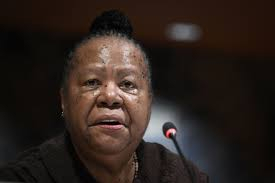
“The Palestinian narrative evokes experiences of South Africa’s own history of racial segregation and oppression,” Naledi Pandor, minister of international relations and cooperation, said at the second meeting of the Palestinian Heads of Mission in Africa, held in the capital Pretoria.
“As oppressed South Africans, we experienced firsthand the effects of racial inequality, discrimination and denial and we cannot stand by while another generation of Palestinians are left behind,” she said.
Pandor said South Africa believes Israel should be classified as an apartheid state and that the United Nations General Assembly (UNGA) should establish a committee to verify whether it satisfies the requirements.
In addition, she said South Africa will continue to put pressure on Israel, as the occupying power.
The Minister was speaking during the Palestinian African Heads of Mission Conference, invited by the Palestinian Minister of Foreign Affairs and Expatriates, Dr Riad Malki, who is currently in South Africa.
She also raised concerns about the continued human rights violations in the occupied territories and that such violations only contribute to the fostering of hatred.
“Israel’s security and that of its future generations do not lie in the annexation of all Palestinian territories, the imprisonment of Palestinians, the erecting of high concrete walls and checkpoints, or the continued blockade of Gaza,”she said.
“Rather it lies in a peaceful and stable neighbour, a sovereign and independent Palestinian State, whose children, like Israeli children, can go to school, play, attend places of worship and compete in sporting activities in peace and security.”
The clash over the holy land, including disputes over borders, Jerusalem, security, and Palestinian refugees has been at the heart of a decades-long conflict between Israelis and Palestinians.
However, the Minister believes that the Israel-Palestine conflict resolution could be attained through sustained dialogue, negotiations, mediation, compromise and understanding from both parties.
Meanwhile, she said recent developments in Ukraine and the response of the most powerful should now make it plausible for the West to support the legitimate struggle of Palestinians.
Pandor has once again lambasted the African Union Commission’s (AUC) unilateral decision to grant Israel an observer status last year.
“The decision is even more shocking in a year in which the oppressed people of Palestine were subjected to bombardments and continued illegal settlements on their land. The AU strenuously objected to the deaths of Palestinians and the destruction of civilian infrastructure. The decision by the AU Commission in this context is inexplicable.”
She said the “unjust” actions committed by Israel offended the spirit of the AU Charter, which embodies the aspirations of all Africans, especially on issues relating to self-determination and decolonisation.
She reminded a group of Ambassadors that Israel continues to illegally occupy Palestine, in defiance of its international obligations and relevant UN resolutions.
“It is therefore incomprehensible that the AU Commission chooses to reward Israel at a time when its oppression of Palestinians has been demonstrably more brutal.”
She said the South African government would continue to support all efforts aimed at the establishment of a viable Palestinian State, existing side-by-side in peace with Israel within the internationally recognised 1967 borders, with East Jerusalem as its capital, in line with all relevant UN resolutions, and international law.
“South Africa affirms that the only way to achieve peace and stability in the Middle East is through reaching a lasting peace between Palestine and Israel, and restoring the legitimate rights of the Palestinian people, in accordance with the two-state solution and the relevant UN resolutions.