
By Lehlohonolo Lehana.
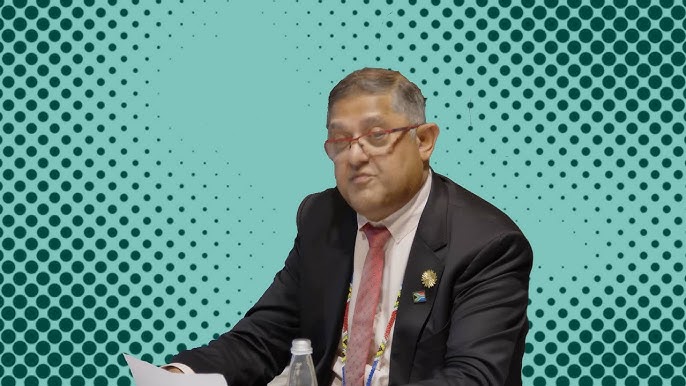
Department of Forestry, Fisheries and the Environment Deputy Minister Narend Singh says global challenges such as climate change, environmental degradation, unsustainable consumption and production practices and resource scarcity have a significant impact on economies, human health and wellbeing.
Singh was speaking on the first day of the company’s Future of Sustainability Conference 2026 in Fourways.
He echoed the call for this to be addressed collectively, with international, national and local action.
Singh touched on the SDGs, he noted that environmental sector was responsible for implementation of eight of the 17 SDGs, with about 70% of the goals directly environmental in focus or cross-cutting in nature to address the sustainability of natural resources.
“We are confronted by the reality of some SDGs have made remarkable progress over the last 11 years, while the remaining SDGs have had mixed and uneven progress and are either progressing too slowly or regressing,” he informed.
Singh said that challenges in implementing the SDGs, including financing for their implementation, were issues that South Africa had consistently raised. He said there was risk that development financing would be redirected to other priorities, placing countries like South Africa behind in its SDG implementation, and broader development targets.
He pointed out that South Africa was at a “critical intersection” in its environmental journey, with considerable natural resources, but grappling with the urgent realities of climate change, addressing the triple challenges of poverty, inequality and unemployment and the necessity of ensuring that the natural wealth benefited the collective.
He underscored the importance of stronger institutional coordination, clearer accountability and improved policy implementation to positively influence environmental governance.
“As we seek practical ways to address the global challenge of climate change, we must enhance our adaptation measures on our economy, particularly the industries, our households and society at large as well as on our environment. The department has accelerated various instruments to ensure that we do everything we can to improve our country’s chances to withstand the impacts of climate change,” he informed.
This includes recent consultations with sector departments, provinces and industry on draft Carbon Budget and Mitigation Plan regulations, laying the groundwork for how major emitters will be held accountable.
These consultations are a precursor to the publishing of the sectoral emission targets (SETs) for public comment, pivotal to translating the Climate Change Act into concrete sector commitments.
As part of the implementation of the Climate Change Act, the department had trained district municipalities on mainstreaming climate adaptation into planning instruments, while further advancing the development of adaptation scenarios to help protect vulnerable communities from the impacts of extreme weather, Singh averred.
He said the department was developing the adaptation scenarios to form the basis for adaptation planning in the country.
“We have enhanced our coordination mechanism with the establishment of the intergovernmental working group on climate change, a technical working group that brings the adaptation stakeholders together and the Presidential Climate Change to provide advice on the just transition.”
As part of the country’s just energy transition, it is piloting green hydrogen and low-carbon steel with the support of development finance institutions and private investors.
Singh stressed that environmental governance would require modernisation of country’s regulatory frameworks to ensure that its systems were transparent, efficient and responsive to people, planet and prosperity objectives.