
By Lehlohonolo Lehana.
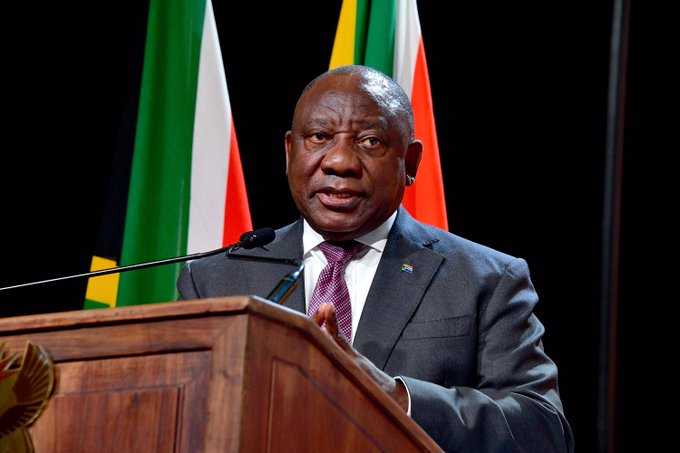
President Cyril Ramaphosa delivered his official address at the George Thabe Stadium in Sharpville on Thursday afternoon to mark Human Rights Day.
Ramaphosa was joined by several Ministers, MECs, Mayors, and thousands of guests in commemorating the 2024 Human Rights Day.
Following the wreath-laying by the president, his entourage descended to the cricket pitch where the national event was held.
This year’s commemoration in Sharpeville coincides with the 30th anniversary of the country’s attainment of freedom and democracy.
During his address, he said the democratic government was doing everything in its power to dismantle the apartheid government’s system.
Ramaphosa said while the journey over the 64 years since the Sharpeville Massacre has been remarkable and the 30 years of democracy have seen great changes in the lives of South Africans, the journey is far from complete.
“Millions of South Africans have been lifted out of dire poverty.
“Eight out of every 10 households have proper housing. Nine out of every 10 homes have electricity and access to clean drinking water.”
South Africans are living longer. Far fewer women are dying in childbirth and far fewer children are dying in infancy.
“More children from poor families are completing school, passing matric, and going on to study at universities and colleges,” he said.
Ramaphosa said this was possible because they are focused on correcting the injustices of the past and meeting the needs of the poor and excluded.
He said the government has returned nearly 4 million hectares of land to people who had been dispossessed of their land and acquired over 5 million hectares of land for redistribution and to provide security of tenure for labour tenants and other farm dwellers.
“We have provided social grants for children, the elderly, and people with disability, and have recently introduced a special social relief of distress grant for unemployed people.
“Government provides free daily meals to millions of school children, has expanded the number of fee-free schools, and has massively increased funding for students from poor and working-class families to attend universities and colleges,” he said.
In addition, since the economy has improved, he said more and more people have been able to exercise the right to freely choose their trade, occupation, or profession.
Despite the unemployment rate being high, Ramaphosa said the number of South Africans in employment has more than doubled in the last 30 years.
“The proportion of executive management positions held by black people increased almost five-fold between 1996 and 2016,” he added.
Gauteng premier Panyaza Lesufi said, South Africans are enjoying the country’s democracy because of the sacrifices of those who died in the massacre.
“If you do take into consideration something that is very key – which is the human rights of these people, the right to access medical facilities, the right to choose where you want to live, the right to choose where you want to stay compared to those days of Group Areas Act and you compared with those days where people could not go to school that is nearby here. When you come here and see the children of this area go to any school of their choice and going to any health facility of their choice and do whatever they want to do without any restriction of being asked of any document whether they stay here or not. You can see that there is major progress that we have made but obviously we can defeat all this at once.”
Justice Minister Ronald Lamola said, the country needs to address inequality among its citizens 30 years since the dawn of democracy.
“After 30 years of our constitutional democracy, it is clear that much has been achieved. However, there are a number of areas where efforts need to be doubled and intensified. There is a need to make the economy inclusive in the next decade, This should be our priority.”
Meanwhile, opposition parties, including ActionSA, BOSA and AZAPO, held a counter-Human Rights Day event.
ActionSA’s Herman Mashaba said, that the governing African National Congress (ANC) had neglected the people of Sharpeville but were turning up now during election season.
“They are insulting the residents going around making wild promises while the country is in big trouble.”
Bosa leader Mmusi Maimane said, “All of us we want the best for our country, particularly our poor people. We are going to fight, and that day is going to happen. One thing that lastly, I want South Africans to understand [is that] the spirit of Robert Sobukwe is not going to be forgotten.
“Whether anybody likes it or not, this day… we grew up from Sub A up to university, the 21st of March, all the time, we would know that it’s Sharpeville massacre. No one is going to change that and one day, we will correct this history. The true history of this country is known…”
Azapo leader Nelvis Qekema said: “Let the spirit of the 69 people of the PAC who were killed rise and ensure that there rises a government that will care about the people who were killed. We need a government that will make sure that we shall never forget the Africans.”