
By Lehlohonolo Lehana.
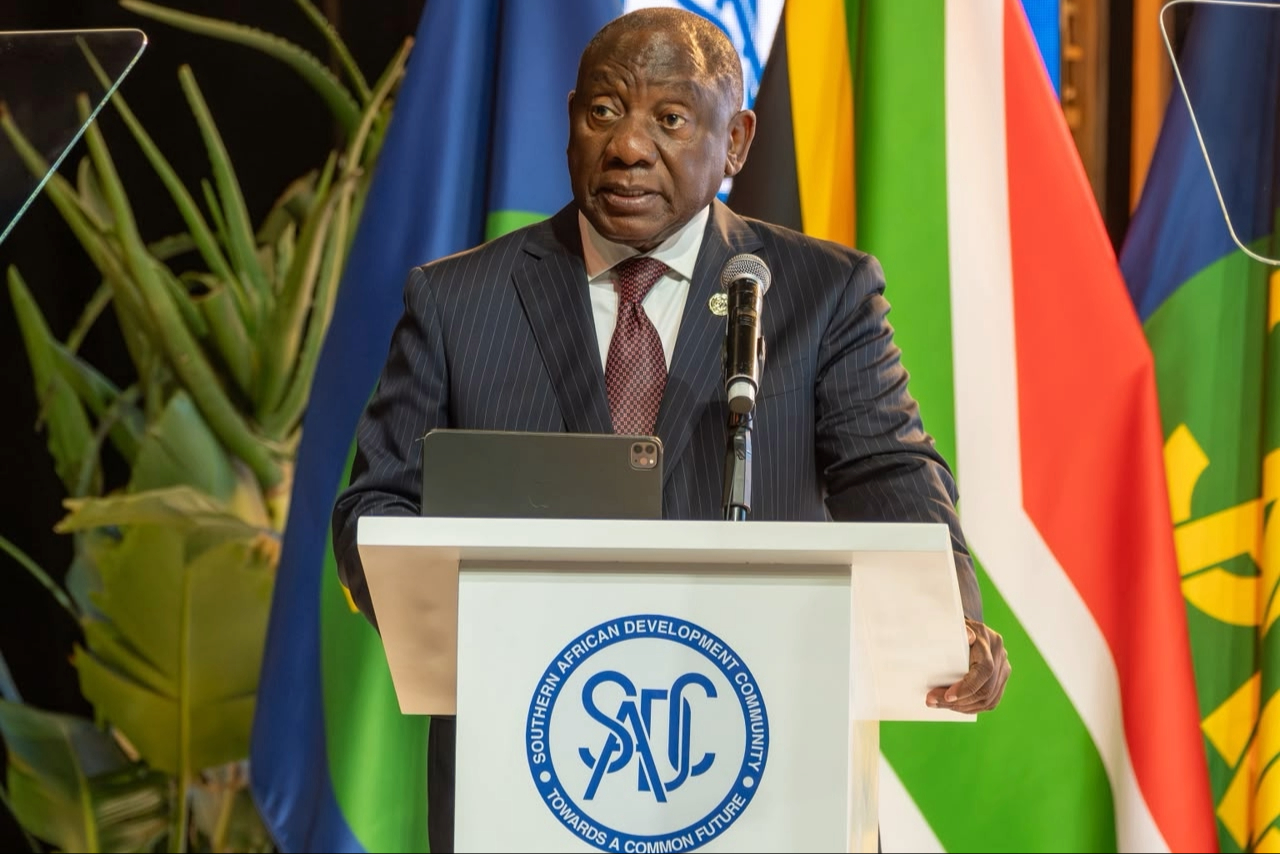
South Africa formally assumed the rotating SADC Chairpersonship at the 46th Ordinary SADC Summit held at the Inkosi Albert Luthuli International Convention Centre in Durban (eThekwini), KwaZulu-Natal, on Monday, August 17, 2026.
The baton moves from Zimbabwe to South Africa with a shared commitment to unity, peace, economic integration and sustainable development.
President Cyril Ramaphosa has pledged to use chairship to deepen regional economic integration and advance resilient, sustainable and inclusive industrialisation.
Ramaphosa said South Africa assumed the responsibility with great humility and a deep sense of responsibility.
He expressed gratitude to outgoing Chairperson President Emmerson Mnangagwa for his leadership.
He also thanked the SADC Secretariat, led by Executive Secretary Elias Magosi, for supporting the Community’s work.
South Africa’s chairship comes as the regional bloc seeks to accelerate implementation of its development agenda, strengthen regional integration and translate its shared vision into tangible economic opportunities for its more than 400 million people.
He said South Africa’s participation in SADC was deeply rooted in the region’s contribution to the country’s liberation.
“As a nation, we owe a debt of gratitude to the members of SADC and its predecessor, the Southern African Development Co-ordination Conference, for their contribution to the achievement of democracy in our country. Our participation in SADC is founded on this history,” the President said.
Ramaphosa pledged to work closely with all Member States while respecting the principles of sovereign equality, mutual respect and consensus building.
He said South Africa would build on the work of previous SADC chairpersons and take forward efforts to achieve the bloc’s Vision 2050 and implement the SADC Regional Indicative Strategic Development Plan.
A key focus would be strengthening economic ties across the region.
SADC recorded economic growth of about 3.4% in 2025, while intra-regional trade accounted for only around one-fifth of the region’s total trade, according to Ramaphosa.
He said the region continued to import products that could be manufactured locally and export raw materials that could instead be processed within Southern Africa.
“We continue to export raw materials that we could process and beneficiate ourselves,” Ramaphosa said.
He argued that greater local processing and manufacturing would create jobs and retain more value within the region.
The President outlined several priorities for accelerating the region’s development.
These include deepening industrialisation and building regional value chains, investing in roads, railways and ports, strengthening energy, water and digital infrastructure, developing climate-resilient food systems and taking greater advantage of the African Continental Free Trade Area.
He called for more minerals and agricultural products to be processed within the region and for stronger cooperation to expand manufacturing.
The commitment comes as SADC seeks to unlock the economic potential of its regional market by strengthening trade and investment links, industrial capacity and cross-border cooperation.
Ramaphosa also committed South Africa to promoting peace, security and stability across the region, describing these as essential conditions for the wellbeing and development of its people.
He said the country would seek to ensure continuity while advancing the region’s long-term development priorities.
The President also addressed the ongoing Ebola outbreak in the Democratic Republic of the Congo, expressing condolences to affected communities and calling for stronger regional cooperation on disease surveillance, emergency preparedness and health security.
He called for a humanitarian ceasefire in affected conflict areas and safe humanitarian access for health workers.
Ramaphosa said the response to the outbreak should also include investment in resilient health systems, research and the African production of vaccines, diagnostics and medicines.