

By Lehlohonolo Lehana.
South Africa’s latest trade data shows the impact of higher fuel prices and a scramble to secure supply as a throttled Strait of Hormuz choked off its traditional Middle Eastern import sources.
Fuel imports from the US surged by almost 80% in a single month.
Still, elevated precious metal prices and vehicle sales helped ensure another trade surplus for SA in March.
SA recorded a preliminary trade balance surplus of R31.9 billion in March, the South African Revenue Service (SARS) reported on Thursday, some R5 billion smaller than in February.
According to the latest data released by the South African Revenue Service (Sars), exports reached R187.9b, while imports stood at R156b, including trade with Botswana, Eswatini, Lesotho and Namibia (BELN).
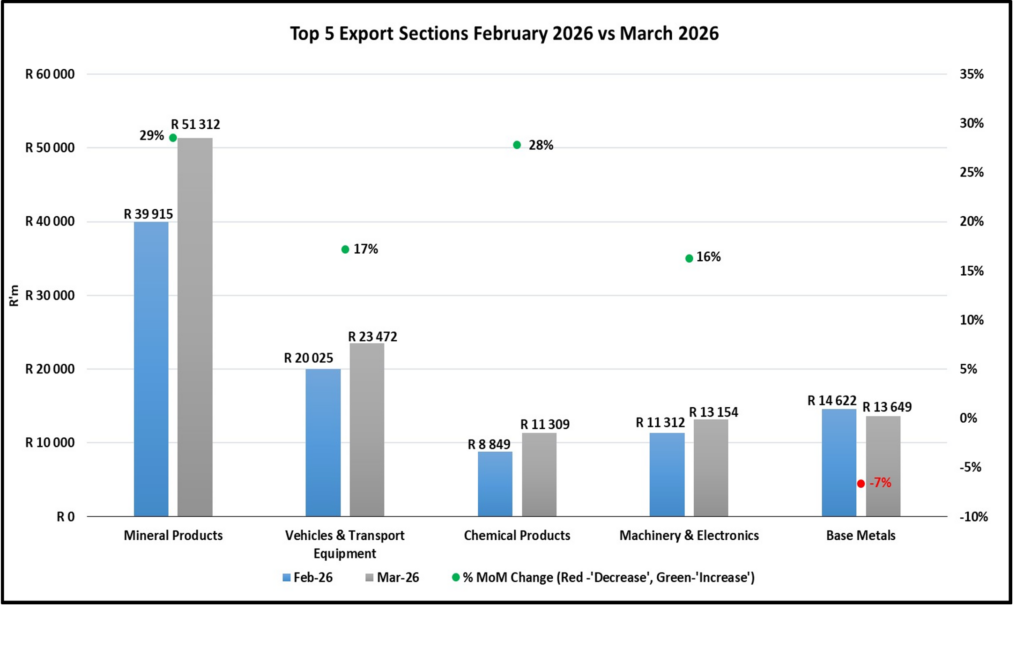
The country’s trade position continues to strengthen, with the year-to-date surplus rising to R75.6b, significantly higher than the R26b recorded during the same period in 2025.
On a month-on-month basis, exports increased by R20.2 billion (12.1%) from R167.7 billion to R187.9 billion between February 2026 and March 2026, whilst imports increased by R24.2 billion (18.4%) from R131.8 billion to R156.0 billion over the same period.
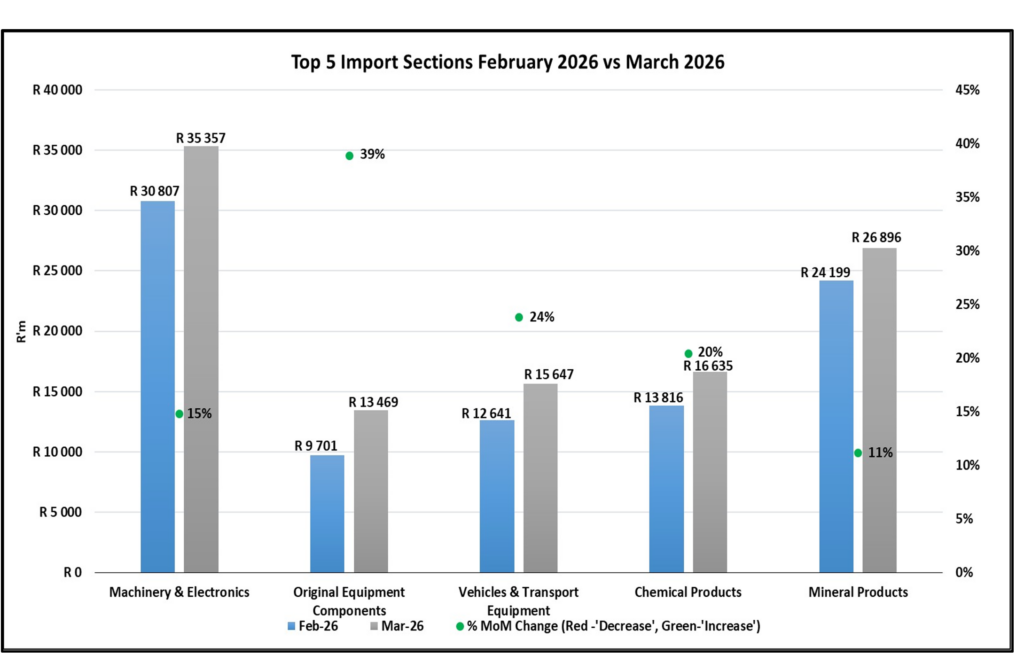
Export flows increased in March 2026, driven by vehicles (passengers), platinum group metals (PGMs), and electrical energy. Import flows increased on the back of higher importation of petroleum oils (excluding crude), original equipment components, and vehicles (passengers).
Due to ongoing Vouchers of Correction (VOCs), the preliminary trade balance surplus of R36.9 billion announced for February 2026 was revised downwards by R1.1 billion, with the final number at R35.9 billion.
February figures revised
Sars revised February’s trade surplus downward from R36.9b to R35.9b, due to ongoing corrections.
Overall outlook
South Africa’s trade performance in March signals continued resilience, supported by commodity exports and manufacturing output.
However, rising imports – particularly in machinery, fuel and equipment – highlight ongoing pressure from domestic demand and global supply chains.