
By Lehlohonolo Lehana.
South Africa’s first exports under the African Continental Free Trade Area (AfCFTA) were loaded on to vessels at the Port of Durban on Wednesday, marking what exporters and government leaders have described as a historic and significant milestone to boost trade on the continent.
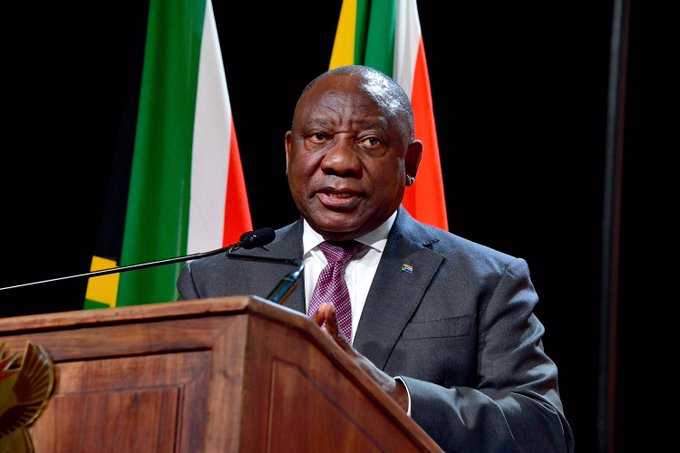
Speaking at the launch to mark the start of the country’s first exports to be dispatched under the preferential trade agreement, President Cyril Ramaphosa said the shipment demonstrated that AfCFTA had become a reality.
“We are in the port city of eThekwini taking forward the dream of an ever larger and ever stronger Africa. African countries trade with the rest of the world but we have limited trade among ourselves,” Ramaphosa said.
According to the African Union (AU) data, intra-Africa exports stand at around 16% of Africa’s total exports, compared with Asia’s 55%, North America’s 49% and the European Union’s 63%.
“African countries trade with the rest of the world but we have limited trade among ourselves. The reason for this is clear: we are principally exporters of raw materials, selling rocks and black liquid to the world, instead of harnessing our oil and the minerals to industrialise our continent. We need to change this.
“We have a unique opportunity to lift millions of people out of poverty by empowering women and young people to change the continent’s business environment. That is why, as the South African government, we are focused on implementing our Freight Logistics Roadmap to improve the efficiency and competitiveness of the country’s rail lines and ports,” the President said.
He said government is working closely with industry to fix Transnet’s rail and port operations in the immediate term and to ensure greater investment in infrastructure into the future.
“Over the last few years, our trade ministers have been finalising rules of origin of what constitutes an African product. They have done well to finalise 92% of the products that nations trade with each other. We need them to be even bolder in further rules of origin. The products that we trade among ourselves must truly be ‘Made in Africa’.
“The modalities for trade in goods has moved faster than for services. We therefore need to put more effort into building African champions in finance, retail and telecommunications, and in expanding tourism between African countries. That is the only way in which our economies will grow faster and sustainably,” Ramaphosa said.
The African Continental Free Trade Area creates the world’s largest free trade area by number of countries, and has the potential to bring transformative change and tremendous opportunities to African economies and businesses.
The President said the implementation of the agreement will accelerate the development of regional and local value chains, offering investors access to a population of 1.7 billion people with a fast-growing continental gross domestic product (GDP).
“Industrial development is core to Africa’s integration. It builds Africa’s productive capacities, adds greater value to our products and diversifies trade beyond the traditional commodities. We have already seen the potential of greater cross-border collaboration.
“South African automotive companies source leather car seats from a factory in Lesotho employing close to a thousand workers and wiring harnesses from Botswana at two plants employing several thousand workers,” Ramaphosa said.
They source copper wire from Zambia, rubber from Cote d’Ivoire, Nigeria, Malawi, Ghana and Cameroon, and steering wheel components from Tunisia.
“These are installed in cars that are then exported from South Africa to other parts of the world. These inputs alone accounted for more than $200 million worth of products traded among African countries and the scope to do more is available to us.
“But it requires bold rules of origin. For every one percent of extra African content, there is an opportunity for a factory or mine based on the continent to supply the products. And as the world moves to green industrialisation, Africa is well positioned to use our critical minerals to leverage industrialisation on the continent,” the President said.
He said the opportunities are vast, with prospects in food and beverages, in cars and trucks, in clothing and textiles.
Watch Live in the video below:
Video Courtesy of Presidency.