
By Lehlohonolo Lehana.
South Africa will require about R1.5-trillion ($84-billion) over next five years to meet targets in transitioning from coal to renewable energy.
The Presidency released the Just Energy Transition Investment Plan on Friday, ahead of COP27, which kicks off on Sunday in Sharm el-Sheikh, Egypt.
The bulk of the funding will go towards the electricity sector, which is the biggest contributor to emissions that contribute to climate change in SA.
The process of developing the plan followed a pledge at COP26 in Glasgow last year by Germany, France, UK, US and the EU (or the Just Energy Transition Partnership, or JETP) of $8.5 billion to assist South Africa’s efforts to decarbonise the economy – to reduce emissions that contribute to climate change.
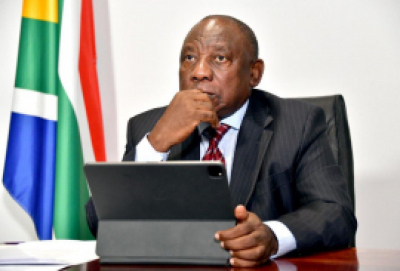
Ramaphosa noted in a briefing hosted by the Presidential Climate Commission that South Africa could not arrive empty-handed at COP27. South Africa has to put a plan forward that to show how the funding will be deployed.
“The Presidential Climate Commission is focused on creating a social partnership around a just transition; defining a vision for a just transition, and means of achieving that vision, covering the necessary sectoral shifts, technological innovation, employment opportunities, and climate finance, as well as conducting independent analysis into climate change impacts on jobs, the economy, and policy.
While the R8.5 billion has been welcomed, it is not enough, and the grant funding component of the offer should also be “upgraded”, Ramaphosa added.
The UN climate talks this year will be hosted on African soil for the second time. There is a strong push for developed nations to up their game and honour their commitments to provide finance to developing countries to mitigate and adapt to climate impacts.
Ramaphosa echoed these calls and said this was a critical message that the South African delegation would be taking to COP27.
“The key challenge for South Africa and our sister countries on the continent is access to new, at-scale and predictable funding that does not further exacerbate our debt crises. Many of our countries, our own included, carry inordinately high levels of debt,” Ramaphosa said.
As it stands, South Africa needs R1.5 trillion over the next five years, but going forward, much more will be needed, Ramaphosa said. “The plan makes it clear, the scale of funding needed to achieve the country’s ambition is significantly higher, much higher than the funding offered through the JETP that we launched together with int partner at COP26.”
Daniel Mminele, head of the Presidential Climate Finance Task Team, unpacked how the funding would be distributed and the nature of the finance.
The three priority areas include interventions in the electricity sector, which is responsible for 45% of the country’s emissions that contribute to climate change. Funding will be needed to develop capacity for new energy vehicles or electric vehicles in South Africa, given that the transport sector is the second-biggest contributor to greenhouse gas emissions. The funding will also be directed to developing the green hydrogen sector, which will provide fuels for sectors which are hard to decarbonise, like aviation.
Importantly the funding includes a “just” component – which involves programmes of support for workers and communities to be reskilled and upskilled to participate in the new industries.
The electricity sector will receive the majority, or 70%, of the funding of about R1.03 trillion. About R648 billion would be needed for infrastructure – this is to decommission coal-fired power stations, expanding and strengthening the transmission grid, and bringing online new renewable energy generation capacity.
Infrastructure investments of R319 billion are also needed to strengthen municipalities’ participation in distribution networks.
Roughly R64 billion will be directed toward just transition programmes, most in Mpumalanga, where the country’s coal value chain is concentrated. “The just component is very central to the transition of the electricity sector and the just investments are embedded alongside the technical ones to make sure the workers and communities are not left behind,” Mminele said.
The green hydrogen sector will receive 22% or R319 billion of the funding. This sector will be critical for reducing emissions after 2030. The investment is also required for port infrastructure, as the plan is for South Africa to be a leading exporter of green hydrogen. The country will also be a consumer of green hydrogen.
The remaining R128 billion will be directed to new energy vehicles. The auto-manufacturing industry is a major employer responsible for 15% of export revenue and contributes about 5.5% to GDP. The shift is needed for the country to remain competitive. “If the sector is not transformed, there are significant economic consequences from the threat of obsolescence,” Mminele said. The interventions in the sector will be focused on localising the supply chain and allowing for the manufacture of new energy vehicles and their components.
The just element of the funding will also support communities affected by the shift away from internal combustion engine vehicles (or those that rely on petrol and diesel).
Ramaphosa will travel to the summit next week as leader of the South African government delegation.
Livestream Video Below:
Video Courtesy of Presidency.