
By Kevin Rademeyer, Sports Journalist.
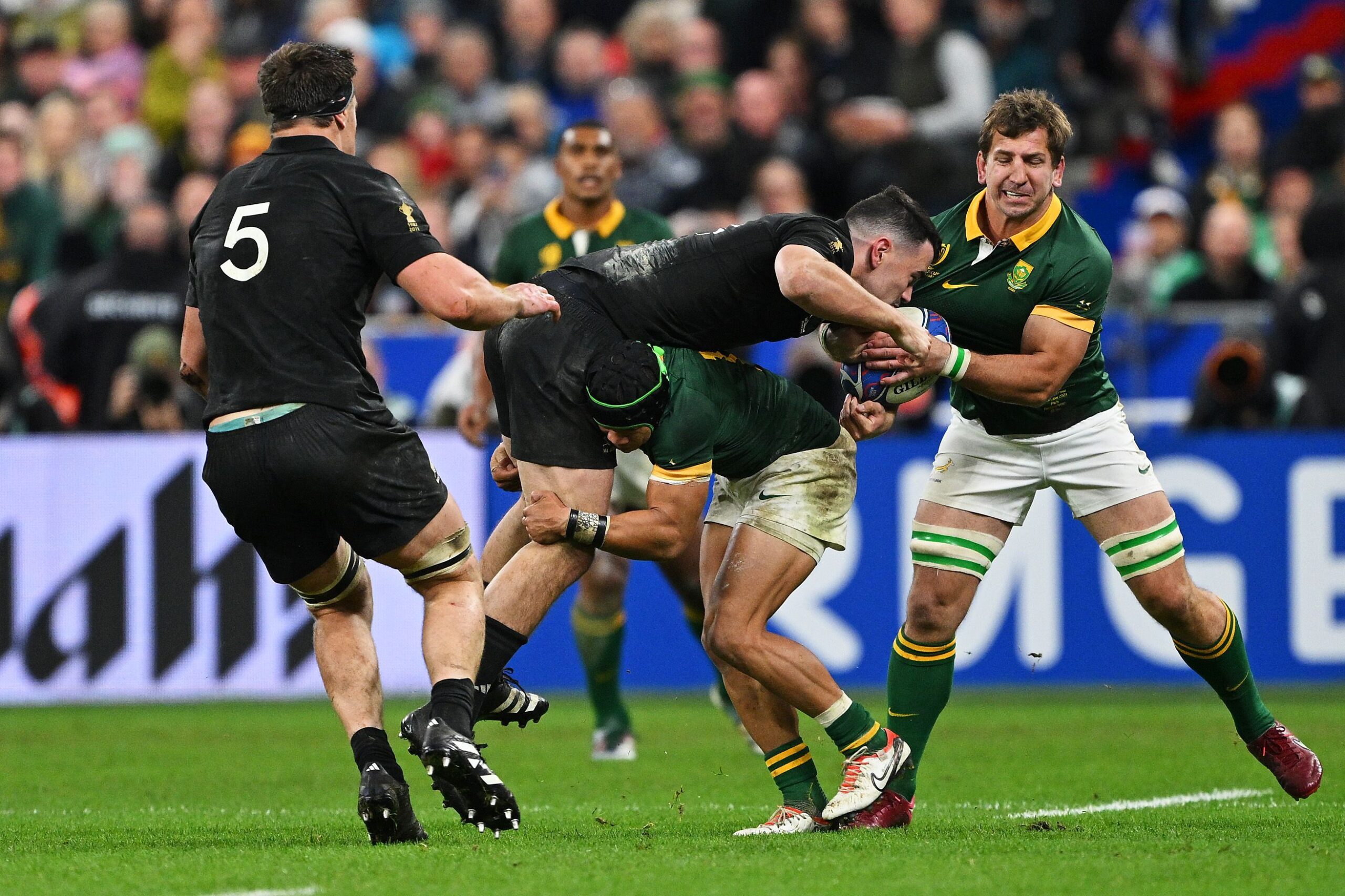
Caption: New Zealand v South Africa_ Final – Rugby World Cup France 2023 (3).
The southern hemisphere reminded everyone where the centre of gravity in world rugby still lies.
Twelve tries in Durban. Six more in Auckland. South Africa and New Zealand won by a combined 62 points, yet the scorelines only hinted at the authority with which they dismantled opponents who arrived believing they belonged in the conversation.
Wales never escaped the Springboks’ grip. Ireland were outplayed in the one area they have spent years claiming as their own. Different matches, different styles, but the same unmistakable conclusion. Rugby’s old powers have found another gear, and the rest are once again chasing shadows.
There were flaws, naturally. Rassie Erasmus will spend far longer discussing handling errors than celebrating seven tries. Dave Rennie will not ignore another second half in which the All Blacks eased off the throttle. That, perhaps, is the most revealing difference between great teams and merely good ones. Victories of 43 -0 and 40 -21 are not viewed as triumphs to be admired but performances to be dissected.
South Africa’s dominance began where so many of theirs do, at the scrum. There are occasions when statistics fail to capture what unfolded. Wales officially conceded a succession of penalties and collapsed under pressure, but numbers cannot convey the psychological damage inflicted every time the two packs crouched. Gerhard Steenekamp and debutant Carlu Sadie reduced experienced international forwards to passengers, reversing them so violently that Cobus Reinach scarcely needed to think before exploiting the retreat.
The Welsh front row was changed. It made little difference. By the closing stages, the contest had become one of survival rather than competition.
Yet Erasmus will know the evening was not flawless. Twenty turnovers missed opportunities and a lengthy spell after half time without points are not the standards the Springboks demand of themselves. Against New Zealand, those errors become invitations. Against Wales, superior muscle simply erased them.
What impressed more than the scoreline was the depth beneath it. Four debutants walked into Test rugby without South Africa lowering their standards. Jaco Williams looked entirely at home, scoring twice and creating more besides.
Carlu Sadie announced himself with immediate authority in the tight exchanges. Paul de Villiers continues to look less like a newcomer and more like the latest product from an endlessly productive Springbok assembly line.
That conveyor belt may be Erasmus’ greatest achievement. Players arrive seemingly ready-made, protected by experienced internationals around them but expected to perform immediately. Increasingly, they do.
If South Africa won through relentless physical pressure, New Zealand won through speed of thought.
Ireland have built their recent reputation around control. Their accuracy at the breakdown, their rhythm through phase play and their ability to suffocate opponents with precision has made them one of rugby’s most admired sides. At Eden Park they discovered what it feels like when somebody performs your own game better than you.
The decisive battle took place over the ball.
New Zealand did not commit bodies unnecessarily to rucks. They trusted their defensive line instead, allowing Ireland to flood breakdowns while quietly maintaining numerical superiority elsewhere. It was intelligent rather than spectacular, but it dictated everything that followed. Ireland enjoyed possession without control, phases without momentum and territory without genuine threat.
The turnover count reflected that imbalance, but more revealing was the quality of the errors. Ireland were not simply forced into mistakes. They hurried themselves into them.
Dave Rennie’s fingerprints are already unmistakable.
His decision to reshape the back row looked unconventional a month ago. Now it looks inspired. Tupou Vaa’i supplied heavyweight carrying and lineout authority from blindside flanker, while Ardie Savea continued performing the work normally associated with an openside. Labels mattered less than function, and the balance worked beautifully.
Then there was Damian McKenzie, who produced perhaps his most complete Test in years. His running threatened constantly, but his tactical kicking and decision making carried equal weight. Every loose Irish kick seemed to become New Zealand territory within seconds.
Not everything was perfect. Once again the All Blacks faded after the hour, allowing Ireland to restore some respectability to the contest. South Africa’s analysts will already have circled those passages because the Springboks rarely allow opponents back into games once control has been established.
Which brings us, inevitably, to what lies ahead.
The rankings still place South Africa first and New Zealand second, separated by little more than a point. Those numbers feel almost incidental now. What matters is that both have spent July making statements in different dialects of the same language.
South Africa remains rugby’s most physically overwhelming side, capable of replacing almost an entire team without surrendering authority. New Zealand appear to have rediscovered the speed, precision and instinct that once made them almost untouchable.
For everybody else, the weekend served as an uncomfortable reminder that while the northern hemisphere continues searching for marginal gains, the game’s traditional heavyweights are busy widening the gap once again.