
By Kevin Rademeyer, Sports Journalist.
Photo Credit: Sportsfile via Getty Images
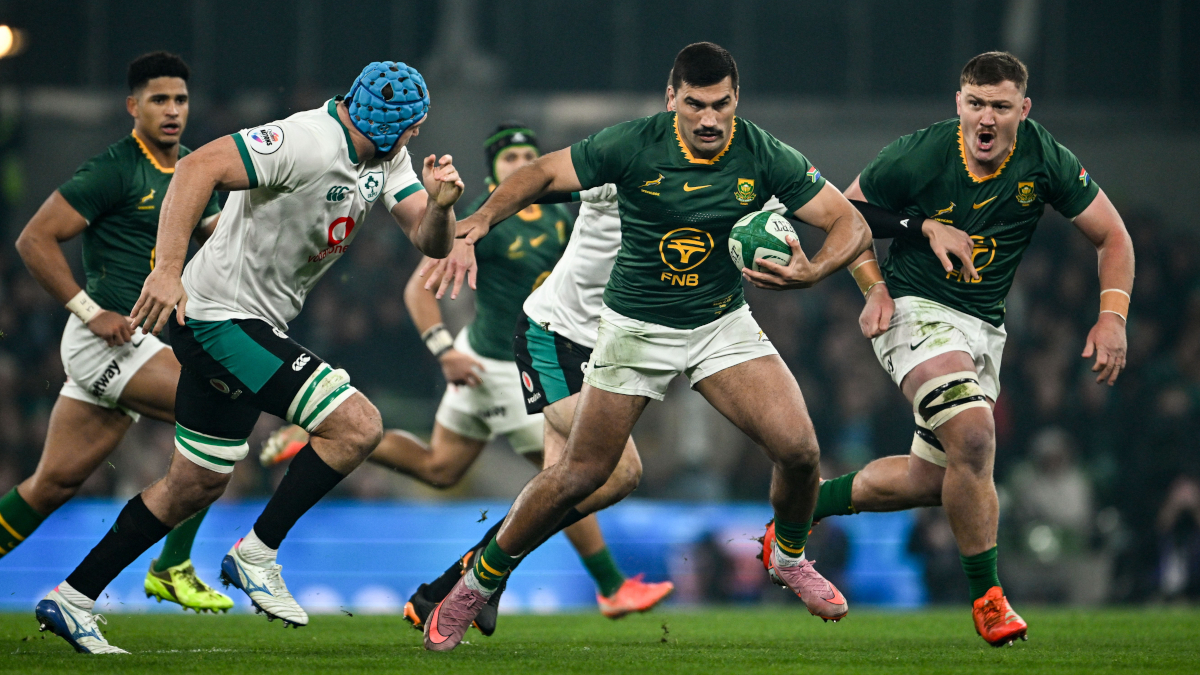
Analysis- South Africa arrived in Dublin with a 13 year drought and left with a 24–13 victory that was every bit as emphatic as the scoreline suggests. The world champions did not simply beat Ireland; they bent the contest to their rhythm, their collisions, and their tactical clarity.
Ireland hailed beforehand by Andy Farrell as ready for a “litmus test” of their standing against the number one team in the world, instead endured a chastening evening in which their discipline crumbled under sustained Springbok pressure.
In the end, five Irish cards , including a bunker upgraded red for James Ryan, told the story of a side suffocated at the set piece, forced into scramble behaviours, and repeatedly punished for technical failings under duress. South Africa’s dominance was structural rather than opportunistic. Every weakness Ireland showed was engineered by the visitors’ superior detail, energy and power.
Springbok Power Creates Irish Panic
The tone was set as early as the fourth minute, when Damian Willemse capped a sweeping counterattack initiated by Jasper Wiese’s turnover and shaped by the interplay of Sacha Feinberg Mngomezulu, Cheslin Kolbe and Pieter Steph du Toit. It was a beautifully layered strike, but more significantly, it established the collision dominance that would define the contest.
From there, Ireland appeared determined to disrupt rather than engage. “They came to spoil,” noted one South African analyst after the match, and the penalty count confirmed it: 16 infringements, many cynical, many born from desperation, most forced by Springbok superiority.
Rassie Erasmus put it plainly. “I thought we were completely dominant for most parts of the game,” he said. “We just could not capitalise in the 22, but that is Test rugby. You must manage those situations.”
Managing situations was exactly what Ireland failed to do. Once Ryan flew into a ruck with a no arms clearout that connected Malcolm Marx in the face, the home side’s structure unravelled. Referee Matthew Carley, who showed six yellow cards across the 80 minutes, repeatedly lost patience with England’s leading European power. The Irish captain’s challenge for consistency became a recurring soundtrack to the first half.
Yet to frame this purely as indiscipline is to miss the foundational truth: Ireland infringed because the Springboks bent them out of shape at every juncture. It was not petulance but pressure.
Scrum Dominance as a Weapon
Ireland’s front row had been widely praised in the lead-up to the fixture, but they were given a sobering lesson here. Marx described it succinctly: “It was a tough game and having that many scrums was not pleasing on the neck, but we had to apply as much pressure as we could. They are a quality pack, but we wanted those rewards.”
The rewards were considerable. Andrew Porter was binned for collapsing, replacement loosehead Paddy McCarthy followed him later, and the penalty try on the stroke of half-time came only after Ireland had conceded repeated infringements five metres from their own line. South Africa’s eight were in complete command: angle, height, timing, foot alignment, and the post–hit squeeze all executed with immaculate precision.
Siya Kolisi explained the team’s decision making: “We always knew what was happening with the cards. We understood they were short in numbers, and the scrum was working for us. That is why we kept going back to it.”
The Springboks turned the set piece into a tactical basecamp. Ireland, by contrast, were reduced to survival drills.
Ireland Overwhelmed at the Breakdown
If the scrum was decisive, the breakdown was definitive. Ireland’s usually slick multi phase attack never materialised because the Boks denied them clean ball. Jasper Wiese, Kwagga Smith and Du Toit were ruthless over the ball, forcing slow ruck speed or penalties.
On the 20 minute mark, Ireland appeared to have crossed through Tadhg Beirne after a superb James Lowe catch, only for replays to show Ryan’s illegal clearout. It was a moment emblematic of the evening: Ireland’s best flashes constantly smothered by technical detail or the absence of it.
Ireland’s brightest moment came with Dan Sheehan’s try while down to 13 men, a superb demonstration of resilience. But resilience was not enough. As Farrell admitted post match, “We needed a near perfect performance. Needless to say, it was the opposite.”
South Africa’s Clinical Edges
The Springboks’ attack was not always tidy, yet it was sharp when required. Cobus Reinach’s score, wriggling past fractured edges after long phase pressure, was followed after the break by Feinberg Mngomezulu slicing past Jamison Gibson Park to kill the contest.
Their only regret will be failing to fully exploit a period when Ireland had 12 men on the pitch. “We were not perfect,” Erasmus conceded. “But the monkey on our backs had to come off.”
The coach was careful not to overstate their display, emphasising that Ireland “were just as physical trying to keep us out”. But anyone in the Aviva could see the decisive gap between the sides.
A Technical, Tactical and Emotional Statement
This was more than a victory. It was a message. South Africa imposed their will on the hosts in every technical domain that matters at Test level. Their physicality had intelligence behind it; their set piece had cruelty; their breakdown work had venom and clarity.
Ireland were not shambolic by nature but by force. This was a top tier side made to look tentative, rushed and panicked by a superior unit. Ireland may lament the cards, but discipline is a technical skill, and on this occasion the Springboks made it impossible for their opponents to maintain it.
South Africa march on to Cardiff for the final match of their tour. Ireland, meanwhile, face the sobering task of using this defeat as a mirror. Against the world’s best, fine margins become chasms if the fundamentals are compromised.
And on Saturday evening in Dublin, the Springboks proved again why they set the standard.