
By Kevin Rademeyer, Sports Journalist.
South Africa left Buenos Aires with a 17 -10 win over Argentina, their 12th consecutive Test victory, but nobody in the travelling camp will have mistaken it for a polished performance. For long periods the Pumas were the better side, quicker in their thinking, more aggressive with ball in hand and sufficiently disruptive in defence to make the world champions look strangely uncomfortable.
And yet, when the match needed to be won, the Springboks found a way. That has become something of a habit.
The difference came after half time when the familiar South African cavalry arrived from the bench. Gerhard Steenekamp, Zachary Porthen and Jan Hendrik Wessels helped change the complexion of the set piece, while Cobus Wiese brought the sort of blunt force that is becoming almost synonymous with the Springbok replacement bench.
Argentina had spent much of the opening 40 minutes taking the game to South Africa. Suddenly, they were being asked questions of a rather different kind.
The scrum began to tilt. The gainline became harder to win. South Africa started to play in the right areas of the field. Cameron Hanekom was at the centre of it.
The number eight was not flawless, conceding a couple of penalties, but he was arguably South Africa’s outstanding starting forward. He carried with purpose, tackled with real authority and made his presence felt around the breakdown. His reward came in the 62nd minute.
A clever kick from Handre Pollard put Argentina under pressure and the resulting five metre scrum gave the Springboks the platform they had been searching for. Hanekom took the opportunity from the back of the set piece and forced his way over.
It was not a pretty try. It did not need to be. It put South Africa ahead for the first time and, more importantly, gave them control of a game that had threatened to slip away from them.
Pollard deserves considerable credit too. When Sacha Feinberg Mngomezulu was struggling to find his rhythm, Pollard provided the calm head South Africa needed. His territorial kicking, decision making and ability to put the Pumas in the uncomfortable corners of their own half became increasingly valuable as the Springboks began to exert pressure.
This was not the sort of match in which a fly half needed to be spectacular. He needed to make the right decision often enough. Pollard did.
The contrast with Argentina’s Santiago Carreras was striking. Carreras was excellent in the first half, manipulating the conditions and finding space with a tactical kicking display that repeatedly exposed South Africa’s difficulties in the air.
The wind was a significant factor. The Springboks struggled to find their range with the boot, and Argentina happily accepted the possession that came with those misplaced kicks.
The Pumas attacked with width and pace, and their defensive line came forward with an intensity that rattled the visitors.
South Africa looked leg weary, as Rassie Erasmus later admitted. “We looked leg weary early on, gave up a lot of territory, and made errors,” Erasmus said.
It was hardly surprising. Several players were returning from injury and had played little rugby in recent weeks. The Springboks had also left 15 players back in South Africa. “I always expected us to look disjointed,” Erasmus added. That may explain the performance, but it does not entirely excuse it.
Argentina deserved to be ahead at half time. Their back row was outstanding, with Pablo Matera bringing his usual menace and Benjamín Grondona continuing to look like a player with a considerable future. Grondona scored Argentina’s opening try after a clever movement involving Boris Wenger, who was one of the hosts’ most impressive forwards.
The Pumas’ wings caused South Africa problems too. Rodrigo Isgro repeatedly challenged the Springbok aerial game, while Ignacio Mendy provided genuine danger whenever he had the ball in space.
That Argentina went into the break level rather than ahead was largely down to a late South African response.
Edwill van der Merwe finished a flowing move involving André Esterhuizen and Canan Moodie, and suddenly a half in which almost everything had gone Argentina’s way had been reduced to 10 10.
Van der Merwe did himself no harm at all in the selection debate. With Kurt Lee Arendse and Cheslin Kolbe still likely to be ahead of him, he nevertheless offered pace, energy and a willingness to compete for every kick.
Then came the second half. And, eventually, the Bomb Squad. It is easy to reduce South Africa’s bench to a slogan, but the value of those replacements was on full display here. They did not simply add fresh legs. They altered the physical contest.
Argentina’s starting front row had been excellent. Without Julian Montoya and with Francisco Moreno making his Test debut, the hosts had more than held their own against a celebrated South African pack. Boris Wenger in particular was impressive.
But the replacement front row could not maintain that resistance indefinitely. Once the Springbok forwards began winning the set piece, Argentina were forced backwards. That gave Pollard the territory he wanted and allowed South Africa to play the final quarter with a degree of control that had been absent earlier.
Erasmus admitted the performance was far from perfect. “It’s a win although it wasn’t pretty and perfect,” he said. “That said, we are happy with the result and with the way we ground it out.” That is probably the most accurate assessment of the afternoon.
The Springboks did not dominate Argentina. They did not produce the sort of performance that will have New Zealand trembling ahead of the looming series. But they showed something perhaps more useful at this stage. They showed that they can be pushed around for long stretches and still find a way to win.
Argentina had one final opportunity to change the story. They came charging towards the South African line in the closing seconds, with a draw still within reach. The Pumas moved the ball across the field and the tryline was tantalisingly close.
Then came the mistake. Matías Moroni knocked the ball on while trying to hold the final pass. Game over. For Moroni, it was a cruel ending. For South Africa, it was the sound of relief. There were concerns too.
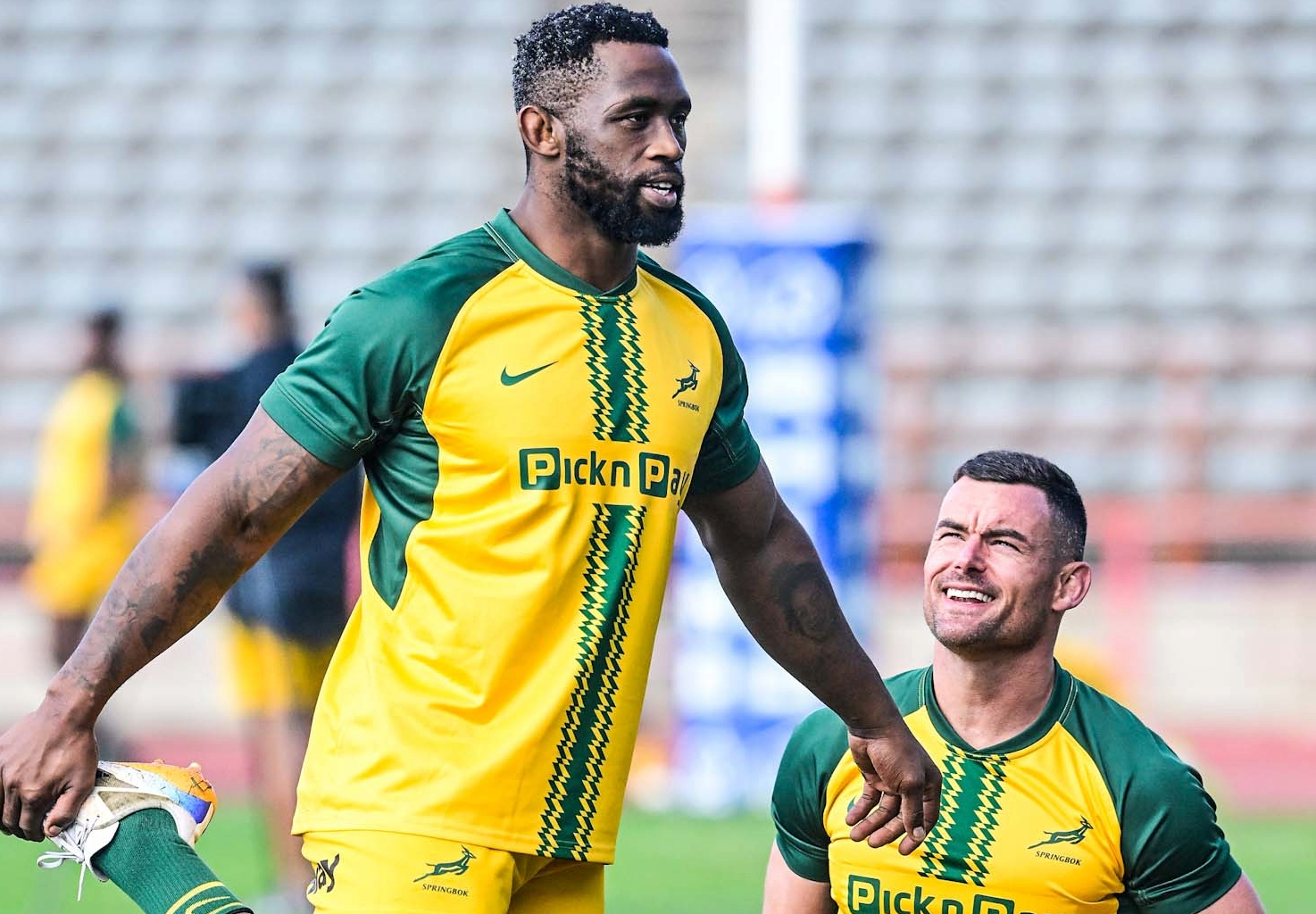
Siya Kolisi lasted only 24 minutes before leaving with a hamstring problem. The Springbok captain said afterwards that he had injured his other hamstring and would undergo a scan. “I hurt my hamstring again, unfortunately. So, I’ll go for a scan and see how far it is,” Kolisi said. He was understandably disappointed but refused to dwell on it. “There is nothing I can do now, other than to go and have a scan and then see how long I’m out for.”
Erasmus was more encouraging. “He injured his hamstring, the other hamstring, but it doesn’t look too bad,” the coach said. For South Africa, that news will matter almost as much as the result with the All Blacks now approaching.
There were other questions too. Feinberg Mngomezulu was courageous but error prone. Lood de Jager looked short of his best on his return, while Aphelele Fassi struggled to impose himself at full back. Eben Etzebeth, playing his first match in months, grew into the contest and completed the full 80 minutes, but this was not yet the Etzebeth we have come to expect.
That is perhaps the point. This was not a finished Springbok side. It was a Springbok side being put through a rather useful examination.
Argentina played with precisely the sort of speed, physicality and attacking ambition that South Africa can expect from New Zealand. They forced the visitors to defend width. They attacked the edges. They contested the gainline. They made South Africa work.
And for 40 minutes, they did a very good job of it. Then the Springboks changed the game from the bench. That is the warning for everybody else.
South Africa can be rattled. They can look disjointed. They can make mistakes and lose territory. But they have an extraordinary capacity to make the final 20 minutes feel like a different sport.
Erasmus knows there is plenty to fix. “Our focus was purely on beating Argentina today, and we had a tough day out there,” he said.
That objective was achieved. The performance can wait. Because when the All Blacks arrive, South Africa will need more than survival. For now, though, survival is enough.
The Springboks are still winning. And after a night in Buenos Aires when it very nearly went wrong, that remains the most important statistic of all.
Scorers:
Argentina – Try: Benjamín Grondona, Conversion: Santiago Carreras, Penalty: Carreras.
South Africa – Tries: Edwill van der Merwe, Cameron Hanekom. Conversions: Sacha Feinberg-Mngomezulu, Handrè Pollard. Penalty: Sacha Feinberg-Mngomezulu.