
By Kevin Rademeyer, Sports Journalist.
Photo Credit: World Rugby.
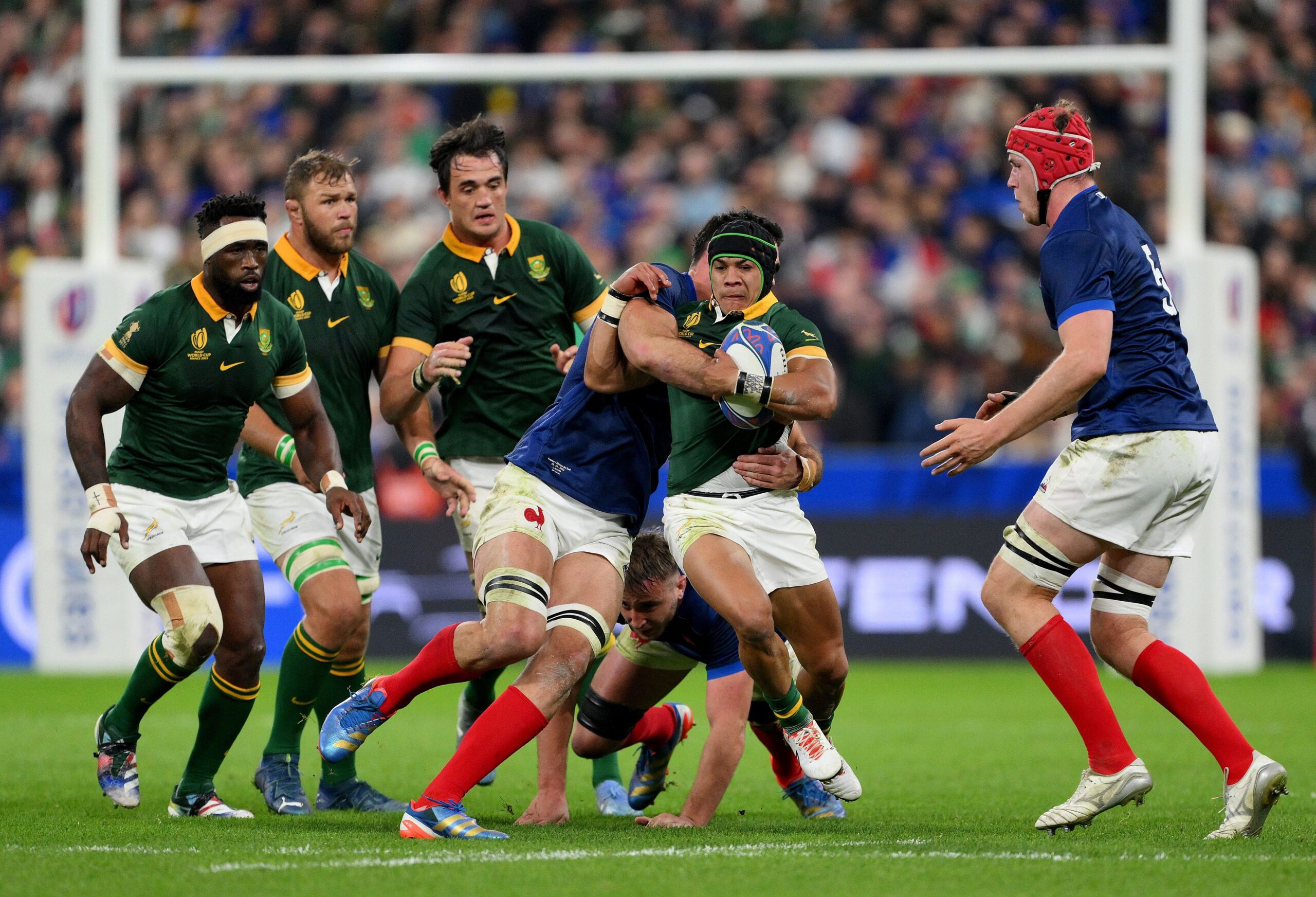
The Springboks have made it to the final, but nobody should mistake their arrival for a convincing march towards another trophy.
South Africa are heading to Twickenham with two successive defeats behind them, familiar questions surrounding their attack and a French side waiting with the confidence of a team that already knows how to beat them.
There is a final to be won. There is also a considerable amount of work to do.
A 20–17 defeat to Ireland in Dublin on Saturday was enough to secure South Africa a place in the inaugural Nations Championship Grand Final, but only because England had earlier dismantled New Zealand 37–12 at Twickenham.
The All Blacks collected no log points, leaving the Springboks and New Zealand level on 22 points. South Africa progressed on points difference, their tournament best defensive record providing the necessary cushion.
It was a narrow escape dressed up as qualification.
The Springboks have now lost four matches this season and suffered back-to-back defeats for the first time since November 2022.
Their only victory in the last four outings came against Italy. More troubling than the results, however, is the growing predictability of their rugby.
Ireland exposed it in Dublin. France had already offered a warning in Paris, where they edged South Africa 21–19 the previous weekend.
The problem is not a lack of commitment. Nobody can question the effort. It is what happens when the opposition refuses to be bullied by the Springbok forward pack, contests the breakdown and forces South Africa to find another way to score.
Against Ireland, the Boks struggled to establish attacking rhythm. They were beaten in the kicking contest, surrendered possession and territory, and found themselves defending against a side that moved the ball with considerably more purpose.
Ireland enjoyed 60% of possession and territory in the first half, scoring three tries to South Africa’s two over the match.
Rob Baloucoune crossed twice after intelligent backline movements, while Rónan Kelleher finished a cleverly constructed lineout move shortly before half time.
South Africa’s response came through Morné van den Berg, whose try followed scrum pressure, and Malcolm Marx, who crossed late after the Boks finally produced a sustained attacking passage.
There were moments of resistance. Cameron Hanekom produced an outstanding try saving tackle on Baloucoune, Sasha held Dan Sheehan up over the line, while Kurt Lee Arendse and Ethan Hooker worked hard in difficult circumstances. But Ireland were more comfortable with the ball, more inventive in attack and better at exploiting South African mistakes.
For Siya Kolisi, the disappointment was unmistakable. “The effort is there, but it’s still not good enough. We’re not playing to our potential, and we need to fix that going into next week,” the captain admitted.
It was an unusually direct assessment from a leader who understands that reputation counts for very little when the scoreboard tells another story.
Kolisi also acknowledged that the Boks had failed to execute their kicking strategy and had not dominated defensively in the manner expected of them. Those are significant admissions heading into a final against France, a team with the attacking resources to punish precisely those weaknesses.
The Springbok captain will need more than words from his players at Twickenham. He will need leadership through the difficult passages, particularly when France begin to move the ball and challenge South Africa across the width of the field.
Felix Jones acknowledged the strain placed on the team’s cohesion by the injuries and the six-two bench split, although he stopped short of suggesting it was decisive.
The uncertainty surrounding Willemse will be particularly important as selection approaches.
France, meanwhile, have arrived at the final in rather better spirits.
Fabien Galthié’s side needed a bonus point victory against Argentina to finish top of the northern hemisphere standings. They delivered with a 45–17 win in Paris, scoring seven tries after being forced to work hard against an uncompromising Argentine side.
Matthieu Jalibert helped unlock the defence, while Kalvin Gourgues crossed twice as France found another gear after half time. Their 26 points put them above England, who finished on 25 despite leading the entire competition for points scored, with 285, and tries scored, with 44.
France have momentum, home continent support and, perhaps most importantly, the psychological advantage of having beaten South Africa already.
The Springboks cannot afford to approach this as another examination of their traditional strengths. The scrum remains an important weapon, the kicking game has its place and the physical confrontation will always be central to their identity. But against France, those elements must become platforms for attack rather than the entirety of the plan.
South Africa led the tournament in kicks in play, with 138. That statistic tells its own story about their territorial approach. It has worked often enough, but opponents are increasingly prepared for it. When the aerial contest is lost and the breakdown becomes a struggle, the Boks need alternative answers.
The tournament has also shown how unforgiving the margins can be. Across 36 pool matches, 264 tries were scored, an average of 7.3 per game. England demonstrated their attacking potential against New Zealand, while France showed against Argentina that they can turn a contest into a rout when their confidence takes hold.
The Springboks, by contrast, have been forced to rely on their defensive resilience to stay in contention. It seems that the Springboks have abandoned their “Tony Ball” experiment, instead focusing on their defensive patterns.
That resilience is reflected in the numbers. South Africa conceded just 97 points across six pool matches, finishing with a points difference of +135. New Zealand’s +41 could not compete with that defensive advantage. It was ultimately the difference between playing for the title and settling for the third place match.
But Kolisi will know that defensive statistics alone, cannot win Sunday’s final.
There was another talking point in Dublin, away from the field. Rassie Erasmus, serving the beginning of a six- match World Rugby suspension, hosted an online watchalong from his hotel room. His repeated muting of the microphone and disappearing behind his laptop attracted attention, but the bigger issue for the Springboks remains what happens when the whistle blows.
They need their coach’s influence translated into a performance that is more composed, more varied and more decisive.
This is a final, and the opportunity to finish the tournament with silverware should not be underestimated. Ireland, England and France have all demonstrated that the northern hemisphere sides are capable of challenging the world champions on their own terms.
Kolisi has been part of a Springbok generation that has repeatedly responded when the pressure was greatest. He will be expected to lead that response again.
South Africa have survived the pool stage, but they have not convinced, especially in the Northern Hemisphere. France will not offer them the luxury of another escape.
The Springboks have spent the past eight years building a reputation that few teams in world sport can match.
They have won back-to-back World Cups, conquered the British and Irish Lions and repeatedly found a way to rise when the stakes were highest.
Under Rassie Erasmus and Siya Kolisi, they have become a team that refuses to accept the odds, a group whose greatest quality has often been its ability to stand together when everything is against them.
There is a reason Kolisi is regarded as one of the greatest captains the game has known, and Erasmus as one of its most influential coaches. They have created something bigger than a collection of talented players.
Now, with another World Cup on the horizon next year, this final offers an opportunity to learn, respond and remind the world what South Africa are capable of.
The players have already given an enormous amount this season, particularly in a bruising 3–1 triumph over the All Blacks in Rugby’s Greatest Rivalry. The question is whether there is one more great performance left in the tank, whether this remarkable group can summon that familiar defiance once again, or whether the demands of a long, punishing campaign have finally caught up with them.
France will test every weakness, every ounce of energy and every measure of belief. But never write off the Springboks when there is something significant to win. They have made a career of answering the biggest questions on the biggest stages.
At Twickenham, the Springboks have one last opportunity to turn a difficult campaign into a successful one. They must rediscover their authority, but just as importantly, their imagination. The final has arrived. Now the rugby must follow.