
By Estea Rademeyer, Sports Journalist.
Photo Credit: Springboks X.
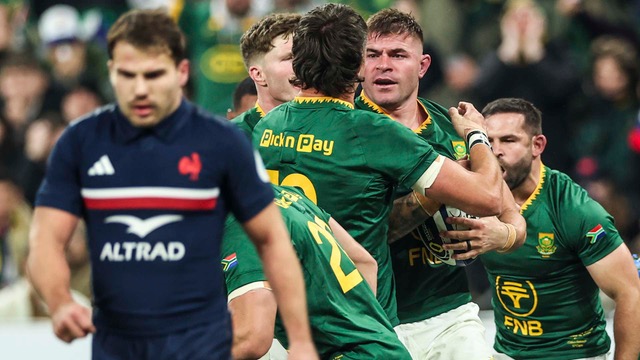
Rassie Erasmus did not hide behind the scoreboard after the Springboks’ 21-19 defeat to France in Paris. Nor did he attempt to disguise the disappointment of a result that cost South Africa the No 1 world ranking and left their Nations Championship campaign hanging in the balance.
But amid the frustration at the Stade de France, the coach also acknowledged that one of his decisions had been made with a bigger objective in mind: the 2027 Rugby World Cup.
The late change to South Africa’s starting front row, which saw Jan-Hendrik Wessels, Gerhard Steenekamp and Thomas du Toit promoted ahead of Malcolm Marx, Ox Nché and Wilco Louw, was not simply a tactical adjustment for France.
Erasmus wanted to see how the combination performed under pressure, with the World Cup in Australia less than a year away. “It was a little bit of an eye on the World Cup, looking at how that combination went,” he said after the defeat. “But as we sit here, it didn’t work because we lost.”
The revised front row performed well enough to make the decision more complicated than the final result suggested. Wessels scored from a rolling maul and impressed at hooker, while Steenekamp and Du Toit helped South Africa establish periods of scrum dominance.
“I really thought Jan-Hendrik and Gerhard and Thomas really played well,” Erasmus said. “It was actually tough to put Malcolm and the guys on because these guys were really doing it.”
He was particularly encouraged by Wessels’ progress in a demanding position. “Jan-Hendrik is really growing into the hooker role. It was good to see him start under pressure against a good scrum, against a good lineout. He didn’t miss a lineout ball.”
The decision had been considered throughout the week before being confirmed shortly before kick off.
“The whole week we were mulling around what should we do,” Erasmus explained. “We announced the team on Monday and then on Thursday we thought, ‘Let’s give it the other way around.”
The experiment was one of several selection and tactical decisions that will inform the Springboks’ planning for the next World Cup. South Africa have built their success on depth, physicality and the ability to change the character of a match through their bench.
Erasmus is clearly still testing combinations and looking for options that can withstand the pressure of a major tournament.
Paris, however, also exposed areas that need attention.
The Boks trailed 21-7 at half time after conceding three converted tries. Lood de Jager’s yellow card in the 12th minute disrupted their defensive structure, while six first half knock ons and repeated penalties handed France the opportunities they needed.
Jasper Wiese’s yellow card after the break was upgraded to a 20 minute red card for a dangerous cleanout on centre Kalvin Gourgues. South Africa were forced to chase the game while a player short, yet still managed to score through Cobus Reinach and Malcolm Marx.
The fightback demonstrated the resilience that has become a defining feature of the Erasmus era. But it could not disguise the lack of accuracy that had put them in trouble in the first place.
“We didn’t play well, so I can’t find a lot of excuses,” Erasmus said. “They took their opportunities when they got them and we didn’t.”
He believed South Africa had enough possession and territory to score more points, but poor execution and hesitant decision making cost them. “There were simple tries we could have scored with one last pass, and perhaps one or two wrong decisions,” he said.
The coach was also critical of the team’s reluctance to turn scrum dominance into points, particularly during a spell in which the Boks won four consecutive penalties. “When we got the opportunity, we were a little bit hesitant, and I have to find out why that happened,” he said.
That assessment matters beyond the immediate Nations Championship standings. At a World Cup, where knockout matches are often decided by a handful of moments, the ability to convert pressure into points is as important as the ability to absorb it.
There is a high probability that the two teams will meet at the semi- final stage of the Rugby World Cup next year. The Springboks will likely need to overcome the All Blacks in Sydney at the quarter final stage, before meeting the French, a week later. This would be a huge test of depth, hunger and resilience.
Captain Siya Kolisi was clear that South Africa had themselves to blame. “They played really well tonight, and I think, as coach Rassie Erasmus said, especially in the first half, we created some opportunities that we didn’t take in the wide channels,” he said. “When they created opportunities, they took them straight away.”
Kolisi praised the team’s effort after the break but accepted that the comeback had come too late. “If you create so many opportunities and don’t take as many in a game against a team like this, you’re not going to get the win,” he said.
The defeat also underlined the importance of discipline. De Jager’s yellow card gave France an early numerical advantage, while Wiese’s upgraded red card made the second half comeback considerably harder.
Erasmus did not dispute the decisions. “I don’t think any of it was intentional, but I agree it should have been a card,” he said. “We can’t moan about that.”
The coach acknowledged that the team had been under pressure after Wiese’s dismissal, but refused to make it an excuse for the result. “The frustration is that the discipline cost us,” he said. “With all the things that went wrong, we played ourselves into that hole. It wasn’t that they forced us to play that way.”
Felix Jones also felt the match had been decided by a series of small moments rather than one defining incident. “We knew it was going to be really tight all the way through and the intensity was sky high just like the previous two or three meetings, so well done to France. They deserved it on the night,” Jones said.
For Erasmus, the immediate challenge is to ensure the Paris defeat does not become a setback that carries into the final stages of the Nations Championship and the longer preparation for 2027.
The Boks have lost their unbeaten record in the competition and slipped behind New Zealand in the race for the southern hemisphere title. They must beat Ireland in Dublin next weekend and need results elsewhere to go their way if they are to reach the final at Twickenham.
The loss of the world ranking also gives the result added significance, although rankings are only one measure of a team’s progress. The more pressing concern for the coaching staff will be the errors that allowed France to build a 14 -point half time lead.
There were positives. Wessels handled the pressure of starting at hooker, the revised front row competed strongly, and the team showed considerable resolve to score twice after the break despite Wiese’s dismissal.
But the Springboks cannot rely on a second half recovery every time they fall behind. France showed how quickly a side with attacking intelligence and pace can punish mistakes, with Dupont and Lucu repeatedly finding ways to unsettle the South African defence.
Erasmus has often used the international calendar to test combinations and broaden the squad. His decision to change the front row in Paris was another example of that approach, even if the result made it difficult to celebrate the experiment.
The World Cup remains the larger target, but the next steps will be measured in the immediate demands of Test rugby. Ireland will provide another examination of the Boks’ discipline, decision making and ability to finish opportunities.
Kolisi believes the players understand what went wrong. “We know what we need to fix,” he said. “Hopefully we will play better next week.”
For a team with ambitions of defending its world title in 2027, that work cannot wait.