
By Lehlohonolo Lehana.
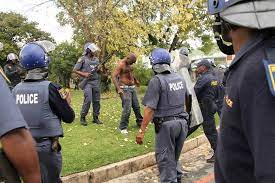
File: The last image Andries Tatane alive, after police beat and shot him with rubber bullets in Ficksburg. @Getty Images.
Ten years ago today, Andries Tatane died after being shot with rubber bullets at close range by police in Ficksburg, in the Free State
Tatane was 33 when a police rubber bullet struck him in the chest on 13 April 2011.
Following his death, eight Free State policemen were arrested on charges of assaulting and killing Tatane. The eight accused were Nicodemus Israel Moiloa, Jonas Skosana, Mothusi Magano, Mphonyana Ntaje, Olebogeng Mphirime, Solomon Moeketsi, Kanathasen Munsamay and Isaac Finger.
Of eight policemen, two were charged with murder and the rest faced charges of assault with intent to cause grievous bodily harm. They were all found not guilty as it was claimed that they could not be identified because of the helmets that were worn.
The street leading to the home of Andries Tatane remains riddled with potholes. Tatane was an activist, husband and a doting father of two young sons. He used to occupy a back room at his home which remained a constant reminder of what he wanted to achieve in life.
Just like many residents, Tatane was unhappy with the dismal service delivery in the area. He joined scores of protestors who took their fight to the doorstep of Setsoto municipality. Sadly, his life was cut short. Police used rubber bullets and batons to subdue him. The incident took place three days before his then four-year-old son’s birthday. Ten years later, the family is still hurting.
Seipati Tatane is Andries Tatane’s sister, ” I still feel the pain that I lost a brother, and I’m sure by now he would be far with his life. I know I would have been the one witnessing his dreams.”
Tatane was a passionate Maths and Science tutor. He dedicated his life to helping high school learners with their studies.
Seipati says her wish is for something to be done for the community, “The sad part is that even what he died fighting for has not happened, we are still suffering in terms of service delivery. I would be happy if something better can happen for the community in memory of Andries Tatane. We know he loved teaching pupils, he loved to witness the success of youngsters. If they can open maths and sciences labs just to assist the community, I would be happy.”
Last month, police minister Bheki Cele and police commissioner Khehla Sitole presented a report by a panel of experts on policing and crowd management, commissioned by the minister following the commission of inquiry into the Marikana massacre. The report highlighted that the anonymity of individual POP members undermined the potential for accountability. It recommended that SAPS ensure that each POP member’s helmet carries a clearly identifiable number.
In fielding questions at the report’s presentation, Sitole said that there is “accountability at all times, for all actions” during crowd management operations. He later went on to confirm that the officers accused in Tatane’s killing were not fired, following a departmental process, and that SAPS retained some of them on active duty in POP.
From IPID’s master case intake registers for the years following Tatane’s killing (April 2012 to March 2020) Viewfinder isolated a sample of 1,157 cases where the police’s use of rubber bullets was mentioned in complaint descriptions.