
By Kevin Rademeyer, Sports Journalist.
There is a quiet shift that happens in tennis every April, almost imperceptible at first. The hard edges of the season begin to soften, the sharp, first strike instincts of January give way to something more deliberate, more patient. The game exhales, and then it slows. By the time the tour arrives at the Monte Carlo Masters, perched above the Mediterranean with its sun-washed courts and long shadows, the transformation is complete. Clay season has begun, and with it comes a different kind of truth.
It is a truth that will be tested, week by week, city by city, as the road bends its way through Barcelona, Madrid, and Rome, before settling, inevitably, on the ochre stage of Roland Garros in Paris. The dates are already marked. The French Open will open its gates on 24 May, and between now and then, the contenders will try to shape themselves into something durable enough to survive it.
Clay does not reveal its secrets quickly. It asks players to wait, to work, to build points instead of ending them. The ball climbs higher, the rallies stretch longer, and matches begin to feel less like contests and more like conversations, sometimes polite, often bruising. It is a surface that resists certainty, which is why the names at the top arrive with both expectation and unease.
Carlos Alcaraz comes into this swing as the man everyone is watching, and perhaps the one best equipped to navigate it. He has already taken the season’s first major, completing a career Grand Slam in Melbourne, and there is something about the way he moves on clay that feels instinctive, almost inherited. The sliding forehand, struck on the run, the sudden drop shot that pulls an opponent forward into unfamiliar territory, the willingness to improvise when structure breaks down. And yet, even for him, clay is not a guarantee. It is a question asked over and over again across six demanding weeks.
Behind him, the familiar figures gather, each bringing their own version of the answer.Novak Djokovic has spent a career solving problems on this surface, not by overpowering it but by outlasting it, turning defence into geometry and patience into pressure. Jannik Sinner arrives with the sense of something unfinished, his clean, linear game still searching for its fullest expression on a surface that prefers curves and margins. Stefanos Tsitsipas, so often at ease in these conditions, knows that this stretch of the season offers him not just opportunity, but necessity.
There are others, too, who wait for this time of year with a kind of quiet confidence. Players like Lorenzo Musetti, whose one handed backhand seems to belong to the clay itself, and Sebastian Baez, who understands the geometry of the surface in ways that cannot be taught. On faster courts they are dangerous. Here, they can be something more.
If the men’s field feels like a slow tightening at the top, the women’s game moves differently, more open, more fluid, though still anchored by a presence that has come to define clay in recent years. Iga Swiatek steps onto this surface with a history that follows her like a shadow across Paris. The heavy topspin forehand, the relentless footwork, the sense that she is not merely playing on clay but shaping it to her will. Even after a season where she did not dominate in quite the same way, she remains the reference point. “As long as I stay healthy, I know what I can do on this surface.”
Yet clay has a way of inviting disruption, especially in the women’s draw. Aryna Sabalenka has learned to temper power with patience, her game evolving into something more adaptable. Coco Gauff, last year’s champion in Paris, carries the memory of what it takes to win seven matches here, where defence is not passive but proactive. Elena Rybakina arrives with the quiet authority of a recent major champion, her clean hitting capable of piercing even the slowest conditions.
And beneath them, the next wave gathers momentum. Mirra Andreeva continues to grow into the demands of the biggest stages, while others circle, waiting for the kind of opening that clay so often provides.
The journey itself matters almost as much as the destination. Madrid, with its altitude, offers a strange distortion, where the ball flies faster and matches can hinge on first strikes that would not hold elsewhere. Rome, at the Italian Open, slows everything down again, asking for clarity and control. By the time players leave Italy, their games have either settled into rhythm or begun to fray.
Through it all, there is a physical toll that cannot be ignored. Clay demands endurance in a way no other surface does. Points extend, matches stretch, and recovery becomes as important as execution. As Jelena Ostapenko once put it, reflecting on the nature of the sport, “Tennis is a 70 per cent mental game. It’s everything in the head.”
On clay, that mental weight feels heavier, because every point asks for another decision, another adjustment, another act of patience. And then, Paris.
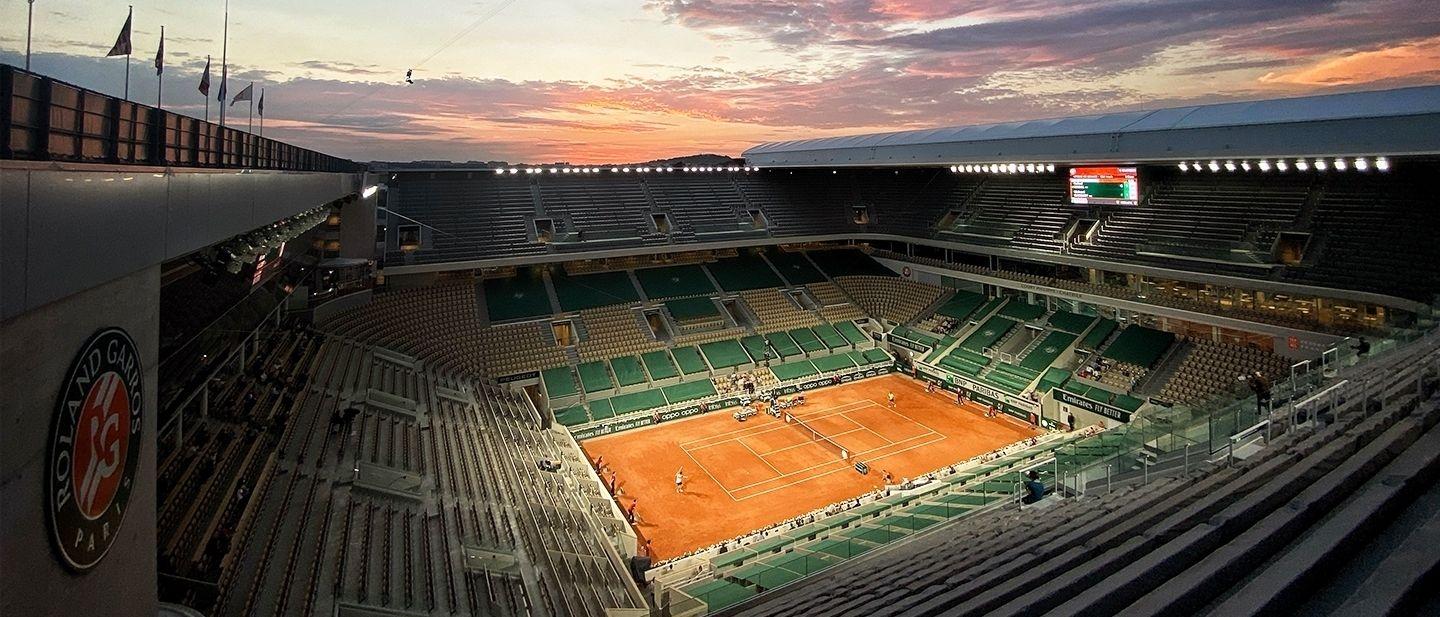
Roland Garros is not simply the end of the clay season. It is its distillation. The courts, layered with crushed brick, glow under the late spring light. The rallies lengthen further. The margins narrow. Seven matches stand between a player and the trophy, and none of them can be rushed.
There is a sense, every year, that the tournament will follow a script, that the favourites will assert themselves and the narrative will resolve cleanly. And every year, clay resists that idea. It produces its own stories. A favourite falters. A newcomer finds belief. A match turns on a point that seemed, at the time, insignificant.
Somewhere between Monte Carlo’s first slide and Paris’s final set, the season will reveal what it always does. Not just who can win, but who can endure the long, slow burn of clay, who can accept its demands and still find a way to impose themselves upon it. By early June, the answers will be written in red dust.