
By Kevin Rademeyer, Sports Journalist.
Every World Cup leaves behind a handful of images that become part of football history.
Pele lifted onto shoulders in Mexico. Maradona’s “Hand of God” and weaving through England in 1986. Andrés Iniesta disappearing beneath a sea of red shirts in Johannesburg. Lionel Messi, finally, holding the trophy aloft in Lusail four years ago.
On Sunday, another will join them.
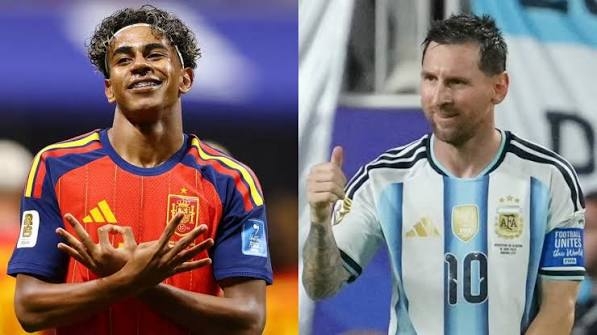
Spain and Argentina arrive at MetLife Stadium with very different ideas about how football should be played, but with exactly the same prize within touching distance. For Spain, it is the chance to reclaim the game’s biggest trophy after sixteen years. For Argentina, it is an opportunity to retain it. For Lionel Messi, remarkably, it is another World Cup final at the age of 39.
Think about that for a moment. This was never supposed to happen.
Messi himself believed Qatar would be his farewell. Instead, he has spent another month reminding the football world why comparisons with anyone else eventually become pointless. Eight goals, four assists and countless moments that statistics simply cannot explain have carried Argentina back to where they believe they belong.
The temptation, as always, is to make this final about one man. Spain won’t.
Luis de la Fuente’s side have quietly become the tournament’s most complete team. They don’t overwhelm opponents with frantic pace or moments of individual brilliance. They wear them down. They monopolise possession, suffocate space and patiently wait for mistakes. France discovered in the semi-final that chasing Spain for ninety minutes is as exhausting mentally as it is physically.
It is not glamorous to everyone. It is devastatingly effective.
De la Fuente laughed this week when he was asked whether Spain would assign somebody to mark Messi. He recalled facing a 16-year-old Messi in a youth match more than two decades ago. Sevilla assigned a dedicated marker. The defender was substituted after receiving a yellow card.
Messi scored four times. The story drew laughter, but it also made the point. There is no blueprint for stopping football’s greatest player. You don’t stop Messi. You merely hope to limit the damage.
Spain will try to do that by staying true to themselves.
Rodri remains the heartbeat of the side. Fabián Ruiz has quietly enjoyed one of the finest tournaments of any midfielder, while Lamine Yamal, still working his way back to full fitness, possesses the sort of genius capable of changing any final with a single touch.
The build-up has been anything but routine. Violent thunderstorms sweeping across New Jersey forced Spain to abandon their final training session, leaving coaches to finish preparations indoors while FIFA monitored lightning around the training ground. It was hardly ideal, but by Sunday evening nobody will remember how the finalists prepared.
Only how they played. Because this is what World Cup finals do.
They reduce careers, systems and reputations to ninety minutes—perhaps a little longer—and ask one simple question. Who deserves to be remembered forever?