
By Lehlohonolo Lehana.
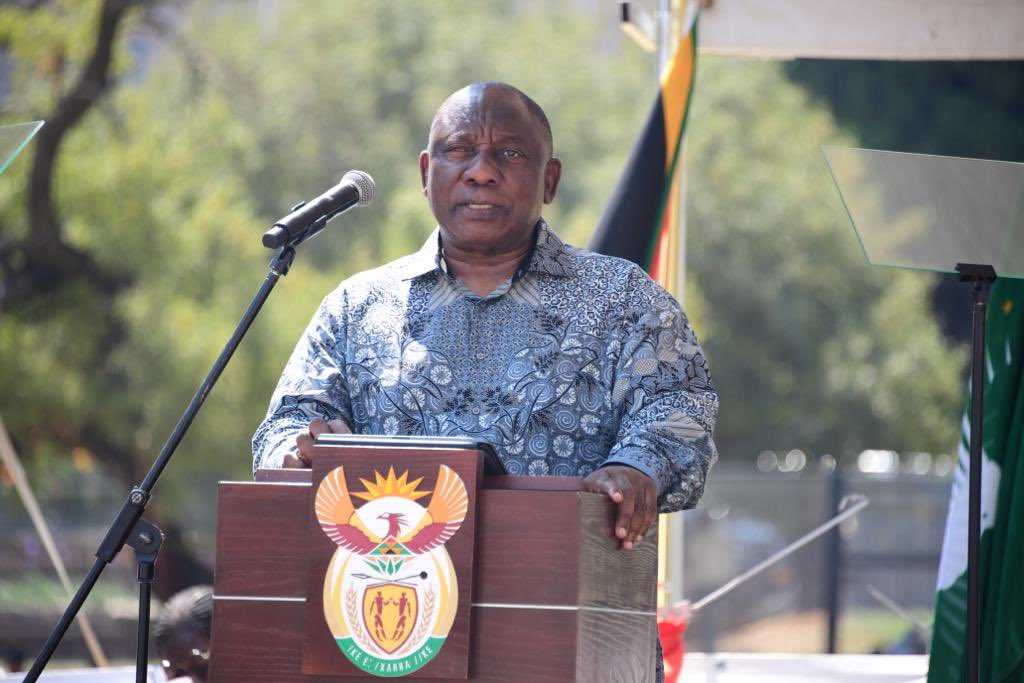
President Cyril Ramaphosa was frank about the mammoth task that lies ahead in moving the country forward, in terms of creating the requisite jobs and expanding the economy.
However he commended the role played by the country’s commitment to strengthening social protection through initiatives designed to propel the recovery trajectory.
Following the praise of the country’s sports teams, the president focused on updating the nation on the progress being made in the country’s economic recovery.
Over the last two years, the number of people with jobs has increased by two million, bringing the level of employment close to its pre-pandemic level.
“The special SRD [Social Relief of Distress] Grant, known as the R350 grant, which we introduced in 2020, has kept millions of people out of poverty, and continues to provide much-needed support for those who are unemployed.
“The Presidential Employment Stimulus has created over 1.2 million opportunities since its establishment, representing the largest expansion of public employment in South Africa’s history,” the President said.
To date, over four million young people have registered on the SAYouth online platform, and more than one million of them have been able to access opportunities for learning and earning.
Ramaphosa listed many features of South Africa’s economy, political and social sphere that run counter to narratives that the country is heading for a failed state.
Reforms – Energy Action Plan
Ramaphosa told the nation that progress is being made towards ending load shedding.
“We are making progress towards ending load shedding. Our greatest priority has been to reduce the severity and frequency of load shedding to achieve energy security. Over the last few months, there has been a measurable decline in the severity of load shedding, “the President said.
He noted that the Energy Action Plan he announced in July last year is showing positive results, “giving us greater confidence that we will bring load shedding to an end”.
The President said that regulatory reforms that have been initiated have enabled a massive increase in private investment in electricity generation, with over 12 000MW of confirmed projects in development.
Following the introduction of tax incentives and financing mechanisms, he said that the amount of installed rooftop solar has more than doubled to over 4 500MW in the last year.
“The steady progress we are making in resolving the energy crisis is a reason for hope,” he said.
Tackling crime and corruption
The President said the South African Police Service has established 20 Economic Infrastructure Task Teams throughout the country to protect critical infrastructure and tackle the “construction mafia”.
“We are seeing results in arrests for illegal mining, cash-in-transit heists, cable theft, drug smuggling and similar crimes. Increasing the number of police men and women will further strengthen our capacity to curb acts of criminality.
“I have also extended the employment of 880 members of the SANDF [South African National Defence Force] to support the police in combating criminal activity that targets critical economic infrastructure. The police have arrested several people for extortion at construction sites and made over 3 000 arrests for illegal mining.
“Through the intensive efforts of our law enforcement agencies, dozens of illegal mines, unregulated coal yards and unregistered second hand dealers have been shut down.”
Additionally, the Economic Infrastructure Task Teams have confiscated significant quantities of copper cable, rail tracks, coal and other metals.
Turning to State capture, the President acknowledged that over the last four years, the National Prosecuting Authority (NPA) Investigating Directorate has taken 34 State capture and corruption cases to court, involving 205 accused persons.
Freezing orders of R14 billion have now been granted to the Asset Forfeiture Unit for State capture related cases. Around R5.4 billion has to date been recovered and returned to the State.
“As recommended by the State Capture Commission, we are putting in place laws, institutions and practices that reduce the potential for corruption of any sort and on any scale.
Infrastructure
Another commitment made in the Reconstruction and Recovery Plan was to fix South Africa’s infrastructure through renewed investment in maintenance and construction of new projects.
The President highlighted that several significant infrastructure projects are underway.
“These projects are both contributing to greater economic activity and jobs, and providing much-needed infrastructure for the growth of our economy and the needs of our people.
“These infrastructure projects range from social housing, road construction, rural bridges, and dam constructions, ” he said.
Ramaphosa further highlighted that the Passenger Rail Agency of South Africa has to date restored operations on 26 out of 40 commuter rail corridors.
To continue with the restoration of the country’s commuter rail corridors, he said R50 billion will be spent over the next three years to modernise the passenger rail network.
As part of the infrastructure build, the President said that the sixth administration is undertaking significant water infrastructure projects. These include Phase II of the Lesotho Highlands Water Project and the Mzimvubu water project in the Eastern Cape, which will involve an investment of R17 billion.
“Around the country, water treatment works are being upgraded, pumping stations are being repaired, and pipes are being laid to get water to under-serviced areas,” he noted.
Logistics system
Ramaphosa said the country is making progress in restoring its logistics system to world-class standards, so that SA can export goods to global markets.
The National Logistics Crisis Committee is overseeing a range of interventions to stabilise and improve the performance of the logistics system in the short term, in addition to ongoing reform to improve its efficiency and competitiveness in the long term.
He said the Transnet board has developed a turnaround plan, which aims to increase volumes transported on SA’s network.
“Progress is also being made with the introduction of private sector participation in container terminals. I want to make it clear that South Africa’s port, rail and electricity infrastructure are strategic national assets, and that they will remain in public ownership.
“However, introducing competition in operations – both in electricity and logistics – will create greater efficiency and reduce prices in the long term, just as the introduction of competition in the telecommunications sector has led to greater choice and enormous benefits for consumers,” he said.
Strengthening municipal performance
The President said urgent and necessary interventions are being undertaken at municipal level in order to improve service delivery in the areas of water and sanitation, electricity, roads and waste collection.
“These interventions are accelerating service delivery where basic services have collapsed.
“While addressing the immediate problems, we are introducing necessary institutional reforms and professionalisation in the appointment of senior municipal officials.”
Spending on health, education, policing and other essential services will be protected as far as possible, the President said.
“As we move to target spending on programmes that are working for the poor, we need to acknowledge that our social grants, including the SRD Grant, as well as our public employment programmes, are vital in supporting those who are vulnerable.
“These programmes have not only reduced poverty, but have enabled recipients to search for jobs and to engage in other economic activity to support their livelihoods.”
Acknowledging the sustained challenges imposed by domestic and global pressures on the South Africa economy, the president made it clear that constraints to growth, including load shedding and the underperformance of the ports and rail network, must be overcome if the country is to realise its own economic growth targets.
Government spending, the President noted, has exceeded revenue since the 2008 global financial crisis, without a commensurate increase in economic growth.
“As the Minister of Finance has noted, for every rand that government collects in revenue, 18 cents go towards servicing our national debt. This means that we are now paying more in interest on our national debt than we are budgeting for the police force.
“Ultimately, more rapid and inclusive growth is the only solution to unemployment, poverty and inequality. Growth is also necessary for the sustainability of public finances.”
More pertinently, the president said that National Treasury is committed to bringing stability to the country’s debt and balancing the budget. Its strategy will be fully explored at the mid-term budget on Wednesday (1 November).