
By Gram Slattery and Humeyra Pamuk.
Photo Credit: Daniel Torok.
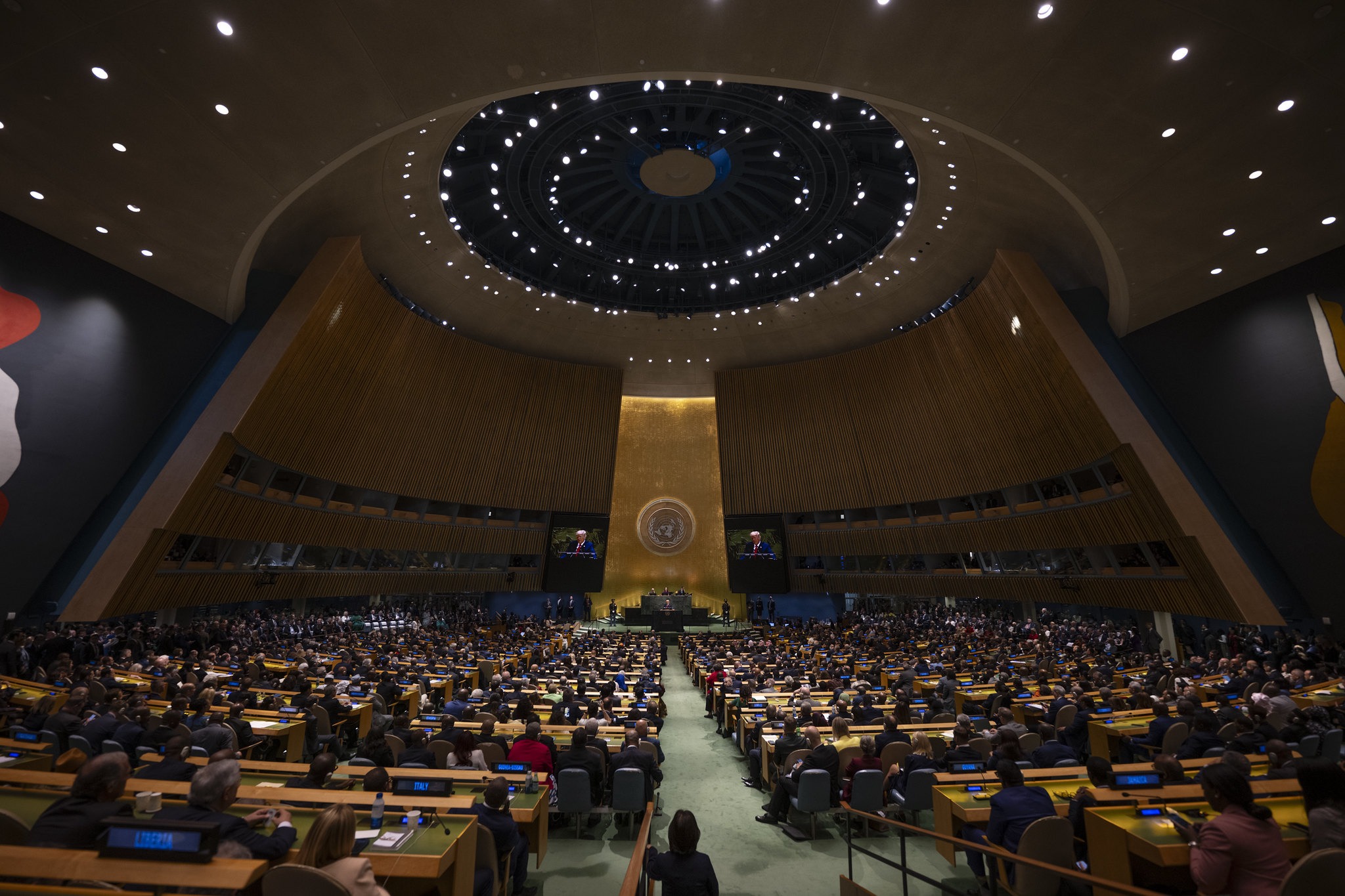
US President Donald Trump used his UN General Assembly speech on Tuesday to make the case for his war on Iran, arguing he has prevented Tehran from obtaining a nuclear weapon and warning that he could “annihilate the Islamic Republic” if no deal is reached to end the conflict.
While predicting his administration would strike a peace deal with Iran following the November 3 US midterm elections, Trump called on other nations to join America in isolating Iran economically to force it to the negotiating table.
“I have a big decision to make. Will a deal be made with Iran that lets them rebuild and create a far greater country than it ever was before?” Trump said. “Or do I annihilate the Islamic Republic and do it quickly, never giving them a chance to kill and destroy people and countries again?”
Since returning to office last year for a second term, Trump has sent waves through the global order, joining Israel to attack Iran, ordering a raid on Venezuela that captured the country’s leader, and threatening to seize Greenland.
In a 37-minute speech, Trump laid out his foreign policy vision, contending that the war with Iran would spare the world the threat of a nuclear-armed menace while maintaining that US military dominance in the Western Hemisphere was essential to preventing crises from taking root.
“Our actions in Venezuela are proof that the United States will no longer permit threats to America to gain a foothold anywhere in the Western Hemisphere,” Trump said. “While others have spoken of peace, I have made peace.”
Outside the UN headquarters, dozens of anti-Iranian-government demonstrators gathered, a few of them holding up signs calling for democracy and decrying dictatorship.
Trump brushed aside suggestions that the midterm elections, in which his Republican Party risks losing control of Congress, could constrain his handling of the war. Some analysts have argued that a Democratic takeover of the legislature would weaken his leverage in the conflict.
“What they don’t realize is that I’m not running,” Trump said, referring to the leadership in Tehran. “I did that already, and won in a landslide. We won in a giant landslide, and I’ll be here for 2-1/2 years.”
Diplomatic Whirlwind
Taking aim at US neighbors, Trump labeled Mexico “the epicenter of cartel violence,” urged its government to “reclaim control of its soil,” and said his administration was pursuing “a fundamental change in the situation in Cuba.”
Members of the Cuban delegation walked out of the hall as Trump referenced his pressure campaign against the country.
“It’s an absolutely failed state, it’s failing like never before, and it will fall,” said Trump, adding that US Secretary of State Marco Rubio was overseeing negotiations with the US neighbor.
“We will not allow a haven for foreign adversaries to threaten America on our own doorstep, right at our doorstep.”
Yet Trump’s appearance was less dramatic than in 2025, when he used a combative speech to chastise world leaders, warning that some countries were “going to hell,” and complained about UN facilities after being briefly stranded on a malfunctioning escalator and suffering an initial teleprompter failure.
Trump renewed his criticism of the UN, highlighting his efforts to cut its bureaucracy, but offered no fresh attacks or indications that the US would leave any additional UN agencies.
Trump spoke less than a week after a UN fact-finding mission said it had reasonable grounds to believe US forces committed war crimes in two strikes on Iran, including one that hit a primary school in the southern city of Minab.
He renewed his criticism of international bodies that could serve as a check on US power, singling out the International Criminal Court and declaring that US military personnel would not be subject to its authority.
“We will never allow US service members or anyone else to be investigated or given show trials by an anti-American tribunal with no jurisdiction over us,” he said.
Ahead of a UN Security Council meeting on AI and international security on Wednesday, Trump acknowledged the challenges of the new technology but said “I’m not going to stifle growth of something that will be bigger than the Industrial Revolution.”
The speech kicked off a day of high-level diplomacy at the United Nations, where Trump was due to meet more than a dozen world leaders as wars in the Middle East and Ukraine continued to test his foreign policy agenda.
After his speech, Trump was scheduled to meet with no fewer than 11 world leaders, including British Prime Minister Andy Burnham, Ukrainian President Volodymyr Zelenskiy, Venezuela’s interim leader Delcy Rodriguez, and the representatives of the Gulf states of the United Arab Emirates, Saudi Arabia, Oman, Bahrain, Kuwait and Qatar.
© 2026 Reuters.