
By Lehlohonolo Lehana.
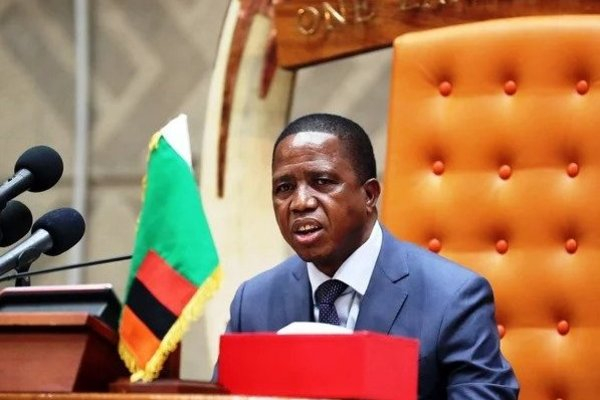
Zambia President Edgar Lungu has declared Friday, August 13, as a public holiday to allow a smooth completion of electoral process.
Zambians will be casting their votes in a general election on Thursday, August 12, 2021, which is also a public holiday.
According to Article 56 (2) of the Constitution Amendment bill No. 2 of 2016, the day on which a general election is held is a public holiday.
“His Excellency the President of the Republic of Zambia Mr. Edgar Chagwa Lungu has declared Friday, 13th August 2021, the day after the general elections as a public holiday. This, therefore, means that both Thursday, 12th August 2021 and Friday, 13th August 2021 shall be non-working days,” Secretary to Cabinet Dr Simon Miti said.
Dr. Miti however said all institutions that provide essential services should ensure that they put measures in place to avoid disruption of services.
“As the country goes to the polls, the government wishes to appeal to all eligible voters to turn up in numbers on 12th August and exercise their right to vote. Further, as they exercise the right to vote, members of the public are urged to observe the Covid-19 guidelines to prevent the spread of the pandemic,” Dr. Miti said.
Meanwhile Zambia’s main opposition leader said he was blocked from flying into the central Copperbelt Province, a region that could swing next week’s election where he was due to campaign.
The copper-rich country goes to the polls on Thursday in a closely-contested and essentially two-horse race between longstanding adversaries, veteran opposition leader Hakainde Hichilema and President Lungu.
Hichilema’s party – United Party for National Development (UPND) – said in a statement that his “flight permit into the Copperbelt (was) cancelled at the last minute”, with no reasons given.
An officer on duty at air traffic control told AFP that the flight “hasn’t been cancelled, it has been rescheduled”.
But Hichilema’s spokesperson Anthony Bwalya rejected the explanation, calling the move a “deliberate attack on our freedoms”.
“Our plan was to get to Copperbelt today but they have denied us permit,” Bwalya told AFP.
Tension has been rising in the lead-up to the August 12 polls, with at least three ruling Patriotic Front party supporters killed.
The Copperbelt province is central to Zambia’s economic and political life and could swing the election.
It is closely tied to the country’s copper-reliant economy and has been the birthplace of powerful labour movements and a political training ground for several politicians who later became state presidents.
Zambians in the mood for political change
The general mood across the country points to the sort of nervous euphoria for change last witnessed in 1991, when the then opposition Movement for Multiparty Democracy (MMD) defeated the ruling United National Independence Party – the party of Kenneth Kaunda that had had ruled Zambia since independence.
This feeling is driven mainly by voters’ outright opposition to Lungu rather than support for Hichilema. In the capital Lusaka and the Copperbelt – two crucial urban constituencies that previously voted PF but are likely to swing to the opposition – the desire for change can be seen in the sometimes-hostile reception that PF campaigners have received.
While campaigning on the politically influential Copperbelt Province on 7 August, Lungu vowed to arrest Hichilema, his main rival whose support is rising considerably there, if he wins re-election for alleged corruption during Zambia’s privatisation of the mines in the 1990s.
At the time, Hichilema worked for a private audit firm that was hired by the government to evaluate the value of state assets to be sold. Lungu claims that Copperbelt residents are poor today because Hichilema took advantage of the privatisation process to enrich himself instead of negotiating better deals for the government.
Critics argue that if the president had tangible evidence, he would have had the opposition leader arrested and prosecuted long ago. Lungu hopes that this threat would, however, shore up his waning support among mineworkers and discredit his opponent ahead of the UPND leader’s much-anticipated visit to the region.
The desire for change is also evident in the size of crowds that Hichilema has been able to attract both before and after the Electoral Commission of Zambia (ECZ) suspended physical campaign meetings in June to curb the spread of COVID-19.
Why the people want change
There are several factors behind the president’s unpopularity. One is the high cost of living, thanks to a faltering economy. According to the latest data on chronic poverty in Zambia from the Overseas Development Institute and Poverty Action, the proportion of adults who cannot afford to have more than one meal a day has risen to 40% under Lungu’s rule.
The second is the high levels of income inequality. Despite being a lower-middle-income country, latest World Bank records show that nearly 60% of Zambia’s 18.8 million people earn below the international poverty line of $1.90 per day (compared to 41% across Sub-Saharan Africa). While poverty is endemic, several PF leaders have continued to accumulate and display obscene or grotesque wealth in ways that have alienated the governing party from many Zambians.
The third is the country’s staggering debt, which, alongside the Lungu administration’s demonstrated lack of commitment to fixing its debt crisis through better fiscal management, has undermined the government’s capacity to improve service delivery, invest in social sectors, and reduce high unemployment. When the PF won power in September 2011, Zambia’s external debt stood at $1.9 billion. By December 2020, it had risen to $12.74 billion. While the government insists that this money has been invested in building roads and infrastructure, the opposition argues that much of it has been lost to corruption, another central concern of many voters, one which, according to the annual trends reports of the Financial Intelligence Centre, has worsened under Lungu’s watch. The lack of service delivery has been felt most notably in the health sector, where the effects of the coronavirus pandemic have exacerbated the crisis.
The fourth is the violent behaviour of the PF cadres who control the markets and bus stations. Lungu’s reluctance to stop their activities has emboldened their conduct, undermined the authority of the police, and left the public greatly exposed.
The fifth is the lack of policy consistency including in the mining industry, Zambia’s major export earner. In addition to undermining revenue collection, this policy instability has raised significant consternation among foreign investors. Economically, this should be a good period for Zambia, with strong commodity prices, but the government has interfered with mining in a very erratic way, forcing mines to submit to nationalisation.
Lungu narrowly won the last vote in 2016, eking out a narrow victory with 50.35 percent of the ballots cast, just enough to avoid a second round runoff, while Hichilema closely came second with 47.63 percent of the votes.
Source:Fullview and News Agencies.