
By Lehlohonolo Lehana.
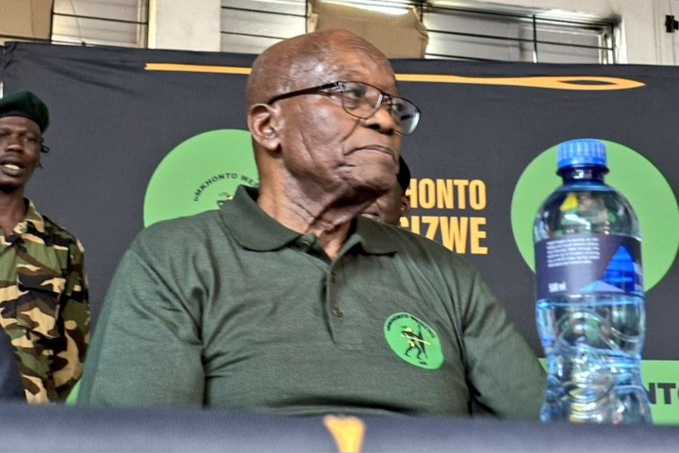
Former President Jacob Zuma says when his newly launched Umkhonto Wesizwe Party’ comes into power after winning the 2024 elections, the Electorial laws of South Africa will be changed.
Zuma addressed members of the All African Alliance Movement at the June 16 Memorial opposite the Morris Isaacson High at CWJ in Soweto.
This an organisation formed in 2022 by church leaders and has openly endorsed former Chief Justice Mogoeng Mogoeng as its presidential candidate.
“We have to vote in numbers to fix what has gone wrong. This thing of not being able to speak the truth will cause us to fight. We have to tell the truth we all have to live dignified lives,” he said.
Zuma said he did not favour extreme measures of fixing what had gone wrong in the past. But he called on engagements in fixing the legacy of South Africa’s colonial history.
“The pastors must pray and tell God that black people in South Africa are suffering. They call our black children Amaphara but there are no white children like that,” Zuma said.
Zuma said South Africans had lost hope in South Africa’s democracy because many of them were living in poverty.
“Maybe we should change the voting process why is it that we vote but we cannot see the people counting these votes,” Zuma said.
South Africa’s proportional representation came from noble intentions during the multiparty negotiation in the 1990s to end apartheid.
Different electoral systems exist across the globe. There is no perfect system for South Africa to choose. Each electoral system is a function of its political context, and when this changes, it also ought to change.
According to the IEC, the counting process can be summed up in eight steps.
-
Verify
All ballot boxes allocated to a voting station are accounted for. Sealed ballot boxes are opened and emptied.
-
Unfold
Each ballot paper is unfolded and checked for the electoral commission security stamp. Ballots without stamps are not counted. The presiding officers and other officials have the responsibility to ensure that the ballot paper is stamped before handing it to a voter. But the voter also has the responsibility to double-check.
-
Sort
All ballot papers are grouped according to colours representing the type of election. The ballots are sorted into piles according to votes for each party and each ward candidate.
-
Count & bundle
The ballots are counted and bundled into packs of 100. The results are counted for each party or candidate.
-
Reconcile
The results for the various parties or candidates are reconciled against the number of ballots received and the total number of ballots cast at that voting station.
-
Sign results slips
Results slips are signed by the counting officer, independent ward candidate agents and party agents. A copy of the results slip is posted on the door of each voting station. The other copy is transported to the local Electoral Commission office where it is scanned and captured in the results system. The results are also verified by independent external auditors.
-
Results centres
The results centres are there for political party representatives and independents to monitor the voting, counting and results process. Parties have the opportunity to raise objections to any alleged irregularities. Other stakeholders present include the media and observers.
-
Final results
The final results and seat allocation are announced by the commission within seven days of the election.
In an ideal world, the whole process should be transparent. This includes the counting of votes. He believes all that should be done publicly.
“We are going to the elections soon and there are people who believe the elections will be rigged. Some have information that the counting system will be changed to advantage a particular party. Where is the truth?” said Zuma.
Zuma urged pastors gathered at the AAAM meeting to encourage their communities to vote “correctly”. “Let us change South Africa and show the world a better country. We have to fix South Africa,” he said.
He said traditional leaders and pastors were important in making sure that South Africa is heading into the right direction.
“God says we are all equal the pastors must now rise up and stand for those who are oppressed,” Zuma said.
Zuma was ousted as the country’s president by Ramaphosa in 2018 amid wide-ranging allegations of corruption in government and state-owned companies during his presidential tenure from 2009 to 2018.
Since his departure from the country’s highest office, Zuma has been facing legal battles.
He was sentenced to 15 months in prison for defying a court order to appear before a judicial commission of inquiry, which was investigating corruption allegations against him and other high-profile politicians and businesspeople during his time in office.
He has also pleaded not guilty to corruption charges related to South Africa’s 1999 arms procurement deal in a trial that has faced major delays.
The ANC is expected to face fierce competition from the opposition parties Democratic Alliance and the Economic Freedom Fighters, but smaller parties and independent candidates could be crucial in case of coalition negotiations.