
By Lehlohonolo Lehana.
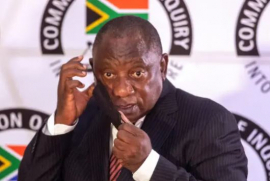
President Cyril Ramaphosa on Wednesday dismissed allegations that he improperly influenced decisions at Eskom in favour of Optimum Coal Mine (OCM) during his tenure as the head of the parastatal’s technical war room.
“I had no interest in, nor any opportunity to, influence Eskom’s decision-making process in matters pertaining to Optimum,” Ramaphosa said in his opening statement to the Commission of Inquiry into Allegations of State Capture.
This follows testimony before the commission by Eskom’s disgraced former executives – Brian Molefe and Matshela Koko – who made allegations about Ramaphosa’s association with the mining company, which was then owned by Glencore before the Guptas took over Optimum Coal Mine.
Molefe has been accused of having close ties to the Gupta family, and during his time at both companies, contracts were awarded to entities linked to the Guptas and their associates. At Transnet alone,an estimated R40 billion in payments related to state capture were made during Molefe’s term.
Ramaphosa said he had “no clue” about Molefe’s Gupta connections when he recommended his appointment at Eskom, and that it was a coincidence.
He regarded Molefe as an effective CEO, and was “surprised” when Molefe’s Gupta connections emerged. He said he was “concerned” that “someone [he] held in high regard was entangled with the capture of the state”.
Prior to his appointment as the country’s deputy president in 2014, Ramaphosa acquired 9.64% shareholding in Optimum Coal Holdings and became a non-executive chairperson of its board.
Ramaphosa reiterated to the commission that in June 2013, he resigned as a director of Optimum Coal Holdings.
He said in May 2014, he disposed of his shareholding in the company ahead of his appointment as deputy president by former president Jacob Zuma.
“I had no further involvement or interest in Optimum after that point, “he said.
Ramaphosa said his role as the chair of the technical war room was an oversight role and its day-to-day direction was the responsibility of deputy ministers of relevant departments.
He said his dealings with Eskom, as well as the chair of the inter-ministerial committee on resolving the country’s energy challenges, had nothing to do with procurement or coal contracts.
“And even if by some imagination, I would have rescued myself immediately because conflict of interest, in my world, is something that that either needs to be declared or avoided,” Ramaphosa said.
The president also denied that he interfered at Eskom to ensure that Koko was dismissed from the utility in January 2018.
“Koko contends that his removal was an instance of unlawful interference in Eskom’s affairs, executive overreach and state capture.
“The suggestion that government cannot lawfully intervene in Eskom’s affairs – even to avert a crisis – is completely incorrect.”
Ramaphosa also said Koko’s removal was not intended to achieve corrupt ends or to somehow capture Eskom.
He said big business, domestically and abroad, had lost confidence in Koko and his team.
“It was not a one-person decision. It was a decision that was taken by a group of us — the president, myself and the ministers. We discussed this matter.
“And there were stories going around about management people being implicated in wrongdoing and so action had to be taken. Ordinarily a minister or deputy president should not get involved in decisions like that, but it was exceptional, because Eskom was said to be the biggest risk the country was facing,” he said.
It was for this reason that it was agreed that part of the solution had to be the firing of executives such as Koko who were embroiled in allegations of wrongdoing, and as such, were a dent on the credibility of the power utility in the financial markets.